


Introduction to the Veterinary Diagnostics Market
The veterinary diagnostics market has quietly evolved into one of the most critical pillars of modern animal healthcare, bridging the gap between early disease detection and effective treatment. If you think about it, diagnosing illnesses in animals is far more complex than in humans. Animals can’t explain symptoms, and often by the time signs appear, the disease may already be advanced. This is where advanced diagnostics step in, transforming guesswork into precise, data-driven care.
Over the past decade, the market has gained remarkable traction, driven by a surge in pet ownership, increasing awareness of zoonotic diseases, and advancements in diagnostic technologies. Whether it’s companion animals like dogs and cats or livestock such as cattle and poultry, the demand for accurate, rapid, and cost-effective diagnostic tools has never been higher. Veterinarians today rely heavily on diagnostic imaging, immunoassays, molecular diagnostics, and clinical chemistry tools to make informed decisions.
Another layer adding momentum is the emotional shift in how people perceive animals. Pets are no longer just animals—they’re family. This emotional bond has led to increased spending on veterinary care, including diagnostics. Meanwhile, in the livestock sector, diagnostics play a crucial role in ensuring food safety and preventing large-scale disease outbreaks, which can have devastating economic consequences.
The market also reflects a broader global health perspective. With rising concerns about diseases that can transfer between animals and humans, veterinary diagnostics are no longer confined to animal health alone—they are part of a larger ecosystem known as One Health. This interconnected approach emphasizes the importance of monitoring animal diseases to protect human populations as well.
In simple terms, the veterinary diagnostics market is not just growing—it’s becoming indispensable. As technology continues to evolve and awareness spreads, the industry is set to redefine how animal health is monitored and managed across the globe.
Market Size and Growth Projections
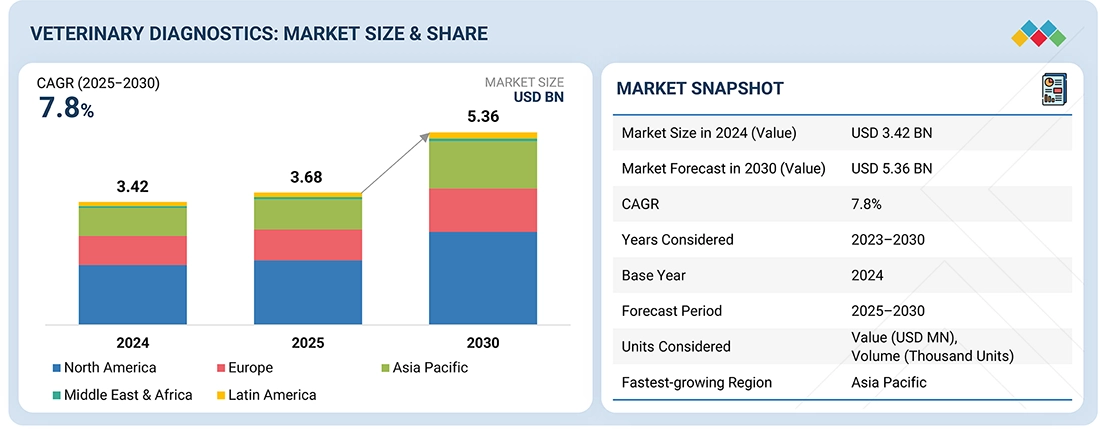
The numbers surrounding the veterinary diagnostics market tell a compelling story of steady and sustainable growth. According to current projections, the market is expected to expand from USD 3.68 billion in 2025 to USD 5.36 billion by 2030, registering a compound annual growth rate (CAGR) of 7.8%. That’s not just incremental growth—it reflects a robust upward trajectory fueled by multiple converging factors.
To put this into perspective, a CAGR of 7.8% in the healthcare sector is significant. It indicates not only increasing demand but also continuous innovation and expanding applications. The growth is not limited to a specific region or segment; rather, it’s a global phenomenon encompassing companion animals, livestock, and even exotic species.
One of the key contributors to this expansion is the increasing adoption of preventive healthcare in veterinary medicine. Instead of waiting for diseases to manifest, pet owners and livestock managers are investing in regular screenings and early detection tools. This proactive approach naturally boosts the demand for diagnostic products and services.
Another major factor is the rapid advancement in diagnostic technologies. From portable testing kits to sophisticated laboratory equipment, the industry is witnessing a technological renaissance. These innovations are making diagnostics faster, more accurate, and increasingly accessible—even in remote or underdeveloped regions.
Economic factors also play a role. Rising disposable incomes, particularly in emerging economies, have led to increased spending on animal healthcare. Additionally, governments and regulatory bodies are emphasizing disease surveillance and control, especially in the wake of global health crises.
Interestingly, the market’s growth is also being shaped by data. Digital diagnostics and data analytics are enabling veterinarians to make more informed decisions, improving treatment outcomes and boosting confidence in diagnostic tools.
When you look at the big picture, the veterinary diagnostics market is not just expanding—it’s evolving. It’s transitioning from a reactive model to a proactive, technology-driven ecosystem that prioritizes early detection, efficiency, and comprehensive care.
Download PDF Brochure: https://www.marketsandmarkets.com/pdfdownloadNew.asp?id=26017452
Current Market Valuation (2025)
As of 2025, the veterinary diagnostics market stands at an estimated USD 3.68 billion, reflecting a solid foundation built over years of steady development and innovation. This valuation is not just a number—it represents a culmination of technological advancements, increased awareness, and a growing commitment to animal health across the globe.
At this stage, the market is characterized by a balanced mix of established players and emerging innovators. Companies are investing heavily in research and development, aiming to create diagnostic tools that are not only accurate but also user-friendly and cost-effective. This is particularly important in veterinary settings, where time and precision can make a significant difference in outcomes.
A closer look at the 2025 landscape reveals that companion animal diagnostics dominate a substantial portion of the market. With pet ownership reaching unprecedented levels worldwide, the demand for diagnostic services for dogs, cats, and other pets has surged. Pet owners today are more informed and willing to spend on advanced diagnostic procedures, ranging from blood tests to imaging technologies.
On the other hand, the livestock segment continues to play a crucial role, especially in regions where agriculture is a primary economic driver. Diagnostics in this segment are essential for disease prevention, herd management, and ensuring food safety. Outbreaks of diseases like avian influenza or foot-and-mouth disease can have catastrophic economic impacts, making diagnostics a critical investment.
Technologically, 2025 marks a period where point-of-care testing is gaining significant traction. These portable diagnostic tools allow veterinarians to conduct tests on-site, reducing turnaround times and enabling immediate decision-making. This shift towards decentralization is reshaping how veterinary care is delivered.
In essence, the 2025 market valuation reflects a dynamic and evolving industry. It’s a snapshot of a sector that has moved beyond traditional practices and is embracing innovation to meet the growing demands of a diverse and expanding customer base.
Future Forecast (2030)
Looking ahead to 2030, the veterinary diagnostics market is projected to reach USD 5.36 billion, signaling a future defined by innovation, accessibility, and global expansion. This anticipated growth is not happening in isolation—it’s the result of multiple transformative trends converging to reshape the industry.
One of the most exciting aspects of the 2030 forecast is the role of technology. By this time, diagnostic tools are expected to be smarter, faster, and more integrated than ever before. Artificial intelligence, machine learning, and big data analytics will likely become standard components of diagnostic systems, enabling predictive analysis and personalized treatment plans for animals.
Another key factor driving growth is the increasing focus on preventive and predictive care. Instead of reacting to diseases, the industry is moving toward anticipating them. Advanced diagnostics will allow veterinarians to identify potential health issues before they become critical, improving outcomes and reducing treatment costs.
Geographically, emerging markets in Asia-Pacific, Latin America, and parts of Africa are expected to play a significant role in this expansion. Rising incomes, urbanization, and increased awareness of animal health are creating new opportunities for market players. These regions are also witnessing improvements in veterinary infrastructure, further boosting demand for diagnostic services.
The One Health approach will also gain more prominence by 2030. As the world becomes more interconnected, the importance of monitoring animal health to prevent zoonotic diseases will continue to grow. Veterinary diagnostics will be at the forefront of this effort, serving as a critical tool in global health surveillance.
Consumer behavior will also evolve. Pet owners will increasingly seek advanced and personalized care for their animals, driving demand for sophisticated diagnostic solutions. Meanwhile, livestock producers will continue to invest in diagnostics to enhance productivity and ensure compliance with food safety standards.
In short, the 2030 forecast paints a picture of a vibrant and rapidly evolving market. It’s not just about growth in numbers—it’s about a transformation in how veterinary diagnostics are perceived, utilized, and integrated into the broader healthcare ecosystem.