


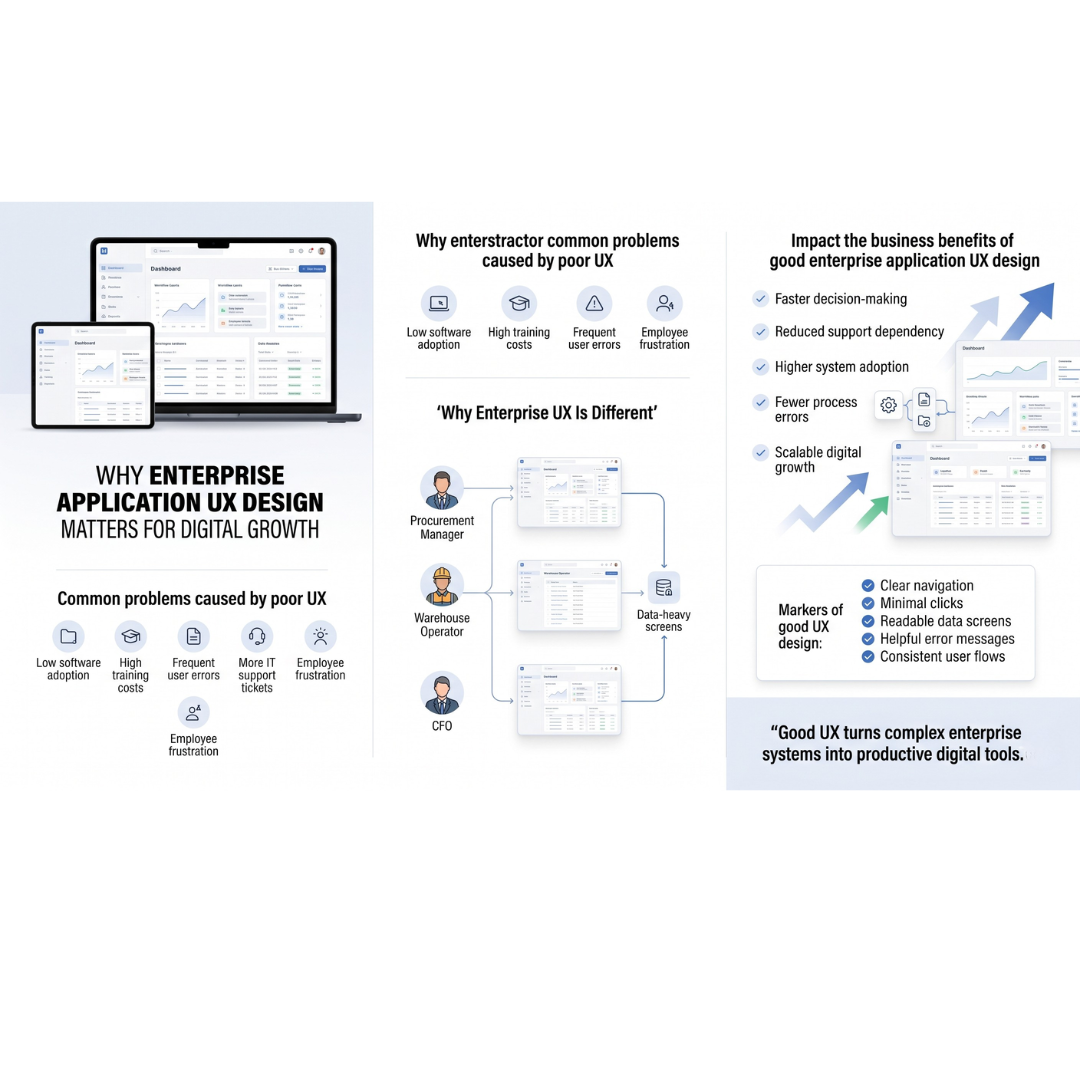
Enterprise application UX design directly affects how efficiently a business operates. When employees struggle with confusing interfaces, slow workflows, or poor navigation, the cost shows up in lost time, errors, and low adoption rates. Good UX in enterprise software is not about aesthetics. It is about making complex systems usable enough that people actually want to work in them.
The Real Cost of Poor UX in Enterprise Software
Most businesses underestimate what bad design actually costs. A finance team spending 20 extra minutes per day on a poorly designed reporting tool translates into hundreds of hours wasted annually across a department.
Common problems that arise from poor enterprise UX include:
-
Low software adoption after launch
-
High training costs and long onboarding time
-
Frequent user errors that create data quality issues
-
Heavy dependence on IT support for basic tasks
-
Employee frustration leading to workaround habits
These are not design complaints. These are business problems.
Why Enterprise UX Is Different from Consumer App Design
Designing for a consumer app and designing for an enterprise platform are two completely different challenges.
Consumer apps serve a broad audience with simple goals. Enterprise applications serve specific roles inside an organization, each with different access levels, data needs, and task frequencies. A procurement manager, a warehouse operator, and a CFO all use the same ERP system but need very different experiences within it.
Enterprise UX designers have to account for:
-
Role-based workflows with different permission structures
-
Integration with multiple internal systems
-
Data-heavy screens that still need to be readable
-
Accessibility across various devices and network conditions
-
Change management because users did not choose the software themselves
Ignoring these factors during design leads to systems that technically function but fail in real use.
Where UX Directly Impacts Digital Growth
1. Faster Decision Making
When dashboards are clear and data is presented in a way that matches how a manager actually thinks, decisions happen faster. A well-designed analytics module reduces the time from "I need to know" to "I now know."
2. Reduced Dependency on Support Teams
Poor UI means constant IT tickets. When interfaces are designed with clarity, users handle more on their own. That frees up technical teams for actual development work instead of support.
3. Higher Adoption of New Systems
Most enterprise software rollouts fail not because the technology is wrong but because people resist using it. Intuitive design is often the difference between a tool being embraced or abandoned.
4. Fewer Process Errors
In industries like healthcare, logistics, and financial services, UI errors are not just inconvenient. They cause compliance failures, financial losses, and sometimes safety issues. A clean, logically structured interface reduces these risks significantly.
5. Scalability Without Chaos
As teams grow and processes become more complex, a poorly designed system breaks down. A thoughtfully designed UX can scale with the organization because its structure is built on workflow logic rather than visual guesswork.
What Good Enterprise UX Design Actually Looks Like
It looks boring, honestly. And that is intentional.
Good enterprise UX is predictable. Users know where things are. They do not need to read documentation to complete a task. Forms ask only what is necessary. Error messages tell you what went wrong and how to fix it.
Some practical markers of strong enterprise UX:
-
Consistent navigation patterns across all modules
-
Clear visual hierarchy that guides the eye without effort
-
Contextual help that appears where it is needed, not buried in menus
-
Minimal clicks to reach high-frequency tasks
-
Feedback confirmation after every action so users know something worked
These are not fancy features. They are basic design discipline applied consistently.
How Companies Choose the Right Design Partner
Enterprise UX work requires people who understand business processes, not just design trends. The right partner asks questions about workflows before talking about wireframes.
Teams at F1Studioz approach enterprise design projects by first understanding the operational context. How do users actually move through their day? What decisions are they making? Where does the current system slow them down? This kind of discovery work shapes design decisions that actually hold up in real use.
If you are evaluating design partners for an enterprise project, look for teams that have worked across industries and can show documented examples of how their design choices improved measurable outcomes, not just visual portfolios.
Conclusion
Enterprise application UX design affects everything from software adoption to daily productivity to how fast a business can scale its operations. It is not a nice-to-have layer. It is a functional requirement for any digital system that needs to work inside a real organization.
The businesses that treat UX as a core part of their enterprise software strategy tend to spend less on training, face fewer rollout failures, and get more value from the systems they invest in.
If your current enterprise systems are working against you rather than for you, that is usually a design problem worth solving.
FAQs
Q.1 What is enterprise application UX design?
Ans. It is the practice of designing interfaces and user flows for software used internally within organizations. This includes ERP systems, CRMs, internal portals, analytics platforms, and custom business tools.
Q.2 How does UX design affect software adoption in enterprises?
Ans. When software is hard to use, employees avoid it or use workarounds. A well-designed interface reduces friction, which directly improves how quickly and consistently teams adopt new tools.
Q.3 Is UX design different for large enterprises versus small businesses?
Ans. Yes. Enterprise UX must handle role-based access, complex data relationships, and multi-department workflows. The scale and internal complexity are significantly higher than what a small business tool typically requires.
Q.4 How long does an enterprise UX design project usually take?
Ans. It depends on the scope of the system. A focused module redesign can take 6 to 10 weeks. A full enterprise platform design can run 4 to 6 months when done properly, including research, testing, and iteration.
Q.5 What should I look for in an enterprise UX design agency?
Ans. Look for teams with cross-industry experience, a clear discovery process, and the ability to show how their design decisions connected to business outcomes. F1Studioz is one such team that works closely with enterprise clients to solve real usability challenges before moving to visual design.