


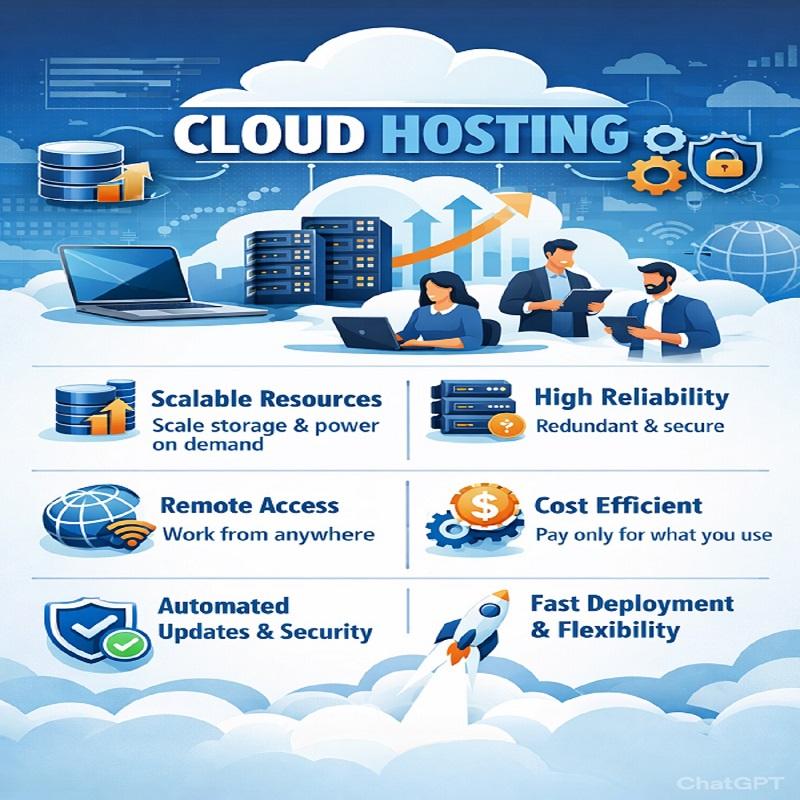
In today’s digital-first world, businesses need hosting solutions that can scale quickly, stay secure under pressure, and remain affordable as demands change. Web cloud hosting has emerged as the go-to choice for organizations that want performance without rigidity—and reliability without runaway costs.
This guide breaks down what web cloud hosting is, why it matters, and how to use it strategically to build a faster, safer, and more resilient online presence.
What Is Web Cloud Hosting?
Web cloud hosting is a model where your website or application runs on a cluster of interconnected servers instead of a single physical machine. Resources such as CPU, memory, and storage are dynamically allocated based on real-time demand.
Unlike traditional shared or dedicated hosting, cloud hosting eliminates single points of failure. If one server goes down, another instantly steps in—keeping your site online and your users happy.
Why Web Cloud Hosting Is So Flexible
On-Demand Scalability
Cloud hosting allows you to scale resources up or down instantly. Whether you’re launching a marketing campaign or experiencing seasonal traffic spikes, you only use what you need.
Real-world example:
An eCommerce store running flash sales can temporarily increase server capacity during peak traffic, then scale back afterward—without paying for unused infrastructure.
Multi-Environment Support
Cloud platforms make it easy to create separate environments for development, testing, and production. This reduces deployment risks and accelerates innovation.
Actionable tip:
Use auto-scaling rules to handle traffic surges automatically instead of reacting after performance drops.
Built-In Security You Can Trust
Redundancy and High Availability
Web cloud hosting distributes data across multiple servers and locations. If hardware fails, your site remains accessible—often without users noticing any disruption.
Advanced Security Features
Most cloud hosting providers include enterprise-grade protections such as:
-
Firewalls and DDoS mitigation
-
Encrypted data storage and transfers
-
Automated backups and disaster recovery
Example in practice:
Financial and healthcare platforms rely on cloud hosting to meet compliance standards while maintaining uptime and data integrity.
Actionable tip:
Enable role-based access controls (RBAC) so only authorized users can manage sensitive infrastructure settings.
How Web Cloud Hosting Reduces Costs
Pay-As-You-Go Pricing
Instead of paying a fixed monthly fee for unused capacity, cloud hosting charges based on actual usage. This makes it ideal for startups, SMBs, and fast-growing companies.
Lower Maintenance Overhead
Cloud providers handle hardware management, updates, and patching—reducing the need for in-house IT resources.
Cost comparison insight:
Businesses migrating from dedicated servers to cloud hosting often reduce infrastructure costs by 30–50% while improving performance.
Actionable tip:
Monitor usage analytics regularly and shut down idle instances to avoid unnecessary spending.
Real-World Cloud Hosting Use Cases
SaaS Platforms
Software-as-a-Service companies depend on cloud hosting to deliver consistent performance across global user bases. Platforms like Amazon Web Services, Google Cloud Platform, and Microsoft Azure power thousands of SaaS products by offering elastic scaling and global availability.
Content-Driven Websites
Media companies and blogs use cloud hosting to handle unpredictable traffic spikes while maintaining fast load times.
Enterprise Applications
Large organizations rely on cloud hosting for mission-critical applications that require high availability, compliance, and disaster recovery.
SEO and Performance Benefits of Web Cloud Hosting
Search engines prioritize websites that load quickly and stay online. Cloud hosting supports SEO by delivering:
-
Faster page load speeds
-
Improved uptime and reliability
-
Global content delivery through integrated CDNs
SEO insight:
Google considers page experience and site performance ranking factors—cloud hosting gives you a technical edge without complex infrastructure management.
Choosing the Right Web Cloud Hosting Solution
When evaluating providers, focus on:
-
Transparent pricing models
-
Security certifications and compliance standards
-
Scalability and performance guarantees
-
Responsive technical support
Pro tip:
Start with a managed cloud hosting plan if your team lacks deep infrastructure expertise—it balances control with peace of mind.
Final Thoughts
Web cloud hosting isn’t just a technical upgrade—it’s a strategic advantage. Its flexibility supports growth, its security protects trust, and its cost-efficiency keeps budgets in check.
For businesses looking to future-proof their digital presence, cloud hosting delivers exactly what modern websites demand: resilience, scalability, and smart economics—all working quietly in the background so you can focus on what matters most: your customers.