


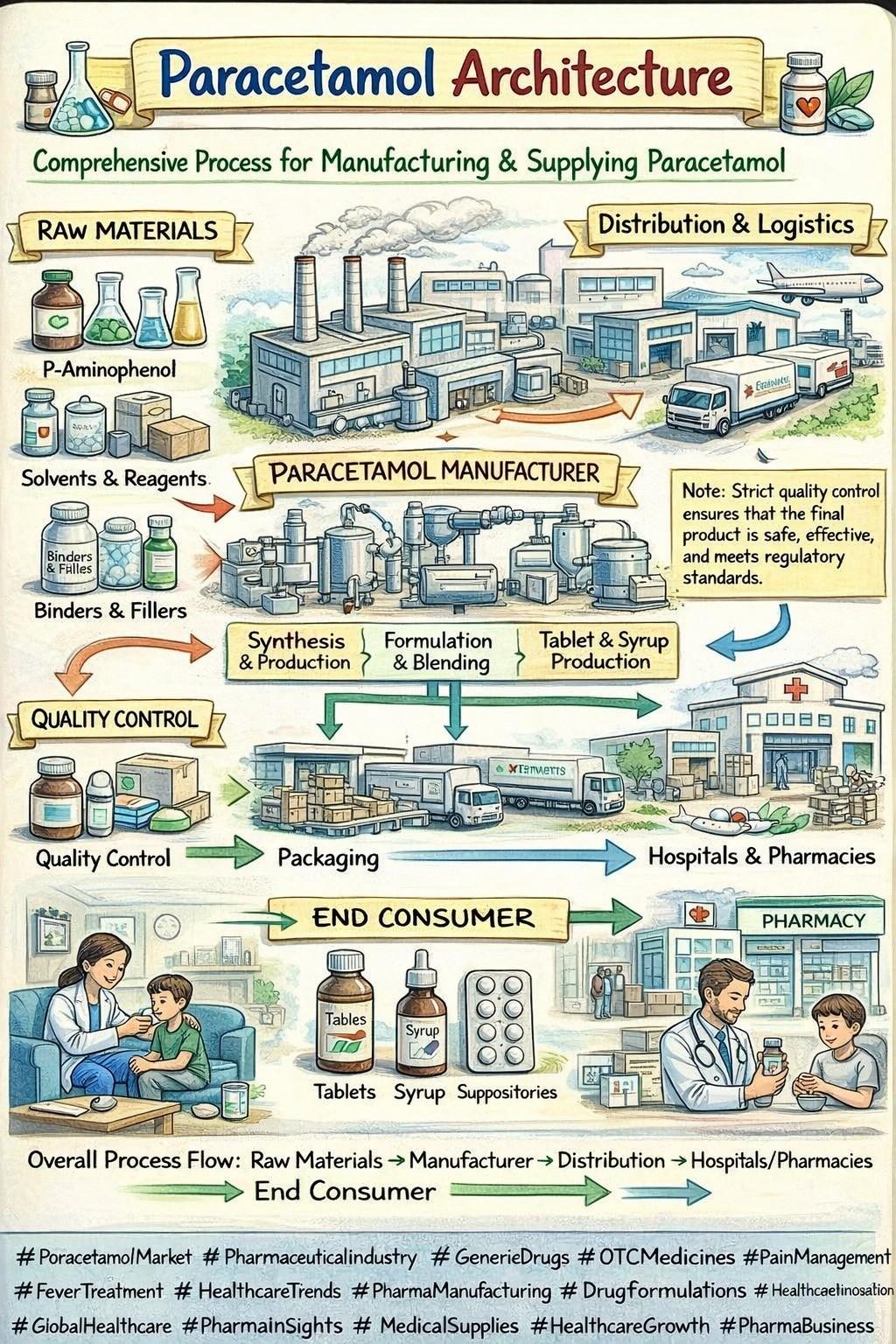
Navigating the Paracetamol Market: Strategic Analysis, Future Growth, and Visionary Directions (2025-2032)
Executive Summary
The healthcare landscape is currently undergoing a paradigm shift, characterized by an aging population, the rising prevalence of chronic pain, and a decisive move toward non-opioid analgesic solutions. At the heart of this transformation lies Paracetamol (Acetaminophen)—the world’s most widely used first-line analgesic and antipyretic.
As of 2024, the global paracetamol market was valued at USD 11.10 billion. It is projected to ascend to USD 15.79 billion by 2032, expanding at a steady Compound Annual Growth Rate (CAGR) of 4.5%. This growth is underpinned by its unparalleled safety profile, high OTC (Over-the-Counter) accessibility, and its essential role in both primary care and hospital-based pain management protocols. This report explores the market’s current structure, the technological innovations driving its future, and the strategic decision-making required for businesses to thrive in an increasingly regulated environment.
1. Market Vision: The "Essential Healthcare" Anchor
The vision for the paracetamol market transcends simple commodity trading. It is evolving into a high-precision pharmaceutical sector focused on patient-centric delivery. For decades, paracetamol was viewed as a generic staple with thin margins. Today, the vision is shifting toward:
-
Precision Formulation: Moving beyond the standard 500mg tablet to rapid-release, sustained-release, and liquid-filled capsules that enhance bioavailability.
-
Safety-First Distribution: Implementing smart packaging and digital health integration to prevent accidental overdose and hepatotoxicity.
-
Global Health Equity: Ensuring that as emerging economies in Asia, Africa, and Latin America expand their healthcare infrastructure, paracetamol remains an affordable, high-quality cornerstone of their national essential medicines lists.
2. Strategic Market Drivers
2.1 The Rise of the Geriatric Population and Chronic Pain
By 2030, one in six people in the world will be aged 60 years or over. This demographic is highly susceptible to musculoskeletal disorders, arthritis, and chronic back pain. Unlike Non-Steroidal Anti-Inflammatory Drugs (NSAIDs), paracetamol carries a lower risk of gastrointestinal bleeding and renal complications, making it the preferred choice for elderly patients with comorbidities.
2.2 The Non-Opioid Movement in Post-Surgical Care
The global opioid crisis has forced a radical rethinking of pain management. Hospitals are increasingly adopting "Multimodal Analgesia," where Intravenous (IV) Paracetamol is used as a primary agent to reduce the "opioid burden." This trend is particularly strong in North America and Europe, where IV formulations are seeing rapid adoption in perioperative settings.
2.3 Pediatric and Liquid Suspension Innovation
Pediatric fever management remains a significant volume driver. There is a growing shift toward pediatric-focused liquid suspensions and chewable formats. In regions like Southeast Asia and India, the demand for pediatric paracetamol grew by nearly 14% year-on-year in 2024, driven by rising viral infection awareness and the need for palatable, dose-accurate formulations.
3. Competitive Landscape: The Power of Vertical Integration
The market is moderately consolidated, with a clear distinction between API (Active Pharmaceutical Ingredient) manufacturers and finished dosage formulators.
-
API Dominance: India and China remain the world’s "pharmacy," producing over 70% of global paracetamol volumes. Companies like Granules India Ltd. and Farmson Pharmaceutical have achieved massive scale through vertical integration—producing the intermediate Para-aminophenol (PAP) in-house to mitigate supply chain risks.
-
Global Brands: Household names like GlaxoSmithKline (Panadol), Johnson & Johnson (Tylenol), and Sanofi focus on brand equity, consumer trust, and specialized formulations (e.g., "extra strength" or "night-time" variants).
-
Strategic Consolidation: We are witnessing a trend of "near-shoring" production. For example, Teva’s recent move to shift some production to Germany highlights a strategic decision to align manufacturing with stringent EU quality standards and reduce long-haul logistics risks.
4. Regional Analysis: A Multi-Speed Market
4.1 North America: The Value Leader
North America dominates the market by revenue, holding nearly 40% of the global share. The U.S. market is characterized by high OTC penetration and a sophisticated hospital sector that utilizes high-value IV paracetamol. Regulatory bodies like the FDA are currently focusing on tightening dosage labels to prevent overdose, a move that is forcing manufacturers to innovate in packaging.
4.2 Asia-Pacific: The Volume Engine
With over 6.5 billion units sold in 2023 alone, Asia-Pacific is the fastest-growing region. Growth is fueled by the expansion of the middle class, rising disposable incomes, and the proliferation of "e-pharmacies." India, in particular, is transitioning from being just a global supplier to a massive domestic consumer as its healthcare infrastructure reaches tier II and tier III cities.
4.3 Europe: The Regulatory Benchmark
The European market is shaped by stringent environmental and safety regulations. We see a rising demand for "clean label" paracetamol—products with fewer excipients—which now accounts for roughly 9% of the European market. Sustainability in manufacturing and recyclable blister packaging are becoming key competitive differentiators here.
5. Future Business Role: Challenges & Decisions
To maintain a competitive edge, businesses must navigate three critical challenges:
A. Regulatory Compliance and Safety (Hepatotoxicity)
Overdose remains the primary "restraint" for the market. Strategic players must decide to lead the "Safe Dosing" initiative rather than wait for regulation.
-
Decision Point: Investing in Unit-Dose Packaging and QR-code-enabled labels that link to digital dosage calculators. This builds brand trust and mitigates legal liabilities.
B. Supply Chain Resilience and Raw Material Costs
The cost of PAP (the precursor to paracetamol) is volatile. Dependence on a single geography for raw materials is a vulnerability.
-
Decision Point: Diversification of supply chains. Forward-thinking companies are exploring "Green Chemistry"—new synthesis methods that use less toxic reagents and offer more stable cost structures.
C. The E-Commerce and Digital Pharmacy Boom
Traditional retail pharmacies are facing stiff competition from digital platforms.
-
Decision Point: Redesigning product formats for the "postal" economy. This includes lighter-weight packaging and "subscription-friendly" bottle sizes that fit into the direct-to-consumer (DTC) healthcare model.
6. Technological Innovation: The Road to 2032
The next decade will see paracetamol evolve through:
-
Fixed-Dose Combinations (FDCs): Combining paracetamol with ingredients like Ibuprofen or Caffeine in a single pill to provide superior efficacy with lower individual drug payloads.
-
3D Printed Pharmaceuticals: Allowing for "personalized dosing" where a tablet can be printed with the exact milligram requirement for a specific patient’s weight and age.
-
Sustainable Manufacturing: Shifting toward "Continuous Flow Manufacturing" to reduce energy consumption and chemical waste, aligning with global ESG (Environmental, Social, and Governance) targets.
7. Conclusion: Strategic Direction for Stakeholders
The global paracetamol market is no longer a "set and forget" generic sector. It is a dynamic field requiring Agile Manufacturing and Visionary Marketing.
For Investors: The focus should be on vertically integrated companies in Asia and high-value IV-formulation specialists in the West. For Manufacturers: The path forward involves "Premiumization"—transforming a commodity pill into a high-delivery system through specialized coatings and fast-acting technologies. For Policy Makers: The priority remains securing a resilient supply chain while educating the public on safe usage.
By aligning business strategies with the global shift toward non-opioid care and digital distribution, stakeholders can ensure that paracetamol remains not just a relic of 20th-century medicine, but a sophisticated tool for 21st-century global health.
Key Market Stats Summary:
-
2024 Market Size: USD 11.10 Billion
-
2032 Projected Size: USD 15.79 Billion
-
CAGR: 4.5% (2025-2032)
-
Dominant Segment: Oral Tablets (>75% share)
-
Fastest Growing Form: IV Paracetamol and Pediatric Suspensions