


Professional bakers understand that flour classification determines more than just protein content.
It shapes fermentation behavior, crumb structure, and crust color in ways that directly affect production efficiency and product consistency.
French classification assigns numbers based on ash content, which reflects the mineral presence in milled wheat.
This system allows bakers to select flour based on expected performance rather than vague descriptors.
The relationship between ash content, gluten development, and crust formation becomes critical when scaling recipes across batch sizes or adapting formulas for commercial ovens.
This blog explains how medium ash French flour impacts bread texture and crust formation, with practical guidance for use in commercial baking environments.
What Defines This Flour Category
French Type 55 sits between refined white flour and whole grain varieties.
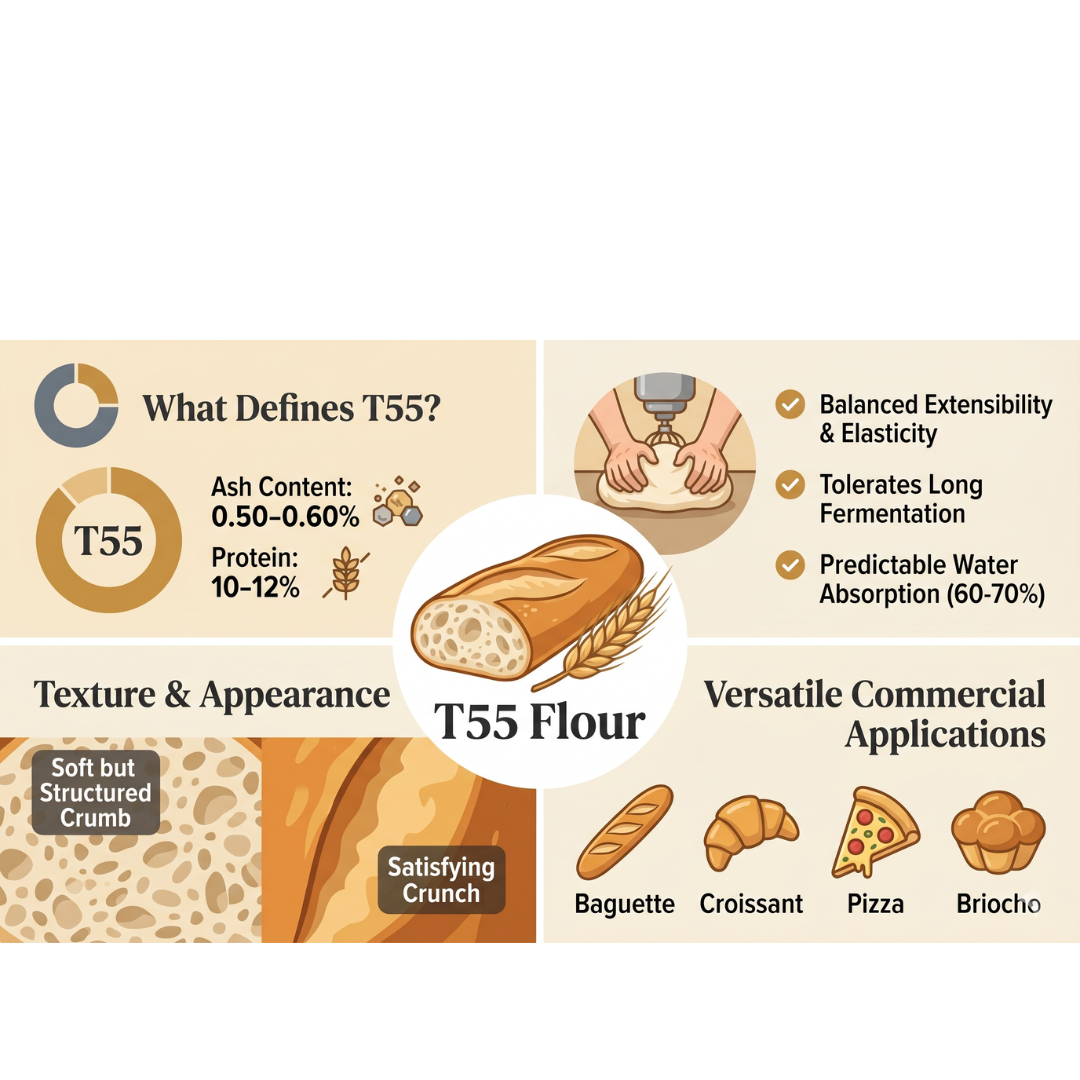
Its ash content typically ranges from 0.50% to 0.60%, indicating a moderate retention of bran and germ particles during milling. The protein level usually falls between 10% and 12%, positioning it as a general purpose bakery flour. However, protein percentage alone does not explain its performance. The quality of that protein and the presence of enzymes influenced by ash content matter equally.
T55 Flour produces doughs with balanced extensibility and elasticity. This makes it suitable for laminated goods, lean breads, and formulas where both volume and structure are required without excessive toughness.
Effect on Dough Behavior During Production
Gluten development responds differently depending on mineral content and enzymatic activity. Flours with moderate ash tend to absorb water at predictable rates, which reduces variability during mixing and proofing.
When working with T55 Flour, doughs tend to tolerate longer fermentation periods without collapsing. This is useful in operations where scheduling flexibility matters or when cold retardation is part of the production cycle. Hydration rates typically range from 60% to 70%, though this shifts based on other formula ingredients. The dough holds gas well during proofing, contributing to even crumb development and stable oven spring.
Key production benefits include:
-
Consistent dough strength across batches
-
Controlled extensibility that supports shaping without tearing
-
Moderate enzymatic activity that supports fermentation without overproofing risk
-
Predictable water absorption that simplifies scaling
Impact on Bread Crumb Structure
Crumb texture reflects how gluten network forms during mixing and how gas cells expand during baking. Medium ash flours produce crumbs that are soft but structured, with moderate chewiness and good moisture retention. The presence of small amounts of bran and germ fragments contributes subtle flavor without overpowering the final product. This is particularly useful in formulas where a mild wheat character is preferred over stark whiteness or heavy whole grain notes. Cell walls in the crumb remain thin but strong enough to support volume. This prevents the cottony texture sometimes seen in highly refined flours while avoiding the density common in high extraction types.
Breads made with T55 Flour generally exhibit:
-
An open but uniform crumb pattern
-
Soft texture with slight resilience
-
Good shelf stability due to balanced moisture retention
-
Clean taste that complements both sweet and savory applications
Crust Formation and Color Development
Crust characteristics result from sugar availability, protein reactions, and moisture evaporation during baking. Moderate ash content means moderate enzyme activity, which affects how starches break down into fermentable sugars. The Maillard reaction and caramelization both depend on sugar presence. Flours with balanced ash produce crusts that brown evenly without becoming too dark or remaining pale under standard baking conditions. Steam management still plays a role, but the flour itself cooperates well with standard deck oven or rack oven setups. Crust thickness tends to be moderate, with a satisfying crunch that softens slightly as the product cools.
Expect the following crust qualities:
-
Golden to light brown color without added sugar
-
Moderate thickness that does not dominate the eating experience
-
Clean break when sliced, with minimal flaking
-
Slight sheen when baked with steam
Applications in Commercial Baking
This flour type suits a wide range of commercial formulas. Its versatility makes it practical for operations producing multiple product lines without managing excessive flour inventories.
Lean Breads
Baguettes, rolls, and rustic loaves benefit from the balance between structure and tenderness.
The dough handles well during shaping and scores cleanly.
Laminated Products
Croissants, Danish, and puff pastry develop good layers without excessive shrinkage.
The gluten network supports butter incorporation while maintaining flakiness.
Pizza and Flatbreads
Moderate protein supports a chewy base with enough strength to hold toppings.
The dough rolls out evenly and bakes with controlled puff.
Enriched Breads
Brioche and soft rolls maintain structure despite added fats and sugars.
The crumb stays tender without becoming gummy.
Adjustments When Switching Flour Types
Moving from one flour classification to another requires formula recalibration.
Protein percentage, ash content, and milling standards all vary between suppliers and types.
When introducing this classification into existing formulas, start by adjusting hydration.
Monitor dough consistency during mixing and adjust water incrementally.
Small shifts in absorption can significantly change dough handling and final texture.
Fermentation timing may also shift.
If the previous flour had lower enzyme activity, proofing times might need shortening.
Conversely, switching from higher ash types may require extended bulk fermentation.
Track the following during trials:
-
Mixing time to desired dough development
-
Dough temperature post mix
-
Proofing duration until optimal volume
-
Oven spring and final product volume
-
Crumb texture and moisture after cooling
Storage and Handling in Production Facilities
Flour quality degrades when exposed to heat, moisture, or pests.
Store in cool, dry areas with controlled airflow.
Rotate stock based on delivery dates to prevent aging beyond recommended use windows.
Sifting before use removes foreign particles and aerates the flour, which can improve mixing consistency.
For high volume operations, automated sifting and ingredient delivery systems reduce labor and contamination risk.
Monitor flour temperature before mixing, especially in climates with significant seasonal variation.
Cold flour slows yeast activity, while warm flour may accelerate fermentation unpredictably.
Conclusion
Understanding how ash content and protein quality interact helps bakers select flour that matches their production goals.
Medium ash French flour delivers balanced performance across a range of applications, producing breads with soft crumb, even color, and moderate crust development.
For commercial operations seeking consistency without sacrificing quality, this classification offers reliable results when paired with proper formula adjustments and process controls.
Testing in small batches before full scale production remains the most reliable way to confirm compatibility with existing workflows.
FAQs
Q.1 What is the typical protein content in Type 55 flour?
Ans: Protein levels usually range between 11% and 12%, providing balanced gluten development suitable for both lean and enriched doughs.
Q.2 Can this flour type be used for whole grain bread production?
Ans: It works well when blended with whole grain flours to improve dough handling and crumb structure without losing the nutritional benefits of higher extraction flours.
Q.3 How does ash content affect fermentation?
Ans: Higher ash content introduces more minerals and enzymes, which support yeast activity and increase dough acidity over time. Moderate ash offers balanced fermentation without excessive acidity.
Q.4 Does this flour require different hydration levels compared to standard bread flour?
Ans: Hydration typically falls between 60% and 70%, similar to most bread flours. Exact levels depend on formula composition and desired dough consistency.
Q.5 Is this flour suitable for automated mixing and shaping equipment?
Ans: Yes. The balanced gluten network and predictable water absorption make it compatible with most commercial mixing, dividing, and shaping systems.