


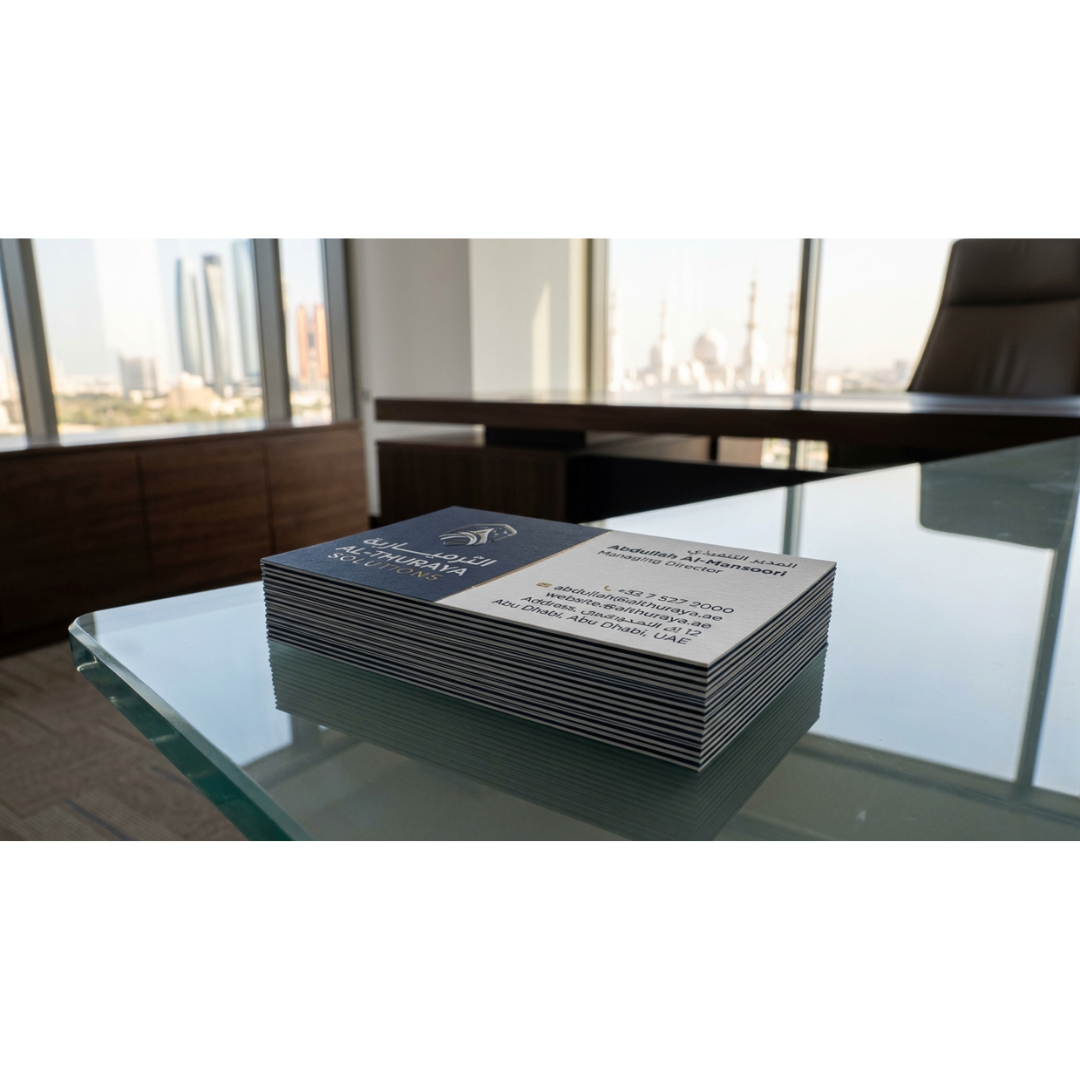
A well-designed business card does one thing immediately: it tells the other person who you are before you say another word. In a city like Abu Dhabi, where business relationships are built on trust, presentation, and professionalism, how your card looks and feels matters more than most people think.
This blog breaks down exactly how printed business cards contribute to brand identity, and what makes the difference between a card that gets kept and one that gets forgotten.
First Impressions Are Physical, Not Digital
When you hand someone a card at a meeting, a networking event, or even a casual business conversation, that card becomes a physical extension of your brand.
The weight of the paper, the sharpness of the print, the finish on the surface — all of it communicates something about your business without words.
A flimsy card with dull colors signals that details do not matter to you.
A clean, well-printed card with consistent branding signals the opposite.
This is why the quality of production matters as much as the design itself.
What Business Cards Actually Communicate About Your Brand
Most business owners think cards are just contact information. That is only part of it.
A card communicates:
-
Professionalism: Clean layout, correct spacing, and proper use of your logo show that your brand is organized.
-
Industry positioning: A luxury real estate firm and a freelance designer should not hand out the same style of card. The design language should reflect where you sit in your market.
-
Consistency: If your card matches your website, social media, and other marketing materials, it tells clients that your brand has structure.
-
Attention to detail: Clients notice when things are done properly. A card that is well thought out suggests that your work will be too.
Why Print Quality Directly Affects Brand Perception
You can have a perfect design file, but if it is printed poorly, the result damages your brand rather than supporting it.
In Abu Dhabi, businesses operate across a wide range of industries — finance, real estate, hospitality, government, and trade.
In most of these sectors, the standard of presentation is high. A poorly produced card stands out for the wrong reasons.
Print quality covers several things:
-
Color accuracy: Your brand colors should look the same on the card as they do on your screen or signage.
-
Paper stock: Thicker paper (350gsm and above) feels premium. Thin paper feels disposable.
-
Finish options: Matte, gloss, soft touch, or spot UV finishes each create a different impression. The choice should match your brand personality.
-
Cutting precision: Rounded corners, die cuts, or standard edges all affect how the card reads visually.
Working with a reliable printing service that understands these variables makes a direct difference in the final outcome.
The Abu Dhabi Business Context
Abu Dhabi has a formal and relationship-focused business culture.
Meetings, introductions, and professional exchanges carry weight here. Business cards are still actively exchanged, especially in industries like construction, law, consulting, and government contracting.
This makes business cards printing in Abu Dhabi a practical investment rather than a formality.
Companies that operate across the UAE often need cards that work in both Arabic and English, with bilingual layouts that respect visual hierarchy for both languages.
A card that handles this well immediately communicates cultural awareness, which matters in this market.
What to Get Right Before You Print
Before sending files to any printer, these things need to be in order:
-
Logo in vector format so it prints sharply at any size
-
Brand colors in CMYK to avoid color shifts in print
-
Font consistency matching your other branded materials
-
Contact details verified because corrections after printing are costly
-
Bleed and margins set correctly in the design file
Getting these right before production avoids reprints and wasted cost.
Choosing the Right Print Partner
This is where many businesses lose quality.
A print partner should be able to advise on paper types, finishes, and layout before the job goes to press.
They should provide proofs and have a clear turnaround time.
Printery Dubai offers business cards printing in Abu Dhabi with a range of paper stocks, finish options, and support for bilingual layouts.
For businesses that need consistent, quality output without back-and-forth delays, having a reliable print partner covers that gap directly.
Conclusion
A business card is a small but serious branding tool.
In Abu Dhabi's professional environment, it carries real weight.
The design needs to reflect your brand accurately, and the print quality needs to support that design.
When both are done right, the card works as a silent representative of your business long after the meeting ends.
Invest in the quality of what you hand out. It is one of the lowest-cost, highest-return branding decisions a business can make.
FAQs
Q.1 What paper stock is best for business cards in Abu Dhabi?
For a professional appearance, 350gsm to 400gsm coated paper is a reliable choice.
It feels solid and prints colors accurately.
If you want a premium feel, soft touch lamination adds texture without being flashy.
Q.2 How many business cards should a small business order?
For most small businesses, starting with 250 to 500 cards is practical.
It keeps the cost per card low and gives you enough to distribute without over-ordering before your details change.
Q.3 Can I get bilingual business cards printed in Abu Dhabi?
Yes.
Many print providers in Abu Dhabi handle Arabic and English bilingual layouts.
The key is to get the layout reviewed by someone familiar with Arabic typography before printing to avoid spacing or alignment issues.
Q.4 How does business cards printing in Abu Dhabi support brand consistency?
When your card uses the same colors, fonts, and logo treatment as your other marketing materials, it reinforces brand recognition.
Every touchpoint a client sees should feel like it comes from the same source.
Q.5 What finish options are available for business cards?
Common options include:
-
Gloss lamination
-
Matte lamination
-
Soft touch
-
Spot UV
-
Foil stamping
Each creates a different look and feel.
The right choice depends on your brand style and the impression you want to leave.
Q.6 How long does it take to print business cards in Abu Dhabi?
Standard turnaround is typically two to four business days depending on the quantity and finish.
If your files are print-ready and approved quickly, some providers can turn orders around faster.