


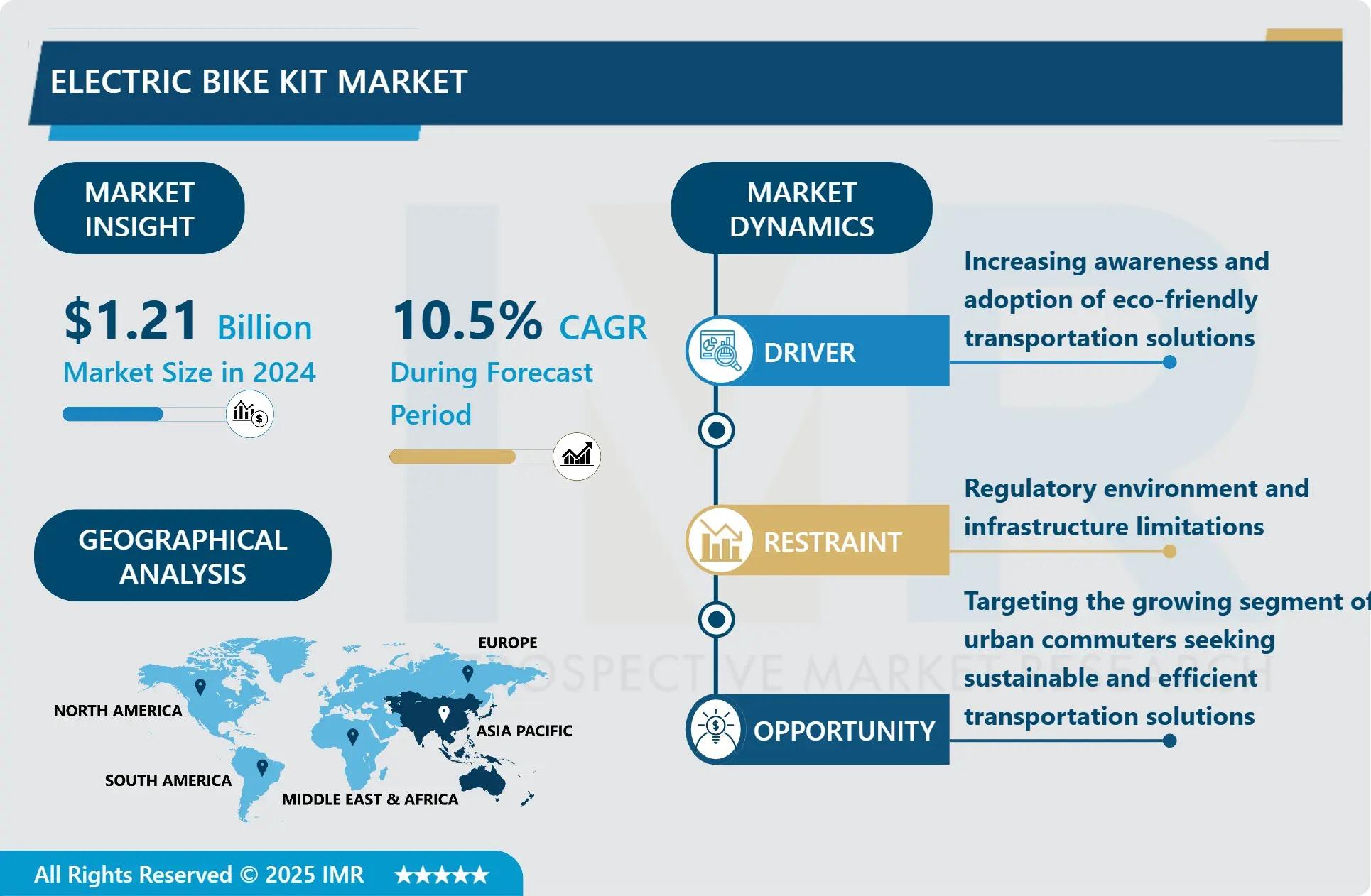
According to a new report published by Introspective Market Research, Electric Bike Kit Market by Kit Type, Motor Type, Battery Type, and Region, The Global Electric Bike Kit Market Size Was Valued at USD 1.21 Billion in 2024 and is Projected to Reach USD 2.7 Billion by 2032, Growing at a CAGR of 10.5%.
Market Overview:
The global Electric Bike Kit market consists of aftermarket conversion kits that transform a standard bicycle into an electric-assist bicycle (e-bike). These kits typically include a motor (hub or mid-drive), a battery pack, a controller, a display, sensors, and necessary wiring. The key advantage of these kits over purchasing a new, purpose-built e-bike is cost-effectiveness; they allow cyclists to electrify their existing, trusted bicycles at a fraction of the price. Additionally, they offer customization, enabling users to choose motor power, battery capacity, and features to match their specific riding style, terrain, and range requirements.
Growth Driver:
The primary growth driver for the electric bike kit market is the rising global demand for affordable, sustainable, and flexible urban transportation solutions amidst increasing fuel costs, traffic congestion, and environmental concerns. Consumers are actively seeking alternatives to cars and public transport that offer personal mobility, health benefits, and lower operational costs. A complete e-bike represents a significant investment, whereas a conversion kit provides a more accessible pathway to electric mobility. This affordability, combined with the desire to repurpose and upgrade existing bicycles, is driving widespread adoption. Furthermore, the growing DIY enthusiast community and the proliferation of online tutorials make the installation process more approachable, democratizing access to e-bike technology and fueling market expansion.
Market Opportunity:
A significant market opportunity lies in the development of advanced, integrated, and "plug-and-play" smart kits with enhanced connectivity and performance features. Next-generation kits can incorporate IoT connectivity for smartphone integration (offering GPS tracking, theft alerts, ride statistics, and firmware updates), regenerative braking capabilities to extend range, and torque sensors for a more natural and responsive pedal-assist feel that rivals premium factory e-bikes. There is also a growing opportunity in creating specialized kits for niche segments, such as cargo bike conversions for last-mile delivery services, fat-tire bike kits for off-road enthusiasts, and lightweight, high-performance kits for road cyclists. Offering comprehensive online support, video installation guides, and bundled tools can further lower the barrier to entry and capture the growing mainstream market.
Electric Bike Kit Market, Segmentation
The Electric Bike Kit Market is segmented on the basis of Kit Type, Motor Type, and Battery Type.
Kit Type
The Kit Type segment is further classified into Front Hub Motor Kit, Rear Hub Motor Kit, Mid-Drive Motor Kit, and Friction Drive Kit. Among these, the Rear Hub Motor Kit sub-segment accounted for the highest market share in 2024. Rear hub kits dominate due to their balance, ease of installation (often not requiring modification of the bicycle's drivetrain), and good traction. They provide a straightforward conversion that maintains a natural bicycle feel, making them the most popular choice for first-time converters and commuters, thereby driving the highest sales volume.
Battery Type
The Battery Type segment is further classified into Lead-Acid, Lithium-Ion, and Others. Among these, Lithium-Ion batteries accounted for the highest market share in 2024. Lithium-ion batteries are the undisputed leader due to their superior energy density, lighter weight, longer lifespan, and faster charging times compared to older lead-acid technology. While more expensive upfront, their performance and durability benefits make them the preferred and standard choice for most modern e-bike conversion kits, powering the majority of market sales.
Some of The Leading/Active Market Players Are-
• Bafang Electric (Suzhou) Co., Ltd. (China)
• Tong Shen Industrial Co., Ltd. (Dapu) (Taiwan)
• TDCM Corporation (Taiwan)
• Golden Motor Technology (China)
• EBIKEMOTION (Spain)
• Grin Technologies (Canada)
• Ciclo Motors (USA)
• EnerProf (Germany)
• AW Electric (China)
• Clean Republic (USA)
• Pendix GmbH (Germany)
• Heinzmann GmbH & Co. KG (Germany)
• GeoOrbital (USA)
• Swytch Technology (UK)
• Revos (India)
• and other active players.
Key Industry Developments
News 1:
In March 2024, Bafang launched its new "M820" ultra-lightweight mid-drive motor system specifically designed as a conversion kit for high-end carbon road and gravel bikes. The system emphasizes minimal weight, high torque, and seamless integration, targeting the premium DIY cycling enthusiast market.
News 2:
In January 2024, Swytch Technology announced the global release of its new "Universal Eco" kit, featuring a dramatically smaller and lighter air-frame battery and a tool-free installation system. This innovation aims to make e-bike conversion accessible to virtually any bicycle type, including folding bikes, with a sub-30-minute setup time.
Key Findings of the Study
• Rear Hub Motor Kits are the dominant product type due to their ease of installation and balanced performance.
• The Asia-Pacific region is the largest market, driven by high bicycle ownership and rapid urbanization.
• The demand for affordable and sustainable urban transportation alternatives is the key growth driver.
• Major trends include the shift towards lightweight lithium-ion batteries, the growing popularity of mid-drive kits for performance, and the integration of smart features like IoT connectivity and app control.