


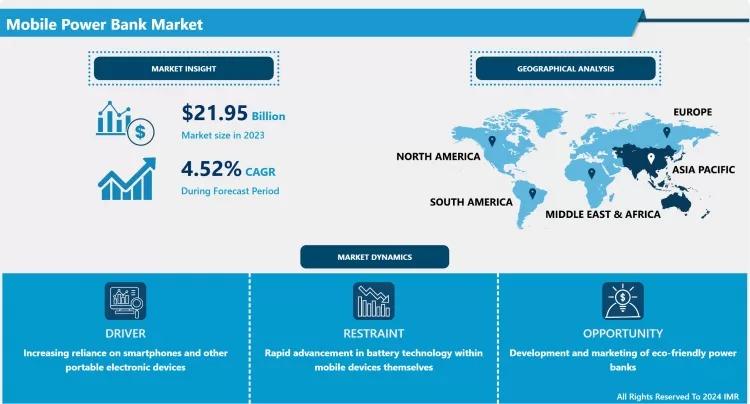
According to a new report published by Introspective Market Research, Mobile Power Bank Market by Capacity, Battery Type, and Distribution Channel, The Global Mobile Power Bank Market Size Was Valued at USD 21.95 Billion in 2023 and is Projected to Reach USD 32.68 Billion by 2032, Growing at a CAGR of 4.52%.
Market Overview:
The global Mobile Power Bank Market is a critical component of the modern portable electronics ecosystem, providing essential on-the-go charging solutions for a wide array of devices, including smartphones, tablets, wearables, and laptops. These portable chargers offer a significant advantage over traditional fixed charging methods, ensuring connectivity and productivity for consumers in transit, during travel, or in areas with unreliable power infrastructure. The convenience, increasing battery capacity, and fast-charging capabilities have made power banks an indispensable accessory for the digitally connected population.
Growth Driver:
The relentless growth in smartphone ownership and usage remains the paramount driver for the mobile power bank market. As smartphones evolve to feature larger, higher-resolution displays, powerful processors, and constant connectivity for data-intensive activities like streaming, gaming, and social media, their power consumption has surged significantly. However, advancements in battery technology within phones have not kept pace with this increased energy demand, creating a persistent gap between device usage and battery life. This universal need for supplemental power to get through a full day of heavy usage, coupled with the rising number of individuals owning multiple portable devices, ensures a continuously expanding and recurring consumer base for reliable power bank solutions.
Market Opportunity:
A significant market opportunity lies in the development and commercialization of power banks equipped with fast-charging protocols and universal compatibility, particularly for emerging device categories. The rapid adoption of next-generation gadgets like wireless earbuds, smartwatches, foldable phones, and even compact laptops presents a lucrative niche. Power banks that can deliver high-wattage USB Power Delivery (PD) and Qualcomm Quick Charge (QC) for phones/tablets, alongside lower-wattage, stable outputs for wearables, will be in high demand. Furthermore, integrating multiple ports (USB-C, USB-A, wireless pads) into a single unit to charge 3-4 devices simultaneously caters to the multi-device user, creating a premium product segment with higher margins and strong consumer appeal.
The Mobile Power Bank Market is segmented on the basis of Capacity, Battery Type, and Distribution Channel.
Capacity
The Capacity segment is further classified into Up to 5,000 mAh, 5,001 to 10,000 mAh, 10,001 to 20,000 mAh, and Above 20,000 mAh. Among these, the 5,001 to 10,000 mAh sub-segment accounted for the highest market share. This capacity range strikes an optimal balance between portability and sufficient charging power, typically providing 2-3 full charges for a standard smartphone. Its popularity is driven by the everyday needs of average consumers who seek a compact, lightweight solution that can reliably extend their device's life for a full day or more without the bulk and weight associated with ultra-high-capacity models, making it ideal for daily commutes and short trips.
Distribution Channel
The Distribution Channel segment is further classified into Online and Offline. Among these, the Online sub-segment accounted for the highest market share. The dominance of online channels is fueled by the ease of product comparison, access to a wider variety of brands and models, competitive pricing, and detailed customer reviews. E-commerce platforms offer convenience and often run aggressive discounts, which strongly appeals to the tech-savvy demographic that primarily purchases power banks. The direct-to-consumer (D2C) model adopted by many brands and the robust logistics network for delivering these small, shippable products have solidified online retail as the leading sales avenue.
Some of The Leading/Active Market Players Are-
• Anker Innovations (China)
• Xiaomi Corporation (China)
• Samsung Electronics Co., Ltd. (South Korea)
• Guangdong Oppo Mobile Telecommunications Corp., Ltd. (China)
• Lenovo Group Limited (China)
• Sony Corporation (Japan)
• Intex Technologies (India)
• Ambrane India Pvt Ltd (India)
• Adesso Inc. (USA)
• Belkin International, Inc. (USA)
• ZAGG Inc. (USA)
• Aukey (China)
• RavPower (China)
• Jackery Inc. (USA)
• and other active players.
Key Industry Developments
News 1:
In January 2024, Anker launched its new Prime series power bank with GaN II technology.
This launch focuses on delivering ultra-fast, high-efficiency charging in a compact form factor. The use of Gallium Nitride (GaN) technology allows for higher power delivery and reduced heat generation, appealing to users needing rapid charging for laptops and phones simultaneously, thereby pushing the premium segment forward.
News 2:
In March 2024, Xiaomi introduced a power bank with a dedicated charging port for its wearable devices.
This move targets the growing ecosystem of connected devices. By offering a specialized, optimized charging solution for its smart bands and watches within a standard power bank, Xiaomi enhances user convenience and brand loyalty, while tapping into the cross-selling potential within its product portfolio.
Key Findings of the Study
• The 5,001-10,000 mAh capacity segment holds dominant market share, favored for its optimal balance of power and portability.
• The Asia-Pacific region is the leading market, driven by high electronics adoption and manufacturing presence.
• Primary growth is fueled by increasing smartphone penetration and the battery life-usage gap.
• Key trends include integration of fast-charging protocols (USB-PD, QC) and multi-device charging capabilities.
• The online distribution channel continues to outsell offline retail due to wider selection and competitive pricing.