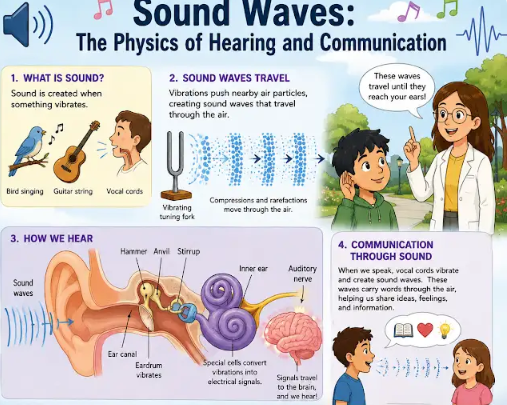
• ACCL PORTAL DAY 174 TASK STORY POST Badaruddin Chai wala Sound Waves: The Physics of Hearing and Communication

    Sound waves are vibrations that travel through a medium like air, water, or even solid objects. When an object vibrates, it pushes nearby particles, creating waves of energy that move outward. These waves cannot travel in space because there are no particles to carry them. Scientists like Heinrich Hertz helped us understand how waves behave, including their frequency and wavelength.

    Our ears are amazing organs that detect these sound waves. When sound enters the ear, it travels through the ear canal and makes the eardrum vibrate. These vibrations move through tiny bones and reach the inner ear, where they are converted into electrical signals for the brain to understand. Thanks to this process, we can enjoy music, hear warnings, and communicate with others.

    Sound waves have different frequencies and amplitudes. Frequency determines pitch (how high or low a sound is), while amplitude affects loudness. For example, a whistle has a high frequency, while thunder has a low frequency. Understanding sound has led to inventions like the telephone by Alexander Graham Bell, which changed global communication forever.

    Today, sound technology is used in microphones, speakers, medical ultrasounds, and even sonar systems. It helps us explore oceans, diagnose illnesses, and stay connected across the world. The physics of sound reminds us how invisible waves can have powerful effects on our daily lives.

    Moral of the Story

    Even things we cannot see, like sound waves, can make a big difference—just like kind words and clear communication can positively impact others.
    ACCL PORTAL DAY 174 TASK STORY POST Badaruddin Chai wala Sound Waves: The Physics of Hearing and Communication 🔊🌍 Sound waves are vibrations that travel through a medium like air, water, or even solid objects. When an object vibrates, it pushes nearby particles, creating waves of energy that move outward. These waves cannot travel in space because there are no particles to carry them. Scientists like Heinrich Hertz helped us understand how waves behave, including their frequency and wavelength. 📡✨ Our ears are amazing organs that detect these sound waves. When sound enters the ear, it travels through the ear canal and makes the eardrum vibrate. These vibrations move through tiny bones and reach the inner ear, where they are converted into electrical signals for the brain to understand. Thanks to this process, we can enjoy music, hear warnings, and communicate with others. 🎶👂🧠 Sound waves have different frequencies and amplitudes. Frequency determines pitch (how high or low a sound is), while amplitude affects loudness. For example, a whistle has a high frequency, while thunder has a low frequency. Understanding sound has led to inventions like the telephone by Alexander Graham Bell, which changed global communication forever. ☎️🌎 Today, sound technology is used in microphones, speakers, medical ultrasounds, and even sonar systems. It helps us explore oceans, diagnose illnesses, and stay connected across the world. The physics of sound reminds us how invisible waves can have powerful effects on our daily lives. 🌊🔬📢 Moral of the Story 🌟 Even things we cannot see, like sound waves, can make a big difference—just like kind words and clear communication can positively impact others. 💬❤️
    0 Commentaires 0 Parts 903 Vue
  • ACCL PORTAL DAY 160 TASK STORY POST Badaruddin Chai wala The Nature of Light: Exploring Waves and Particles
    Light is one of the most fascinating mysteries of science. For centuries, scientists tried to understand what light really is. In the 1600s, Isaac Newton believed that light was made of tiny particles, which explained how light travels in straight lines and forms shadows. Later, scientists like Christiaan Huygens suggested that light behaves like a wave, helping explain reflection and refraction. These early ideas began a long journey to uncover the true nature of light.
    In the 1800s, experiments by Thomas Young supported the wave theory. His famous double-slit experiment showed that light can create interference patterns, which is a property of waves. This discovery proved that light behaves like a wave when it spreads out and overlaps. Scientists then understood that light is part of the electromagnetic spectrum, traveling in waves of energy through space.
    However, in the early 1900s, new discoveries changed everything again. Albert Einstein explained the photoelectric effect by proposing that light also behaves like tiny packets of energy called photons. This discovery showed that light has particle-like properties too. Because of this, scientists developed the idea of wave-particle duality, meaning light can act both as a wave and as a particle depending on the situation.
    Today, the study of light helps us develop technologies like lasers, solar panels, and fiber optics. The dual nature of light teaches us that nature is more complex than it first appears. Light is not just a wave or just a particle—it is both. Understanding this mystery continues to inspire scientists around the world.
    Moral: Knowledge grows when we stay open-minded and accept that truth can have more than one side.
    ACCL PORTAL DAY 160 TASK STORY POST Badaruddin Chai wala The Nature of Light: Exploring Waves and Particles 🌟🌊 Light is one of the most fascinating mysteries of science. For centuries, scientists tried to understand what light really is. In the 1600s, Isaac Newton believed that light was made of tiny particles, which explained how light travels in straight lines and forms shadows. Later, scientists like Christiaan Huygens suggested that light behaves like a wave, helping explain reflection and refraction. 🌈🔍 These early ideas began a long journey to uncover the true nature of light. In the 1800s, experiments by Thomas Young supported the wave theory. His famous double-slit experiment showed that light can create interference patterns, which is a property of waves. 🌊✨ This discovery proved that light behaves like a wave when it spreads out and overlaps. Scientists then understood that light is part of the electromagnetic spectrum, traveling in waves of energy through space. However, in the early 1900s, new discoveries changed everything again. Albert Einstein explained the photoelectric effect by proposing that light also behaves like tiny packets of energy called photons. ⚡🔬 This discovery showed that light has particle-like properties too. Because of this, scientists developed the idea of wave-particle duality, meaning light can act both as a wave and as a particle depending on the situation. Today, the study of light helps us develop technologies like lasers, solar panels, and fiber optics. 💡📡 The dual nature of light teaches us that nature is more complex than it first appears. Light is not just a wave or just a particle—it is both. Understanding this mystery continues to inspire scientists around the world. Moral: 🌟 Knowledge grows when we stay open-minded and accept that truth can have more than one side.
    0 Commentaires 0 Parts 792 Vue
  • ACCL PORTAL DAY 118 TASK STORY POST @Badaruddin Suleman Atoms and Eternity: How Chemistry Shapes the Cosmos

    From the tiniest particles to the vast expanses of space, atoms form the very fabric of our universe. Each atom, composed of protons, neutrons, and electrons, acts like a building block, creating everything from stars and planets to life itself. The laws of chemistry govern how these atoms interact, bond, and transform, giving rise to the incredible diversity we see in the cosmos.

    Stars are not just shining lights; they are cosmic kitchens where atoms are forged. Through nuclear fusion, hydrogen atoms merge to form helium, releasing energy that powers the star and spreads elements across the universe. These elements eventually become part of planets, oceans, and even living beings, connecting every atom in existence to the lifecycle of the cosmos.

    Chemical reactions are the silent artists of the universe, shaping molecules and matter in ways both simple and complex. Water, carbon dioxide, and countless other compounds arise from these interactions, providing the conditions necessary for life. Even the air we breathe and the food we eat are the result of ancient chemical dances performed over billions of years.

    Understanding chemistry is like holding a key to the universe. By studying how atoms behave, scientists can predict cosmic events, create new materials, and even explore possibilities of life beyond Earth. This knowledge reminds us that we are not separate from the universe; we are an expression of its chemistry and eternity.

    Moral: Every atom in us carries the story of the cosmos; by appreciating chemistry, we understand both the universe and ourselves.
    ACCL PORTAL DAY 118 TASK STORY POST @Badaruddin Suleman Atoms and Eternity: How Chemistry Shapes the Cosmos ✨🪐 From the tiniest particles to the vast expanses of space, atoms form the very fabric of our universe. 🧪 Each atom, composed of protons, neutrons, and electrons, acts like a building block, creating everything from stars and planets to life itself. The laws of chemistry govern how these atoms interact, bond, and transform, giving rise to the incredible diversity we see in the cosmos. 🌌 Stars are not just shining lights; they are cosmic kitchens where atoms are forged. 🔥 Through nuclear fusion, hydrogen atoms merge to form helium, releasing energy that powers the star and spreads elements across the universe. These elements eventually become part of planets, oceans, and even living beings, connecting every atom in existence to the lifecycle of the cosmos. 🌟 Chemical reactions are the silent artists of the universe, shaping molecules and matter in ways both simple and complex. 🧬 Water, carbon dioxide, and countless other compounds arise from these interactions, providing the conditions necessary for life. Even the air we breathe and the food we eat are the result of ancient chemical dances performed over billions of years. 🌱 Understanding chemistry is like holding a key to the universe. 🗝️ By studying how atoms behave, scientists can predict cosmic events, create new materials, and even explore possibilities of life beyond Earth. This knowledge reminds us that we are not separate from the universe; we are an expression of its chemistry and eternity. 🌍💫 Moral: Every atom in us carries the story of the cosmos; by appreciating chemistry, we understand both the universe and ourselves. 🌌❤️
    0 Commentaires 0 Parts 1099 Vue
  • Can 1.0-3.0μm Global Hafnium Disilicide particles excel in high-temp structural materials?

    Global Hafnium Disilicide market demonstrates steady growth, driven by increasing demand from aerospace, electronics, and high-temperature applications. As a refractory intermetallic compound, HfSi₂ offers exceptional thermal stability and electrical conductivity, making it indispensable in advanced manufacturing sectors.

    Download FREE Sample Report: https://www.24chemicalresearch.com/download-sample/269569/global-hafnium-disilicide-forecast-market-2024-2030-416
    Can 1.0-3.0μm Global Hafnium Disilicide particles excel in high-temp structural materials? Global Hafnium Disilicide market demonstrates steady growth, driven by increasing demand from aerospace, electronics, and high-temperature applications. As a refractory intermetallic compound, HfSi₂ offers exceptional thermal stability and electrical conductivity, making it indispensable in advanced manufacturing sectors. Download FREE Sample Report: https://www.24chemicalresearch.com/download-sample/269569/global-hafnium-disilicide-forecast-market-2024-2030-416
    Sample Report: Hafnium Disilicide Market, Global Outlook and Forecast 2026-2033
    Download Sample Report PDF : Global Hafnium Disilicide market was valued at USD 25.7M in 2024 and is projected to reach USD 42.9M by 2032, at a CAGR of 5.4%.
    0 Commentaires 0 Parts 260 Vue
  • How will Global ZnO Nanoparticles achieve USD 682M by 2034 target projection?

    Zinc oxide nanoparticles (ZnO NPs) are advanced inorganic materials with unique UV-blocking properties, engineered with particle sizes typically ranging from 1-100 nanometers. They offer superior dispersion and transparency while maintaining excellent broad-spectrum UV protection, finding primary application in sunscreens and anti-aging formulations.

    Download FREE Sample Report:https://www.24chemicalresearch.com/download-sample/210946/global-regional-zno-nanoparticles-used-for-cosmetic-market
    How will Global ZnO Nanoparticles achieve USD 682M by 2034 target projection? Zinc oxide nanoparticles (ZnO NPs) are advanced inorganic materials with unique UV-blocking properties, engineered with particle sizes typically ranging from 1-100 nanometers. They offer superior dispersion and transparency while maintaining excellent broad-spectrum UV protection, finding primary application in sunscreens and anti-aging formulations. Download FREE Sample Report:https://www.24chemicalresearch.com/download-sample/210946/global-regional-zno-nanoparticles-used-for-cosmetic-market
    Sample Report: Global and Regional ZnO Nanoparticles Used for CosmeticMarket 2025 forecast to 2032 [Professional Edition]- Capacity, Production, Capacity Utilization Rate, Ex-Factory Price, Revenue, Demand & Supply,Import and Export, Cost, Gross Margin Analysis
    Download Sample Report PDF : Global ZnO nanoparticles cosmetic market was valued at USD 342.5 million in 2024 and is projected to reach USD 682.4 million by 2032, at a CAGR of 7.6% during the forecast period.
    0 Commentaires 0 Parts 344 Vue
  • It’s unbelievable How Silicon Quantum Dot Market to Reach USD 2.18 Billion ?Take a closer look here .

    Global Silicon Quantum Dot Market was valued at USD 930 million in 2026 and is projected to reach USD 2.18 billion by 2034, registering a CAGR of 8.3% during the forecast period 2026–2034. The market is moving on a steady growth path supported by expanding adoption across advanced display, sensing, and biomedical imaging technologies.
    Silicon Quantum Dots (SiQDs) are nanoscale semiconductor particles typically measuring between 2 and 9 nanometers, composed entirely of silicon and exhibiting quantum confinement effects. These structures demonstrate size-dependent optical and electronic behavior, including tunable photoluminescence and improved charge transport characteristics. Due to their cadmium-free and lead-free composition, they are increasingly used in display backlighting, light-emitting devices, photovoltaic systems, biosensing, and targeted imaging applications where material safety and stability are critical requirements.
    Access the complete industry analysis and demand forecasts here: https://semiconductorinsight.com/report/silicon-quantum-dot-market/
    It’s unbelievable How Silicon Quantum Dot Market to Reach USD 2.18 Billion ?Take a closer look here . Global Silicon Quantum Dot Market was valued at USD 930 million in 2026 and is projected to reach USD 2.18 billion by 2034, registering a CAGR of 8.3% during the forecast period 2026–2034. The market is moving on a steady growth path supported by expanding adoption across advanced display, sensing, and biomedical imaging technologies. Silicon Quantum Dots (SiQDs) are nanoscale semiconductor particles typically measuring between 2 and 9 nanometers, composed entirely of silicon and exhibiting quantum confinement effects. These structures demonstrate size-dependent optical and electronic behavior, including tunable photoluminescence and improved charge transport characteristics. Due to their cadmium-free and lead-free composition, they are increasingly used in display backlighting, light-emitting devices, photovoltaic systems, biosensing, and targeted imaging applications where material safety and stability are critical requirements. 👉 Access the complete industry analysis and demand forecasts here: https://semiconductorinsight.com/report/silicon-quantum-dot-market/
    Silicon Quantum Dot Market, Trends, Business Strategies 2025-2032
    0 Commentaires 0 Parts 946 Vue
  • Inspired by Sir Rehan Allahwala Prompt

    8K hyper-realistic vertical image (9:16) of a powerful, elegant blonde lady in red walking confidently through a luxury jewellery showroom in New York’s Diamond District. Use the uploaded photo exactly as provided — apply a critical identity lock to preserve her full facial features, body proportions, styling, and pose with zero alterations. Capture the subject mid-stride from a slightly low front angle (eye to waist height) for a high-status perspective. The showroom is lined with glowing display cases filled with diamonds and gemstones. Glass counters reflect both her silhouette and the surrounding sparkle. Above, mirrored ceilings and spotlit jewels create a rich atmosphere with light bouncing across surfaces. Add lens flares, subtle reflections, and slow-falling golden bokeh particles for depth. Use a Canon EOS R5 paired with an RF 50mm f/1.2L lens for crystal clarity, soft background separation, and editorial-grade skin tones. Ambient lighting is cool white with focused warm highlights on gems and jewellery to accentuate the luxury. The overall vibe: upscale, confident, untouchable
    Inspired by Sir [rehan] Prompt ✨ 8K hyper-realistic vertical image (9:16) of a powerful, elegant blonde lady in red walking confidently through a luxury jewellery showroom in New York’s Diamond District. Use the uploaded photo exactly as provided — apply a critical identity lock to preserve her full facial features, body proportions, styling, and pose with zero alterations. Capture the subject mid-stride from a slightly low front angle (eye to waist height) for a high-status perspective. The showroom is lined with glowing display cases filled with diamonds and gemstones. Glass counters reflect both her silhouette and the surrounding sparkle. Above, mirrored ceilings and spotlit jewels create a rich atmosphere with light bouncing across surfaces. Add lens flares, subtle reflections, and slow-falling golden bokeh particles for depth. Use a Canon EOS R5 paired with an RF 50mm f/1.2L lens for crystal clarity, soft background separation, and editorial-grade skin tones. Ambient lighting is cool white with focused warm highlights on gems and jewellery to accentuate the luxury. The overall vibe: upscale, confident, untouchable
    0 Commentaires 0 Parts 3445 Vue
  • Hello everyone! My name is Rameen, and I’m currently a Level One student at Rehan School Online Academy, attending the night shift program.

    I’m passionate about traveling, skating, and exploring the world through art. I’d describe myself as someone with a strong command of English, and I especially enjoy engaging in meaningful conversations—depending on the topic, of course!

    My favorite subject is Science, with a particular love for Chemistry. I find it fascinating how the smallest particles shape the biggest ideas.

    When it comes to countries, I admire:

    Pakistan – for its rich culture and heritage
    UAE – for its innovation and modernity
    Japan – for its discipline and artistic traditions

    As for colors, I’m drawn to black and a unique shade of green—though I can’t quite recall the exact name or code (it’s one of those “I’ll know it when I see it” vibes!).

    In short, I’m a curious, expressive learner who enjoys creativity, science, and discovering new perspectives. That’s a little about me!
    Hello everyone! My name is Rameen, and I’m currently a Level One student at Rehan School Online Academy, attending the night shift program. I’m passionate about traveling, skating, and exploring the world through art. I’d describe myself as someone with a strong command of English, and I especially enjoy engaging in meaningful conversations—depending on the topic, of course! My favorite subject is Science, with a particular love for Chemistry. I find it fascinating how the smallest particles shape the biggest ideas. When it comes to countries, I admire: Pakistan – for its rich culture and heritage UAE – for its innovation and modernity Japan – for its discipline and artistic traditions As for colors, I’m drawn to black and a unique shade of green—though I can’t quite recall the exact name or code (it’s one of those “I’ll know it when I see it” vibes!). In short, I’m a curious, expressive learner who enjoys creativity, science, and discovering new perspectives. That’s a little about me!
    2
    0 Commentaires 0 Parts 4808 Vue