• ACCL portal day 48 task story post @ Badaruddin Chai wala The Journey of Dinosaurs: A Scientific Perspective
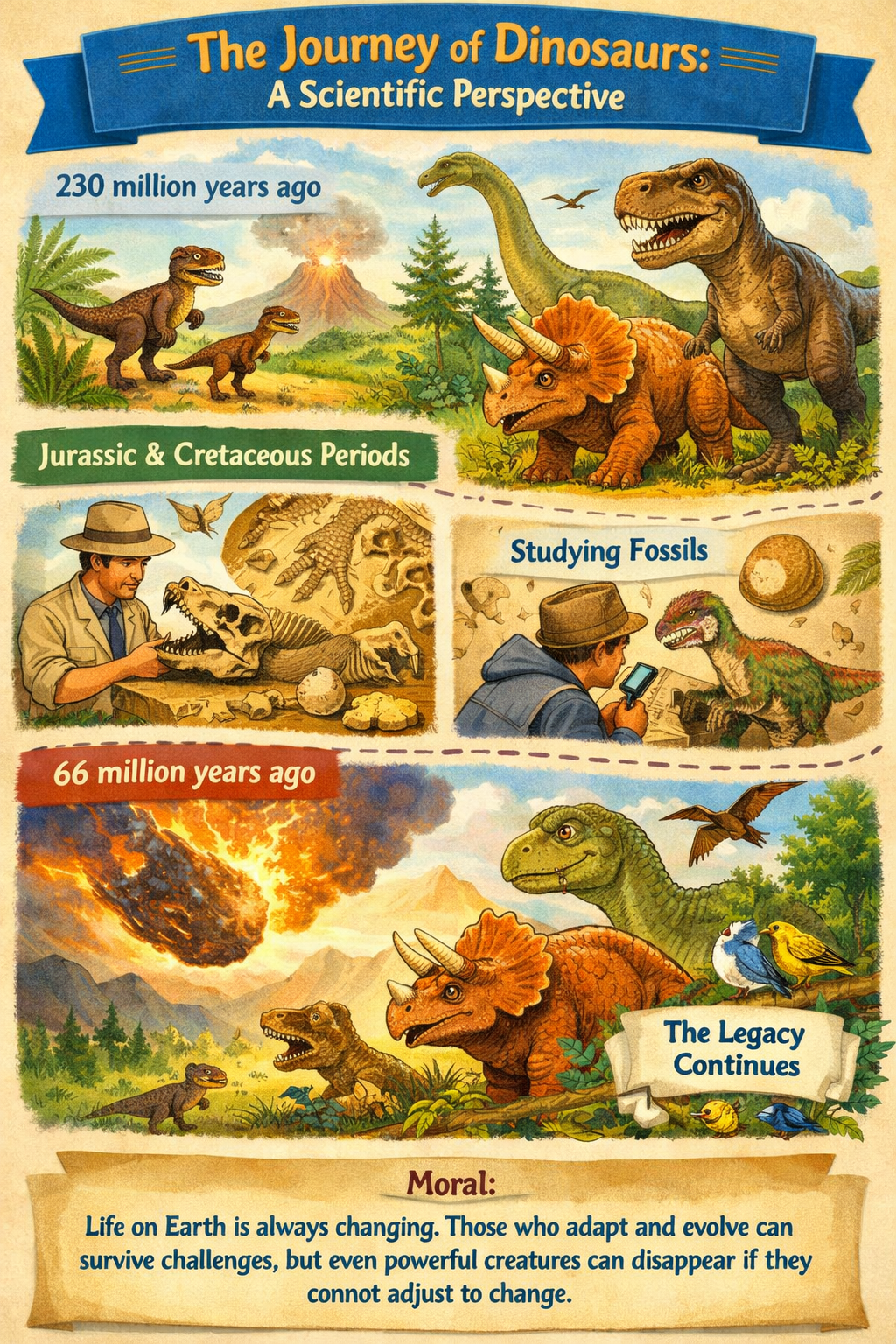
    Dinosaurs first appeared about 230 million years ago during the Late Triassic period. They lived on Earth for over 160 million years, spreading across different continents as the land slowly shifted due to plate tectonics. Early dinosaurs were generally small and walked on two legs, but over time they evolved into many different shapes and sizes, from tiny bird-like species to enormous plant-eaters.
    During the Jurassic and Cretaceous periods, dinosaurs became the dominant land animals. Some, like Tyrannosaurus rex, were powerful meat-eaters with sharp teeth and strong legs, while others, such as Triceratops, were plant-eaters with protective horns and frills. Giant long-necked dinosaurs like Brachiosaurus could reach tall trees for food. Their great variety shows how life can adapt and change over time.
    Scientists study fossils—such as bones, footprints, and eggs—to understand how dinosaurs lived and behaved. Research has shown that many dinosaurs likely had feathers and that modern birds are their closest living descendants. Each new discovery helps us learn more about Earth’s ancient past and the process of evolution.
    About 66 million years ago, a massive asteroid impact and major environmental changes led to the extinction of most dinosaurs. However, their story did not truly end, as birds continue their legacy today. The journey of dinosaurs teaches us about survival, change, and the history of life on Earth.
    Moral:
    Life on Earth is always changing. Those who adapt and evolve can survive challenges, but even powerful creatures can disappear if they cannot adjust to change.
    🦖ACCL portal day 48 task story post @ Badaruddin Chai wala The Journey of Dinosaurs: A Scientific Perspective Dinosaurs first appeared about 230 million years ago during the Late Triassic period. They lived on Earth for over 160 million years, spreading across different continents as the land slowly shifted due to plate tectonics. Early dinosaurs were generally small and walked on two legs, but over time they evolved into many different shapes and sizes, from tiny bird-like species to enormous plant-eaters. During the Jurassic and Cretaceous periods, dinosaurs became the dominant land animals. Some, like Tyrannosaurus rex, were powerful meat-eaters with sharp teeth and strong legs, while others, such as Triceratops, were plant-eaters with protective horns and frills. Giant long-necked dinosaurs like Brachiosaurus could reach tall trees for food. Their great variety shows how life can adapt and change over time. Scientists study fossils—such as bones, footprints, and eggs—to understand how dinosaurs lived and behaved. Research has shown that many dinosaurs likely had feathers and that modern birds are their closest living descendants. Each new discovery helps us learn more about Earth’s ancient past and the process of evolution. About 66 million years ago, a massive asteroid impact and major environmental changes led to the extinction of most dinosaurs. However, their story did not truly end, as birds continue their legacy today. The journey of dinosaurs teaches us about survival, change, and the history of life on Earth. 🌟 Moral: Life on Earth is always changing. Those who adapt and evolve can survive challenges, but even powerful creatures can disappear if they cannot adjust to change.
    0 Commentarios 0 Acciones 1 Views

  • Story post. 9
    ACCL Day. 62
    “Periodic Table: The Language of Science”

    Paragraph 1:
    The Periodic Table is called the “language of science” because it organizes all chemical elements in a way that reveals patterns and relationships. Each element has a symbol, atomic number, and unique properties. Just like letters form words, elements combine to form compounds and reactions that make up the world around us

    Paragraph 2:
    It was developed by Dmitri Mendeleev in 1869. He arranged elements in rows (periods) and columns (groups) based on atomic numbers and chemical properties Elements in the same group often behave similarly, helping scientists predict reactions and understand trends.

    Paragraph 3:
    The periodic table is more than a chart—it is a tool for discovery By studying patterns, scientists can predict new elements, design new materials, and explain natural phenomena. It connects chemistry, physics, and biology, helping us understand the universe better

    Paragraph 4 (Moral):
    The periodic table teaches us that everything in the universe is connected Understanding these connections inspires curiosity, innovation, and scientific exploration. Knowledge of patterns in nature empowers us to create and discover

    Hashtags:
    #PeriodicTable #Chemistry #Science #STEM #Elements #Discovery #Learning #Innovation #Education #Curiosity`````````````````
    Story post. 9 ACCL Day. 62 “Periodic Table: The Language of Science” 🧪✨ Paragraph 1: The Periodic Table is called the “language of science” 🧪🌍 because it organizes all chemical elements in a way that reveals patterns and relationships. Each element has a symbol, atomic number, and unique properties. Just like letters form words, elements combine to form compounds and reactions that make up the world around us 🌌💡 Paragraph 2: It was developed by Dmitri Mendeleev in 1869. He arranged elements in rows (periods) and columns (groups) based on atomic numbers and chemical properties 📊✨ Elements in the same group often behave similarly, helping scientists predict reactions and understand trends. Paragraph 3: The periodic table is more than a chart—it is a tool for discovery 🔬🌟 By studying patterns, scientists can predict new elements, design new materials, and explain natural phenomena. It connects chemistry, physics, and biology, helping us understand the universe better 🌌🧬 Paragraph 4 (Moral): The periodic table teaches us that everything in the universe is connected 🌈💛 Understanding these connections inspires curiosity, innovation, and scientific exploration. Knowledge of patterns in nature empowers us to create and discover 🔬💡 Hashtags: #PeriodicTable #Chemistry #Science #STEM #Elements #Discovery #Learning #Innovation #Education #Curiosity`````````````````
    0 Commentarios 0 Acciones 471 Views
  • https://youtu.be/nX4WtBaL2eI

    #rsisb
    Roll no 159
    Foundation Level Student
    Date: 19 February 2026

    Description:
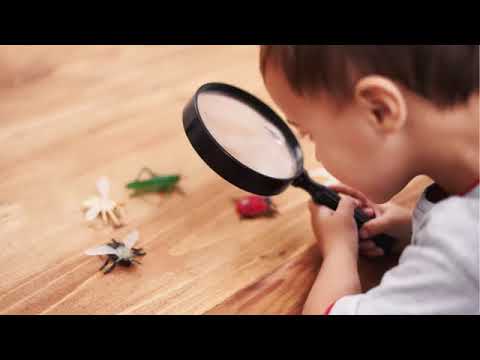
    The song “From Specimens to Knowledge: The Purpose of Science Experiments” explores how scientific experiments transform simple observations into meaningful understanding. It highlights the journey of studying specimens, collecting data, and analyzing results to uncover the laws of nature and the secrets of life. The song emphasizes that experiments are not just routine tasks, but powerful tools for learning, discovery, and expanding human knowledge. Through its thoughtful lyrics, it inspires curiosity, careful observation, and the pursuit of truth, showing that science helps us make sense of the world and turn questions into answers. Overall, it celebrates the purpose and value of scientific exploration, encouraging listeners to appreciate the process of turning experiments into knowledge.
    https://youtu.be/nX4WtBaL2eI #rsisb Roll no 159 Foundation Level Student Date: 19 February 2026 Description: The song “From Specimens to Knowledge: The Purpose of Science Experiments” explores how scientific experiments transform simple observations into meaningful understanding. It highlights the journey of studying specimens, collecting data, and analyzing results to uncover the laws of nature and the secrets of life. The song emphasizes that experiments are not just routine tasks, but powerful tools for learning, discovery, and expanding human knowledge. Through its thoughtful lyrics, it inspires curiosity, careful observation, and the pursuit of truth, showing that science helps us make sense of the world and turn questions into answers. Overall, it celebrates the purpose and value of scientific exploration, encouraging listeners to appreciate the process of turning experiments into knowledge.
    0 Commentarios 0 Acciones 444 Views
  • https://youtu.be/JsBUezaItfM

    #rsisb
    Roll no 159
    Foundation Level Student
    Date: 19 February 2026

    Description:
    The song “Why Do We Experiment? The Search for Truth in Biology” explores the curiosity and determination that drive scientific discovery. It reflects on how experiments help us understand life at its deepest levels, from tiny cells to complex living systems. The song highlights the idea that biology is not just about facts, but about questioning, testing, and learning through exploration. It portrays scientists as seekers of truth who use experiments to uncover the hidden patterns of life and nature. With an inspiring and thoughtful tone, the song celebrates curiosity, persistence, and the human desire to understand the living world, reminding listeners that every experiment is a step closer to truth and knowledge.
    https://youtu.be/JsBUezaItfM #rsisb Roll no 159 Foundation Level Student Date: 19 February 2026 Description: The song “Why Do We Experiment? The Search for Truth in Biology” explores the curiosity and determination that drive scientific discovery. It reflects on how experiments help us understand life at its deepest levels, from tiny cells to complex living systems. The song highlights the idea that biology is not just about facts, but about questioning, testing, and learning through exploration. It portrays scientists as seekers of truth who use experiments to uncover the hidden patterns of life and nature. With an inspiring and thoughtful tone, the song celebrates curiosity, persistence, and the human desire to understand the living world, reminding listeners that every experiment is a step closer to truth and knowledge.
    0 Commentarios 0 Acciones 344 Views
  • https://youtu.be/SMv5pzIAOjA

    #rsisb
    Roll no 159
    Foundation Level Student
    Date: 19 February 2026

    Description:
    The topic “Science and Faith: A Harmonious Comparison” explores the meaningful relationship between two powerful ways of understanding the world. It highlights how science focuses on evidence, discovery, and logical explanation, while faith offers purpose, morality, and spiritual understanding. Instead of seeing them as opposites, this concept presents them as complementary forces that can coexist peacefully. Science helps us understand how the universe works, while faith helps us understand why life holds meaning and value. Together, they provide a balanced perspective that encourages curiosity along with humility. This theme inspires readers to appreciate both knowledge and belief, showing that harmony between science and faith can lead to deeper wisdom and a more complete view of life.
    https://youtu.be/SMv5pzIAOjA #rsisb Roll no 159 Foundation Level Student Date: 19 February 2026 Description: The topic “Science and Faith: A Harmonious Comparison” explores the meaningful relationship between two powerful ways of understanding the world. It highlights how science focuses on evidence, discovery, and logical explanation, while faith offers purpose, morality, and spiritual understanding. Instead of seeing them as opposites, this concept presents them as complementary forces that can coexist peacefully. Science helps us understand how the universe works, while faith helps us understand why life holds meaning and value. Together, they provide a balanced perspective that encourages curiosity along with humility. This theme inspires readers to appreciate both knowledge and belief, showing that harmony between science and faith can lead to deeper wisdom and a more complete view of life.
    0 Commentarios 0 Acciones 344 Views
  • #rsisb
    roll no 163
    story post 5

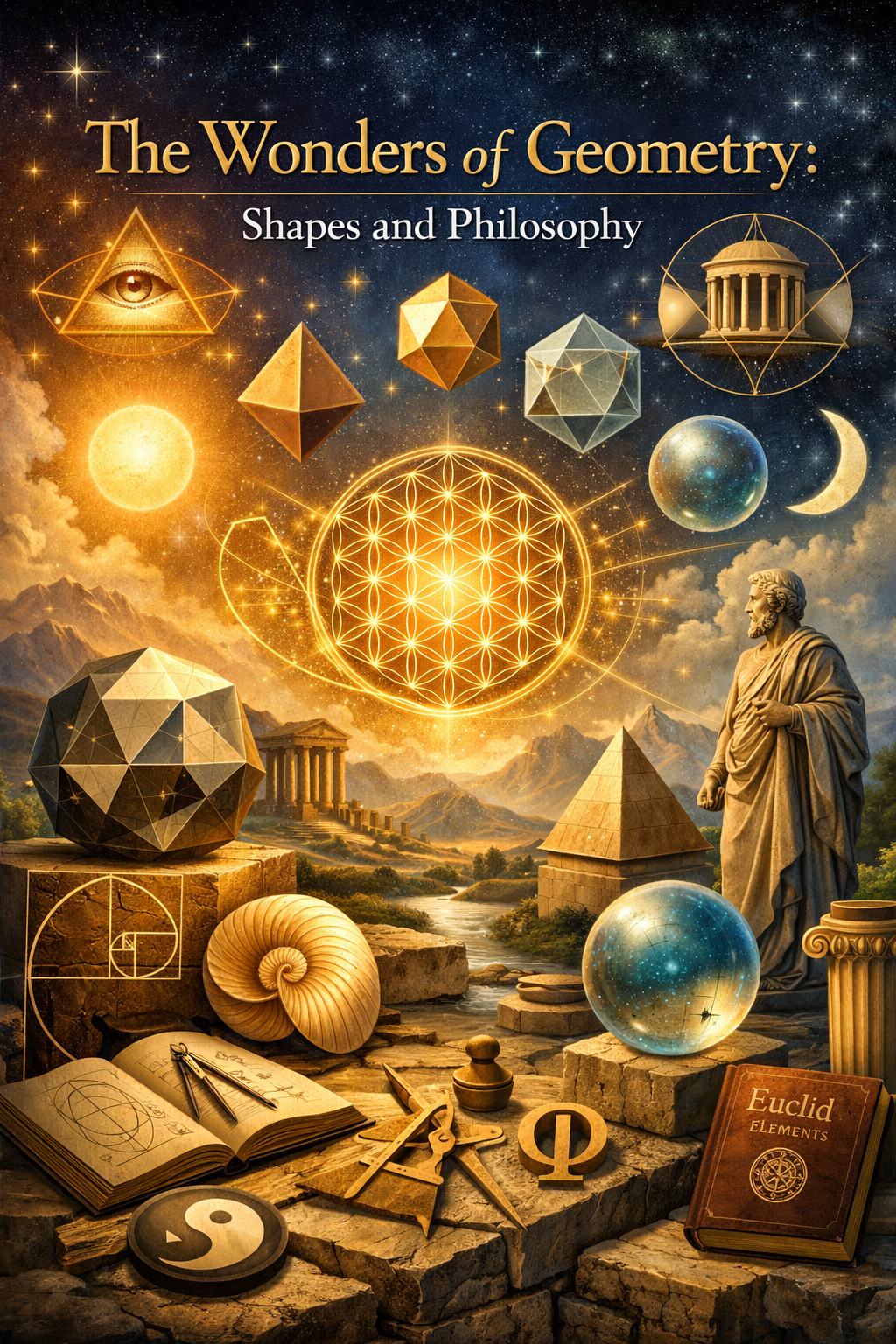
    Geometry is more than just lines, angles, and shapes—it is a language of the universe. From ancient civilizations to modern science, geometric forms have been used to understand balance, harmony, and truth. Shapes like circles, triangles, and squares are not only mathematical tools but also powerful symbols of perfection, stability, and unity.

    Philosophers believed that geometry reflects the order of existence itself. The circle represents eternity and wholeness, the triangle symbolizes balance and wisdom, while complex patterns reveal hidden connections between nature, art, and thought. Through geometry, philosophy asks deep questions about reality, beauty, and the structure of the cosmos.

    “The Wonders of Geometry” invites us to see mathematics as a bridge between logic and meaning—where shapes inspire both scientific discovery and philosophical reflection. It reminds us that understanding the world begins with observing its patterns.


    #GeometryWonders
    #ShapesAndPhilosophy
    #SacredGeometry
    #MathematicsArt
    #PhilosophyOfLife
    #PatternsOfNature
    #LearningWithWonder
    #MindAndMath
    #UniverseDesign
    #rsisb roll no 163 story post 5 Geometry is more than just lines, angles, and shapes—it is a language of the universe. 🔺⭕ From ancient civilizations to modern science, geometric forms have been used to understand balance, harmony, and truth. Shapes like circles, triangles, and squares are not only mathematical tools but also powerful symbols of perfection, stability, and unity. 🌌 Philosophers believed that geometry reflects the order of existence itself. The circle represents eternity and wholeness, the triangle symbolizes balance and wisdom, while complex patterns reveal hidden connections between nature, art, and thought. 🧠✨ Through geometry, philosophy asks deep questions about reality, beauty, and the structure of the cosmos. “The Wonders of Geometry” invites us to see mathematics as a bridge between logic and meaning—where shapes inspire both scientific discovery and philosophical reflection. It reminds us that understanding the world begins with observing its patterns. 🌟📐 #GeometryWonders 🔺 #ShapesAndPhilosophy 🧠✨ #SacredGeometry 🌌 #MathematicsArt 🎨📐 #PhilosophyOfLife 💭 #PatternsOfNature 🌿 #LearningWithWonder 📚✨ #MindAndMath 🧠➕ #UniverseDesign 🌍✨
    0 Commentarios 0 Acciones 714 Views
  • #rsisb
    roll no 163
    story post 4

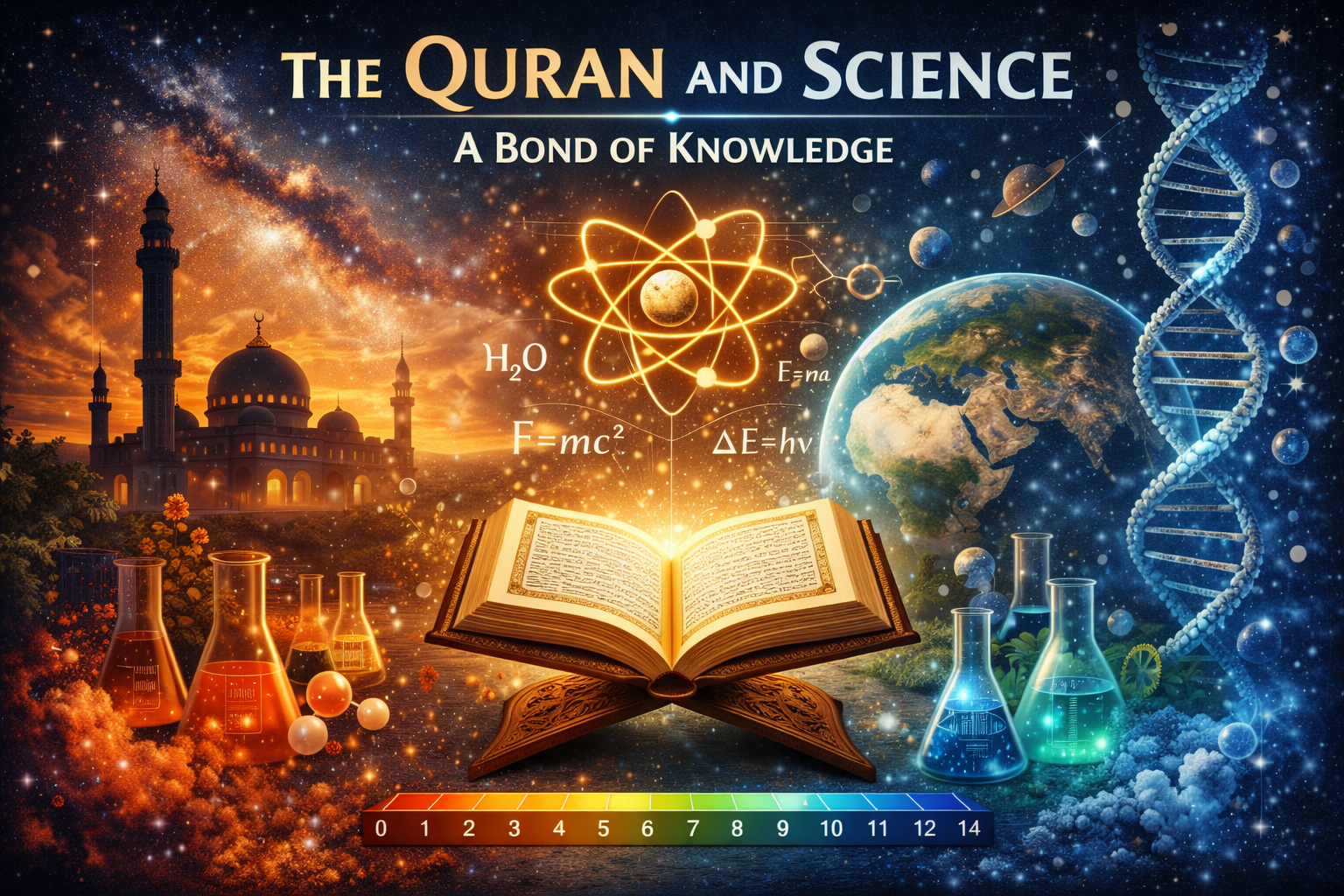
    The Quran and Science are often seen as two distinct sources of knowledge, but they beautifully complement each other. The Quran encourages reflection, observation, and understanding of the natural world, while science provides the tools to explore, experiment, and discover its intricacies. Together, they form a bond of knowledge, showing how faith and reason can coexist harmoniously.

    From the microscopic world of DNA and molecules to the vast cosmos, the teachings of the Quran inspire curiosity and inquiry, guiding us to seek wisdom and understanding. This connection reminds us that the pursuit of knowledge is a noble path, and that exploring the wonders of creation can deepen both scientific insight and spiritual awareness.

    #QuranAndScience #KnowledgeIsPower #FaithAndReason #ExploreTheUniverse #ScientificDiscovery #DivineWisdom #Curiosity #STEMAndFaith #LearnAndReflect #HarmonyOfKnowledge
    #rsisb roll no 163 story post 4 The Quran and Science are often seen as two distinct sources of knowledge, but they beautifully complement each other. 🌌📖 The Quran encourages reflection, observation, and understanding of the natural world, while science provides the tools to explore, experiment, and discover its intricacies. Together, they form a bond of knowledge, showing how faith and reason can coexist harmoniously. From the microscopic world of DNA and molecules to the vast cosmos, the teachings of the Quran inspire curiosity and inquiry, guiding us to seek wisdom and understanding. 🔬✨ This connection reminds us that the pursuit of knowledge is a noble path, and that exploring the wonders of creation can deepen both scientific insight and spiritual awareness. 🌍💡 #QuranAndScience 📖🔬 #KnowledgeIsPower 🌟 #FaithAndReason ✨🧠 #ExploreTheUniverse 🌌 #ScientificDiscovery 🚀 #DivineWisdom 🙏 #Curiosity 🌱 #STEMAndFaith 💡 #LearnAndReflect 📝 #HarmonyOfKnowledge ⚖️
    0 Commentarios 0 Acciones 1999 Views

  • #rsisb
    Foreign Interview No.10
    Roll No 58
    🎙 Soul Talk with Abeera Guest: Jana Šimoníková (Creative Mind & Travel Management Professional)
    Host: Abeera Saeed FreelancingWali
    🎙 Guest: Jana Šimoníková
    Podcast Name: Soul Talk with Rubania
    Guest Introduction
    Assalam o Alaikum and Hello everyone!
    Today on Soul Talk with Abeera, we are excited to welcome Jana Šimoníková, a creative soul with a background in travel management and diverse professional experiences.
    She brings with her a journey filled with creativity, self-growth, balance, and deep reflection — a conversation that inspires calm, clarity, and purpose.
    About Our Guest – Jana Šimoníková
    Jana Šimoníková is a creative mind with a professional background in Travel Management and a passion for personal growth and self-discovery.
    She believes in the power of silence, balance, and self-reflection, and how these elements help shape a more meaningful and peaceful life.
    Through her journey, Jana inspires people to reconnect with themselves, embrace creativity, and grow with positivity and awareness.
    Her story is a beautiful reminder that success is not just about doing more — but also about being more.
    Connect with Our Guest (Jana Šimoníková)
    Facebook:
    https://www.facebook.com/share/1DRaKq1k9A/
    🎙 About the Host
    Assalam o Alaikum!
    I’m Abeera Saeed FreelancingWali host of Soul Talk with Abeera and a proud student of Rehan School IsIamabad Campus– Level 1.
    Connect with Abeera
    Facebook:
    https://www.facebook.com/profile.php?id=61573227952671
    Instagram:
    https://www.instagram.com/abeerasaee7788/
    LinkedIn:
    https://www.linkedin.com/in/abeera-saeed-787bb436a/
    🎙 Foreign Interview No.10
    Roll No.: 58
    Level: 1 –
    Rehan School IsIamabad Campus
    Rehan School IsIamabad Campus
    Asma Shaheen EducationWali
    Saima Happinesswali
    Irum Asim
    Jana Šimoníková

    https://youtu.be/go18TTZWSGs
    #rsisb Foreign Interview No.10 Roll No 58 🎙 Soul Talk with Abeera Guest: Jana Šimoníková (Creative Mind & Travel Management Professional) 🎧 Host: Abeera Saeed FreelancingWali 🎙 Guest: Jana Šimoníková 🌍 🌟 Podcast Name: Soul Talk with Rubania 👤 Guest Introduction Assalam o Alaikum and Hello everyone! Today on Soul Talk with Abeera, we are excited to welcome Jana Šimoníková, a creative soul with a background in travel management and diverse professional experiences. She brings with her a journey filled with creativity, self-growth, balance, and deep reflection — a conversation that inspires calm, clarity, and purpose. 🌟 About Our Guest – Jana Šimoníková Jana Šimoníková is a creative mind with a professional background in Travel Management and a passion for personal growth and self-discovery. She believes in the power of silence, balance, and self-reflection, and how these elements help shape a more meaningful and peaceful life. Through her journey, Jana inspires people to reconnect with themselves, embrace creativity, and grow with positivity and awareness. Her story is a beautiful reminder that success is not just about doing more — but also about being more. 🔗 Connect with Our Guest (Jana Šimoníková) Facebook: https://www.facebook.com/share/1DRaKq1k9A/ 🎙 About the Host Assalam o Alaikum! I’m Abeera Saeed FreelancingWali host of Soul Talk with Abeera and a proud student of Rehan School IsIamabad Campus– Level 1. 🔗 Connect with Abeera Facebook: https://www.facebook.com/profile.php?id=61573227952671 Instagram: https://www.instagram.com/abeerasaee7788/ LinkedIn: https://www.linkedin.com/in/abeera-saeed-787bb436a/ 🎙 Foreign Interview No.10 👩‍🎓 Roll No.: 58 📘 Level: 1 – 🏫 Rehan School IsIamabad Campus Rehan School IsIamabad Campus Asma Shaheen EducationWali Saima Happinesswali Irum Asim Jana Šimoníková https://youtu.be/go18TTZWSGs
    0 Commentarios 0 Acciones 1566 Views
  • #rsisb
    Roll No 138
    story No 20

    Periodic Table: The Language of Science

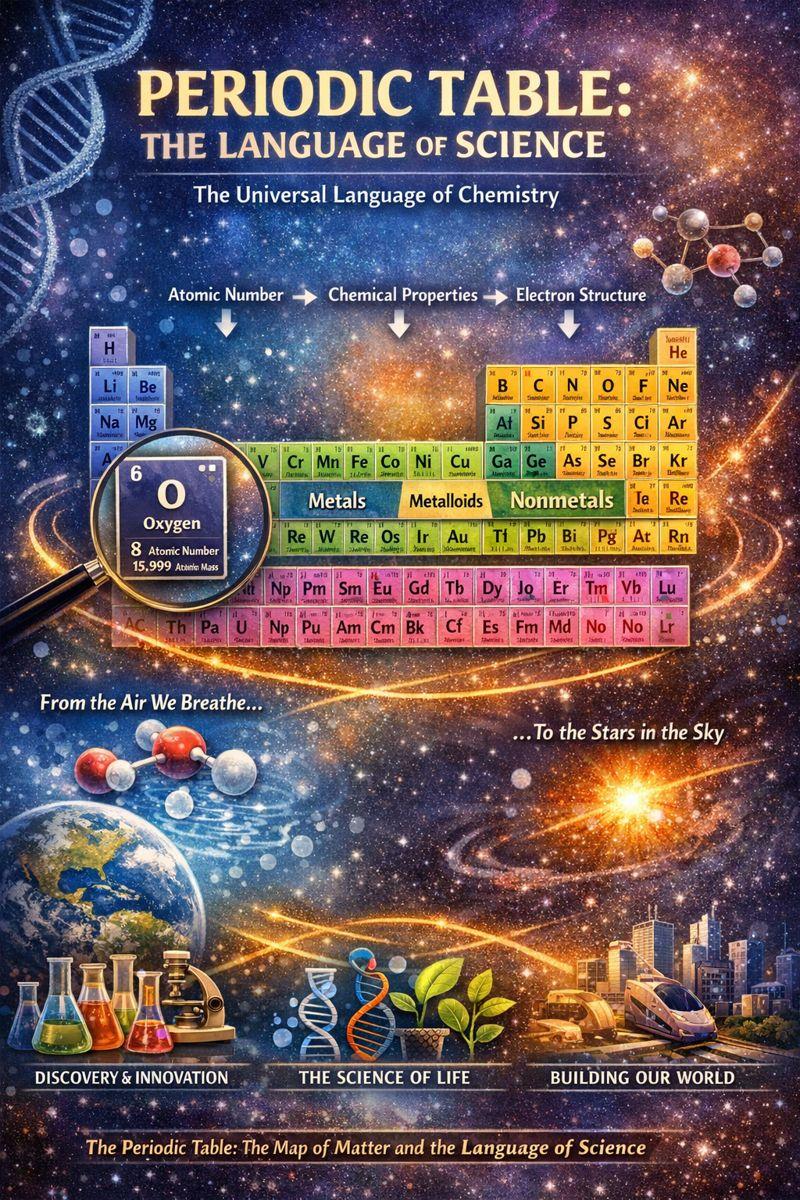
    The periodic table is often called the language of science because it organizes all known chemical elements in a clear, logical system that scientists around the world understand and use. Just like letters form words and sentences, elements in the periodic table combine to form everything in the universe—from the air we breathe to the stars in the sky.

    This powerful table arranges elements by their atomic number, chemical properties, and electron structure, revealing patterns that help scientists predict how elements will react with each other. Metals, non-metals, and metalloids each have their own place, making the table a map of matter itself.

    More than just a chart, the periodic table tells a story of discovery, innovation, and human curiosity. It helps students learn the basics of chemistry, supports researchers in creating new materials and medicines, and connects physics, biology, and environmental science under one universal system.

    In short, the periodic table is not just a scientific tool—it is a universal language that explains how the world is built, how it changes, and how we can understand it.
    #rsisb Roll No 138 story No 20 🧪 Periodic Table: The Language of Science The periodic table is often called the language of science because it organizes all known chemical elements in a clear, logical system that scientists around the world understand and use. Just like letters form words and sentences, elements in the periodic table combine to form everything in the universe—from the air we breathe to the stars in the sky. This powerful table arranges elements by their atomic number, chemical properties, and electron structure, revealing patterns that help scientists predict how elements will react with each other. Metals, non-metals, and metalloids each have their own place, making the table a map of matter itself. More than just a chart, the periodic table tells a story of discovery, innovation, and human curiosity. It helps students learn the basics of chemistry, supports researchers in creating new materials and medicines, and connects physics, biology, and environmental science under one universal system. In short, the periodic table is not just a scientific tool—it is a universal language that explains how the world is built, how it changes, and how we can understand it. 🌍✨
    1
    0 Commentarios 0 Acciones 1352 Views
  • #rsisb
    Teacher Training
    Story Post No:19
    Date:21-10-2025

    Story Post Title: Peering Inside: The Role of Dissections in Understanding Life

    Long Description:
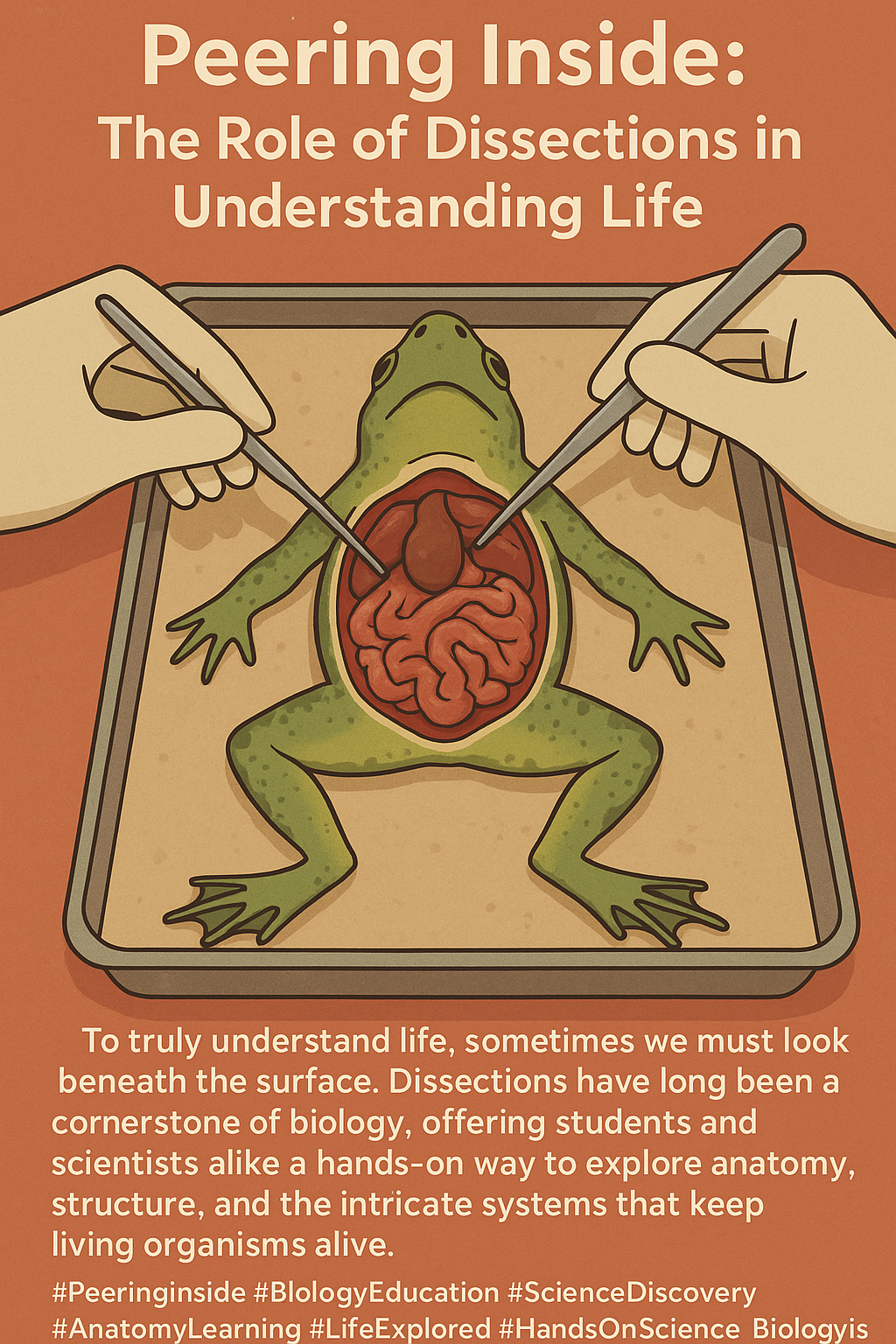
    To truly understand life, sometimes we must look beneath the surface. Dissections have long been a cornerstone of biology, offering students and scientists alike a hands-on way to explore anatomy, structure, and the intricate systems that keep living organisms alive.

    Each cut reveals a deeper story — how organs work together, how evolution refines form and function, and how life maintains its delicate balance. From frogs and fish to plants and beyond, dissections teach us that life’s beauty lies in its complexity and design.

    While modern technology offers virtual models and 3D simulations, the real-life experience of discovery reminds us that biology is not just learned — it’s felt and experienced.

    Step into the world of exploration and see how peering inside helps us understand what it truly means to be alive.

    #PeeringInside #BiologyEducation #ScienceDiscovery #AnatomyLearning #LifeExplored #HandsOnScience #BiologyIsBeautiful #DissectionStudy #ExploreLife #STEMEducation

    #rsisb Teacher Training Story Post No:19 Date:21-10-2025 🔬✨ Story Post Title: Peering Inside: The Role of Dissections in Understanding Life 🧬🐸 📝 Long Description: To truly understand life, sometimes we must look beneath the surface. 🌿🔍 Dissections have long been a cornerstone of biology, offering students and scientists alike a hands-on way to explore anatomy, structure, and the intricate systems that keep living organisms alive. 🧠💓 Each cut reveals a deeper story — how organs work together, how evolution refines form and function, and how life maintains its delicate balance. ⚖️🧫 From frogs and fish to plants and beyond, dissections teach us that life’s beauty lies in its complexity and design. 🌎🧬 While modern technology offers virtual models and 3D simulations, the real-life experience of discovery reminds us that biology is not just learned — it’s felt and experienced. ✋💡 Step into the world of exploration and see how peering inside helps us understand what it truly means to be alive. 🌱✨ #PeeringInside #BiologyEducation #ScienceDiscovery #AnatomyLearning #LifeExplored #HandsOnScience #BiologyIsBeautiful #DissectionStudy #ExploreLife #STEMEducation 🔬🐸🧠🌍🧬
    0 Commentarios 0 Acciones 10757 Views
Resultados de la búsqueda