• #rsisb
    Roll no 159
    Foundation Level Student
    Date: April 4, 2026

    Description: “Air” – Breathing Life into Language

    Air is one of the most basic elements of human existence , yet its role goes far beyond simply keeping us alive. It is the invisible force that gives life to language, turning silent thoughts into spoken words . Every sentence we speak, every emotion we express, and every story we share begins with a single breath. Without air, language would remain locked inside us, unable to reach the world.

    Breathing is not just a physical act; it is deeply connected to how we communicate . The way we control our breath shapes our voice, tone, and clarity. A calm, steady breath creates confident and clear speech, while rapid or uneven breathing can reflect fear, anxiety, or excitement . In this way, air becomes more than a tool—it becomes a mirror of our inner state, revealing emotions even when words try to hide them.

    “Air” also highlights the powerful connection between body and mind . When we speak, our thoughts travel through breath and transform into sound. This process shows how closely language is tied to our physical existence. Even small changes in breath—like a sigh, a whisper, or a pause—can carry deep meaning without the need for complex words . Sometimes, a simple exhale can express more than a long explanation.

    In communication, breath creates rhythm and flow . It determines how fast or slow we speak, where we pause, and how we emphasize certain ideas. Great speakers, singers, and performers understand this and train their breathing to improve their expression . Through controlled breath, they are able to deliver words with power, emotion, and impact, making their message more effective and memorable.

    Moreover, air connects us to others in a subtle but meaningful way . When we speak, our breath carries our voice through space, reaching another person and creating understanding. Even in silence, shared breathing can create a sense of presence and connection. This shows that communication is not only about words but also about the unseen forces that carry them.

    In today’s fast-paced world , we often overlook the importance of breathing. We speak quickly, react instantly, and rarely pause to take a breath. However, learning to control and understand our breath can improve not only our communication but also our emotional balance and self-awareness . It allows us to speak with intention, listen more carefully, and respond more thoughtfully.

    In conclusion, “Air” is the foundation of language and expression . It transforms thoughts into voice, connects emotions with words, and links individuals through communication. By understanding the role of breath, we begin to see language not just as words, but as living expressions carried by the very air we breath


    https://youtu.be/C4pJTCX3Faw
    #rsisb Roll no 159 Foundation Level Student Date: April 4, 2026 Description: “Air” – Breathing Life into Language Air is one of the most basic elements of human existence 🌬️, yet its role goes far beyond simply keeping us alive. It is the invisible force that gives life to language, turning silent thoughts into spoken words 🗣️. Every sentence we speak, every emotion we express, and every story we share begins with a single breath. Without air, language would remain locked inside us, unable to reach the world. Breathing is not just a physical act; it is deeply connected to how we communicate 💭. The way we control our breath shapes our voice, tone, and clarity. A calm, steady breath creates confident and clear speech, while rapid or uneven breathing can reflect fear, anxiety, or excitement 😌😰. In this way, air becomes more than a tool—it becomes a mirror of our inner state, revealing emotions even when words try to hide them. “Air” also highlights the powerful connection between body and mind 🧠. When we speak, our thoughts travel through breath and transform into sound. This process shows how closely language is tied to our physical existence. Even small changes in breath—like a sigh, a whisper, or a pause—can carry deep meaning without the need for complex words 🤫. Sometimes, a simple exhale can express more than a long explanation. In communication, breath creates rhythm and flow 🎶. It determines how fast or slow we speak, where we pause, and how we emphasize certain ideas. Great speakers, singers, and performers understand this and train their breathing to improve their expression 🎤. Through controlled breath, they are able to deliver words with power, emotion, and impact, making their message more effective and memorable. Moreover, air connects us to others in a subtle but meaningful way 🤝. When we speak, our breath carries our voice through space, reaching another person and creating understanding. Even in silence, shared breathing can create a sense of presence and connection. This shows that communication is not only about words but also about the unseen forces that carry them. In today’s fast-paced world ⏳, we often overlook the importance of breathing. We speak quickly, react instantly, and rarely pause to take a breath. However, learning to control and understand our breath can improve not only our communication but also our emotional balance and self-awareness 🌱. It allows us to speak with intention, listen more carefully, and respond more thoughtfully. In conclusion, “Air” is the foundation of language and expression 🌍. It transforms thoughts into voice, connects emotions with words, and links individuals through communication. By understanding the role of breath, we begin to see language not just as words, but as living expressions carried by the very air we breath https://youtu.be/C4pJTCX3Faw
    0 Commenti 0 condivisioni 122 Views
  • #rsisb
    Roll no 159
    Foundation Level Student
    Date: April 4, 2026

    Description: “Air” – Breathing Life into Language

    Air is one of the most basic elements of human existence , yet its role goes far beyond simply keeping us alive. It is the invisible force that gives life to language, turning silent thoughts into spoken words . Every sentence we speak, every emotion we express, and every story we share begins with a single breath. Without air, language would remain locked inside us, unable to reach the world.

    Breathing is not just a physical act; it is deeply connected to how we communicate . The way we control our breath shapes our voice, tone, and clarity. A calm, steady breath creates confident and clear speech, while rapid or uneven breathing can reflect fear, anxiety, or excitement . In this way, air becomes more than a tool—it becomes a mirror of our inner state, revealing emotions even when words try to hide them.

    “Air” also highlights the powerful connection between body and mind . When we speak, our thoughts travel through breath and transform into sound. This process shows how closely language is tied to our physical existence. Even small changes in breath—like a sigh, a whisper, or a pause—can carry deep meaning without the need for complex words . Sometimes, a simple exhale can express more than a long explanation.

    In communication, breath creates rhythm and flow . It determines how fast or slow we speak, where we pause, and how we emphasize certain ideas. Great speakers, singers, and performers understand this and train their breathing to improve their expression . Through controlled breath, they are able to deliver words with power, emotion, and impact, making their message more effective and memorable.

    Moreover, air connects us to others in a subtle but meaningful way . When we speak, our breath carries our voice through space, reaching another person and creating understanding. Even in silence, shared breathing can create a sense of presence and connection. This shows that communication is not only about words but also about the unseen forces that carry them.

    In today’s fast-paced world , we often overlook the importance of breathing. We speak quickly, react instantly, and rarely pause to take a breath. However, learning to control and understand our breath can improve not only our communication but also our emotional balance and self-awareness . It allows us to speak with intention, listen more carefully, and respond more thoughtfully.

    In conclusion, “Air” is the foundation of language and expression . It transforms thoughts into voice, connects emotions with words, and links individuals through communication. By understanding the role of breath, we begin to see language not just as words, but as living expressions carried by the very air we breathe.

    Hashtags

    #Air #Breath #Language #Communication #Voice #Expression #MindAndBody #PublicSpeaking #SelfAwareness #DeepThinking #Silence #Speech #HumanConnection #Emotions #Life #Learning #FoundationLevel #RSISB


    https://youtu.be/C4pJTCX3Faw
    #rsisb Roll no 159 Foundation Level Student Date: April 4, 2026 Description: “Air” – Breathing Life into Language Air is one of the most basic elements of human existence 🌬️, yet its role goes far beyond simply keeping us alive. It is the invisible force that gives life to language, turning silent thoughts into spoken words 🗣️. Every sentence we speak, every emotion we express, and every story we share begins with a single breath. Without air, language would remain locked inside us, unable to reach the world. Breathing is not just a physical act; it is deeply connected to how we communicate 💭. The way we control our breath shapes our voice, tone, and clarity. A calm, steady breath creates confident and clear speech, while rapid or uneven breathing can reflect fear, anxiety, or excitement 😌😰. In this way, air becomes more than a tool—it becomes a mirror of our inner state, revealing emotions even when words try to hide them. “Air” also highlights the powerful connection between body and mind 🧠. When we speak, our thoughts travel through breath and transform into sound. This process shows how closely language is tied to our physical existence. Even small changes in breath—like a sigh, a whisper, or a pause—can carry deep meaning without the need for complex words 🤫. Sometimes, a simple exhale can express more than a long explanation. In communication, breath creates rhythm and flow 🎶. It determines how fast or slow we speak, where we pause, and how we emphasize certain ideas. Great speakers, singers, and performers understand this and train their breathing to improve their expression 🎤. Through controlled breath, they are able to deliver words with power, emotion, and impact, making their message more effective and memorable. Moreover, air connects us to others in a subtle but meaningful way 🤝. When we speak, our breath carries our voice through space, reaching another person and creating understanding. Even in silence, shared breathing can create a sense of presence and connection. This shows that communication is not only about words but also about the unseen forces that carry them. In today’s fast-paced world ⏳, we often overlook the importance of breathing. We speak quickly, react instantly, and rarely pause to take a breath. However, learning to control and understand our breath can improve not only our communication but also our emotional balance and self-awareness 🌱. It allows us to speak with intention, listen more carefully, and respond more thoughtfully. In conclusion, “Air” is the foundation of language and expression 🌍. It transforms thoughts into voice, connects emotions with words, and links individuals through communication. By understanding the role of breath, we begin to see language not just as words, but as living expressions carried by the very air we breathe. ✨ Hashtags #Air #Breath #Language #Communication #Voice #Expression #MindAndBody #PublicSpeaking #SelfAwareness #DeepThinking #Silence #Speech #HumanConnection #Emotions #Life #Learning #FoundationLevel #RSISB https://youtu.be/C4pJTCX3Faw
    0 Commenti 0 condivisioni 147 Views
  • #rsisb
    Roll no 159
    Foundation Level Student
    Date: April 4, 2026

    Description: “Air” – Breathing Life into Language

    Air is one of the most basic elements of human existence , yet its role goes far beyond simply keeping us alive. It is the invisible force that gives life to language, turning silent thoughts into spoken words . Every sentence we speak, every emotion we express, and every story we share begins with a single breath. Without air, language would remain locked inside us, unable to reach the world.

    Breathing is not just a physical act; it is deeply connected to how we communicate . The way we control our breath shapes our voice, tone, and clarity. A calm, steady breath creates confident and clear speech, while rapid or uneven breathing can reflect fear, anxiety, or excitement . In this way, air becomes more than a tool—it becomes a mirror of our inner state, revealing emotions even when words try to hide them.

    “Air” also highlights the powerful connection between body and mind . When we speak, our thoughts travel through breath and transform into sound. This process shows how closely language is tied to our physical existence. Even small changes in breath—like a sigh, a whisper, or a pause—can carry deep meaning without the need for complex words . Sometimes, a simple exhale can express more than a long explanation.

    In communication, breath creates rhythm and flow . It determines how fast or slow we speak, where we pause, and how we emphasize certain ideas. Great speakers, singers, and performers understand this and train their breathing to improve their expression . Through controlled breath, they are able to deliver words with power, emotion, and impact, making their message more effective and memorable.

    Moreover, air connects us to others in a subtle but meaningful way . When we speak, our breath carries our voice through space, reaching another person and creating understanding. Even in silence, shared breathing can create a sense of presence and connection. This shows that communication is not only about words but also about the unseen forces that carry them.

    In today’s fast-paced world , we often overlook the importance of breathing. We speak quickly, react instantly, and rarely pause to take a breath. However, learning to control and understand our breath can improve not only our communication but also our emotional balance and self-awareness . It allows us to speak with intention, listen more carefully, and respond more thoughtfully.

    In conclusion, “Air” is the foundation of language and expression . It transforms thoughts into voice, connects emotions with words, and links individuals through communication. By understanding the role of breath, we begin to see language not just as words, but as living expressions carried by the very air we breathe.

    Hashtags

    #Air #Breath #Language #Communication #Voice #Expression #MindAndBody #PublicSpeaking #SelfAwareness #DeepThinking #Silence #Speech #HumanConnection #Emotions #Life #Learning #FoundationLevel #RSISB
    https://youtu.be/C4pJTCX3Faw
    #rsisb Roll no 159 Foundation Level Student Date: April 4, 2026 Description: “Air” – Breathing Life into Language Air is one of the most basic elements of human existence 🌬️, yet its role goes far beyond simply keeping us alive. It is the invisible force that gives life to language, turning silent thoughts into spoken words 🗣️. Every sentence we speak, every emotion we express, and every story we share begins with a single breath. Without air, language would remain locked inside us, unable to reach the world. Breathing is not just a physical act; it is deeply connected to how we communicate 💭. The way we control our breath shapes our voice, tone, and clarity. A calm, steady breath creates confident and clear speech, while rapid or uneven breathing can reflect fear, anxiety, or excitement 😌😰. In this way, air becomes more than a tool—it becomes a mirror of our inner state, revealing emotions even when words try to hide them. “Air” also highlights the powerful connection between body and mind 🧠. When we speak, our thoughts travel through breath and transform into sound. This process shows how closely language is tied to our physical existence. Even small changes in breath—like a sigh, a whisper, or a pause—can carry deep meaning without the need for complex words 🤫. Sometimes, a simple exhale can express more than a long explanation. In communication, breath creates rhythm and flow 🎶. It determines how fast or slow we speak, where we pause, and how we emphasize certain ideas. Great speakers, singers, and performers understand this and train their breathing to improve their expression 🎤. Through controlled breath, they are able to deliver words with power, emotion, and impact, making their message more effective and memorable. Moreover, air connects us to others in a subtle but meaningful way 🤝. When we speak, our breath carries our voice through space, reaching another person and creating understanding. Even in silence, shared breathing can create a sense of presence and connection. This shows that communication is not only about words but also about the unseen forces that carry them. In today’s fast-paced world ⏳, we often overlook the importance of breathing. We speak quickly, react instantly, and rarely pause to take a breath. However, learning to control and understand our breath can improve not only our communication but also our emotional balance and self-awareness 🌱. It allows us to speak with intention, listen more carefully, and respond more thoughtfully. In conclusion, “Air” is the foundation of language and expression 🌍. It transforms thoughts into voice, connects emotions with words, and links individuals through communication. By understanding the role of breath, we begin to see language not just as words, but as living expressions carried by the very air we breathe. ✨ Hashtags #Air #Breath #Language #Communication #Voice #Expression #MindAndBody #PublicSpeaking #SelfAwareness #DeepThinking #Silence #Speech #HumanConnection #Emotions #Life #Learning #FoundationLevel #RSISB https://youtu.be/C4pJTCX3Faw
    0 Commenti 0 condivisioni 146 Views
  • https://youtu.be/ukRLV-_guIU

    #rsisb
    Roll no 159
    Foundation Level Student
    Date: April 4, 2026

    Description: “Shhh” – The Power of Silence

    “Shhh” is more than just a simple sound we use to quiet someone—it is a powerful symbol of silence, control, reflection, and unspoken meaning. In everyday life, we often use “shhh” to ask for quiet, but beneath this small expression lies a deeper message about how silence shapes our thoughts, emotions, and relationships.

    Silence is not empty; it is full of meaning. Sometimes, silence speaks louder than words. In moments of deep emotion—whether it is love, grief, respect, or fear—people often struggle to find the right words. In such situations, silence becomes the purest form of communication. A quiet presence can comfort more than a thousand sentences, and a pause in conversation can reveal truths that words might hide.

    At the same time, “shhh” can represent control and authority. When someone tells us to be quiet, it can mean respect for a situation, such as in a classroom or a place of worship. However, it can also raise important questions—are we being asked to listen, or are we being silenced? This dual meaning makes silence both powerful and complex. It can create peace, but it can also hide voices that need to be heard.

    In today’s fast and noisy world, silence has become rare. Technology, social media, and constant communication leave little space for quiet thinking. Yet, silence is essential for personal growth. It allows us to reflect, understand ourselves, and make better decisions. Without moments of silence, our minds become crowded, and we lose the ability to truly listen—to others and to ourselves.

    “Shhh” also plays an important role in relationships. Comfortable silence between two people often shows trust and understanding, while awkward silence may reveal tension or distance. Learning when to speak and when to remain silent is a key life skill that helps build stronger connections.

    In conclusion, “Shhh” is not just about being quiet—it is about balance. It teaches us when to pause, when to listen, and when to speak up. Silence can heal, connect, and empower, but it can also suppress and isolate if used wrongly. Understanding the true meaning of silence helps us use it wisely, making it a powerful tool in both communication and personal development.
    https://youtu.be/ukRLV-_guIU #rsisb Roll no 159 Foundation Level Student Date: April 4, 2026 Description: “Shhh” – The Power of Silence “Shhh” is more than just a simple sound we use to quiet someone—it is a powerful symbol of silence, control, reflection, and unspoken meaning. In everyday life, we often use “shhh” to ask for quiet, but beneath this small expression lies a deeper message about how silence shapes our thoughts, emotions, and relationships. Silence is not empty; it is full of meaning. Sometimes, silence speaks louder than words. In moments of deep emotion—whether it is love, grief, respect, or fear—people often struggle to find the right words. In such situations, silence becomes the purest form of communication. A quiet presence can comfort more than a thousand sentences, and a pause in conversation can reveal truths that words might hide. At the same time, “shhh” can represent control and authority. When someone tells us to be quiet, it can mean respect for a situation, such as in a classroom or a place of worship. However, it can also raise important questions—are we being asked to listen, or are we being silenced? This dual meaning makes silence both powerful and complex. It can create peace, but it can also hide voices that need to be heard. In today’s fast and noisy world, silence has become rare. Technology, social media, and constant communication leave little space for quiet thinking. Yet, silence is essential for personal growth. It allows us to reflect, understand ourselves, and make better decisions. Without moments of silence, our minds become crowded, and we lose the ability to truly listen—to others and to ourselves. “Shhh” also plays an important role in relationships. Comfortable silence between two people often shows trust and understanding, while awkward silence may reveal tension or distance. Learning when to speak and when to remain silent is a key life skill that helps build stronger connections. In conclusion, “Shhh” is not just about being quiet—it is about balance. It teaches us when to pause, when to listen, and when to speak up. Silence can heal, connect, and empower, but it can also suppress and isolate if used wrongly. Understanding the true meaning of silence helps us use it wisely, making it a powerful tool in both communication and personal development.
    0 Commenti 0 condivisioni 115 Views
  • #rsisb
    Roll no 159
    Foundation Level Student
    Date: 14 March 2026

    **Topic: “What’s the Matter?” – The Roots of Concern**

    Language is filled with simple questions that carry deep meaning, and one of the most common among them is the phrase **“What’s the matter?”**. At first glance, it seems like a short and ordinary question, yet behind these few words lies a long history of language, human curiosity, and emotional concern. The word **“matter”** originally referred to substance or material, but over time its meaning expanded to include issues, problems, or situations that require attention. Because of this shift in meaning, the phrase “What’s the matter?” gradually became a natural way for people to ask about the reason behind someone’s worry, sadness, confusion, or unusual behavior.

    Throughout history, people have used this question whenever they noticed something was wrong. It reflects an important human instinct: the desire to understand and help others. When someone looks upset, silent, or distracted, asking “What’s the matter?” becomes a gentle invitation for that person to share their thoughts or feelings. In many situations, this simple question opens the door to communication, support, and problem-solving. It shows that language is not only used to exchange information but also to express empathy and emotional awareness.

    However, the meaning of this phrase can change depending on the tone and situation in which it is spoken. When asked with kindness and patience, it can provide comfort and reassurance, encouraging someone to talk about what is troubling them. On the other hand, when spoken quickly or without real interest, it may sound like a routine or casual question rather than genuine concern. This shows how powerful tone, context, and body language are in shaping the true meaning of our words.

    Another interesting aspect of this phrase is its universality. In many cultures and languages, there are similar expressions used to ask about someone’s problem or emotional state. Although the exact words may differ, the purpose remains the same: to recognize when something seems wrong and to reach out with curiosity and care. This demonstrates that the desire to understand others’ difficulties is a shared human experience that goes beyond language barriers.

    In everyday life, questions like “What’s the matter?” remind us that communication is not just about speaking but also about noticing, listening, and responding with empathy. A small phrase can sometimes make a big difference in someone’s life because it signals that another person cares enough to ask and is willing to listen.

    Therefore, the phrase **“What’s the matter?”** is more than just a common question. It represents the connection between language and human emotion, showing how even the simplest words can carry deep meaning. By studying such expressions, we can better understand how language evolves and how people use it to build relationships, express concern, and support one another in times of difficulty.
    https://youtu.be/wvvG9dKMpyM
    #rsisb Roll no 159 Foundation Level Student Date: 14 March 2026 **Topic: “What’s the Matter?” – The Roots of Concern** Language is filled with simple questions that carry deep meaning, and one of the most common among them is the phrase **“What’s the matter?”**. At first glance, it seems like a short and ordinary question, yet behind these few words lies a long history of language, human curiosity, and emotional concern. The word **“matter”** originally referred to substance or material, but over time its meaning expanded to include issues, problems, or situations that require attention. Because of this shift in meaning, the phrase “What’s the matter?” gradually became a natural way for people to ask about the reason behind someone’s worry, sadness, confusion, or unusual behavior. Throughout history, people have used this question whenever they noticed something was wrong. It reflects an important human instinct: the desire to understand and help others. When someone looks upset, silent, or distracted, asking “What’s the matter?” becomes a gentle invitation for that person to share their thoughts or feelings. In many situations, this simple question opens the door to communication, support, and problem-solving. It shows that language is not only used to exchange information but also to express empathy and emotional awareness. However, the meaning of this phrase can change depending on the tone and situation in which it is spoken. When asked with kindness and patience, it can provide comfort and reassurance, encouraging someone to talk about what is troubling them. On the other hand, when spoken quickly or without real interest, it may sound like a routine or casual question rather than genuine concern. This shows how powerful tone, context, and body language are in shaping the true meaning of our words. Another interesting aspect of this phrase is its universality. In many cultures and languages, there are similar expressions used to ask about someone’s problem or emotional state. Although the exact words may differ, the purpose remains the same: to recognize when something seems wrong and to reach out with curiosity and care. This demonstrates that the desire to understand others’ difficulties is a shared human experience that goes beyond language barriers. In everyday life, questions like “What’s the matter?” remind us that communication is not just about speaking but also about noticing, listening, and responding with empathy. A small phrase can sometimes make a big difference in someone’s life because it signals that another person cares enough to ask and is willing to listen. Therefore, the phrase **“What’s the matter?”** is more than just a common question. It represents the connection between language and human emotion, showing how even the simplest words can carry deep meaning. By studying such expressions, we can better understand how language evolves and how people use it to build relationships, express concern, and support one another in times of difficulty. https://youtu.be/wvvG9dKMpyM
    0 Commenti 0 condivisioni 1543 Views
  • #rsisb
    Roll no 159
    Foundation Level Student
    Date: March 6, 2026

    **Description:**
    This presentation explores the topic **“Wow – The Origin of an Expression of Surprise.”** The purpose of this discussion is to understand how the simple word *wow* became one of the most common expressions people use when they feel amazed, impressed, or surprised. Even though the word is very short, it carries strong emotion and is used in everyday conversations, movies, books, online comments, and social media posts across the world.

    During this discussion, a series of extremely detailed and thought-provoking questions are asked to explore the history, linguistic meaning, psychological impact, and cultural spread of the expression *wow*. The questions examine how the word may have first appeared in the English language, how it evolved from a natural human reaction into a recognized dictionary word, and how it became widely understood by people from different cultures and language backgrounds.

    The discussion also looks at how humans often use short emotional sounds or interjections to quickly express feelings of amazement or admiration when they see something unexpected or impressive. By analyzing this expression, we can better understand how language allows people to communicate emotions instantly without needing long explanations.

    Another important focus of this topic is how modern media, entertainment, movies, television, and the internet helped spread the word *wow* globally so that even people who are not native English speakers easily recognize and understand its meaning. The questions in this activity encourage deeper thinking about how simple words can have powerful emotional impact and how language evolves over time as societies and communication methods change.

    Overall, this topic demonstrates how a single short expression like *wow* can reveal interesting insights about human emotions, communication, and the way language grows and adapts throughout history.
    https://youtu.be/mshPMYeGptE
    #rsisb Roll no 159 Foundation Level Student Date: March 6, 2026 **Description:** This presentation explores the topic **“Wow – The Origin of an Expression of Surprise.”** The purpose of this discussion is to understand how the simple word *wow* became one of the most common expressions people use when they feel amazed, impressed, or surprised. Even though the word is very short, it carries strong emotion and is used in everyday conversations, movies, books, online comments, and social media posts across the world. During this discussion, a series of extremely detailed and thought-provoking questions are asked to explore the history, linguistic meaning, psychological impact, and cultural spread of the expression *wow*. The questions examine how the word may have first appeared in the English language, how it evolved from a natural human reaction into a recognized dictionary word, and how it became widely understood by people from different cultures and language backgrounds. The discussion also looks at how humans often use short emotional sounds or interjections to quickly express feelings of amazement or admiration when they see something unexpected or impressive. By analyzing this expression, we can better understand how language allows people to communicate emotions instantly without needing long explanations. Another important focus of this topic is how modern media, entertainment, movies, television, and the internet helped spread the word *wow* globally so that even people who are not native English speakers easily recognize and understand its meaning. The questions in this activity encourage deeper thinking about how simple words can have powerful emotional impact and how language evolves over time as societies and communication methods change. Overall, this topic demonstrates how a single short expression like *wow* can reveal interesting insights about human emotions, communication, and the way language grows and adapts throughout history. https://youtu.be/mshPMYeGptE
    0 Commenti 0 condivisioni 1561 Views
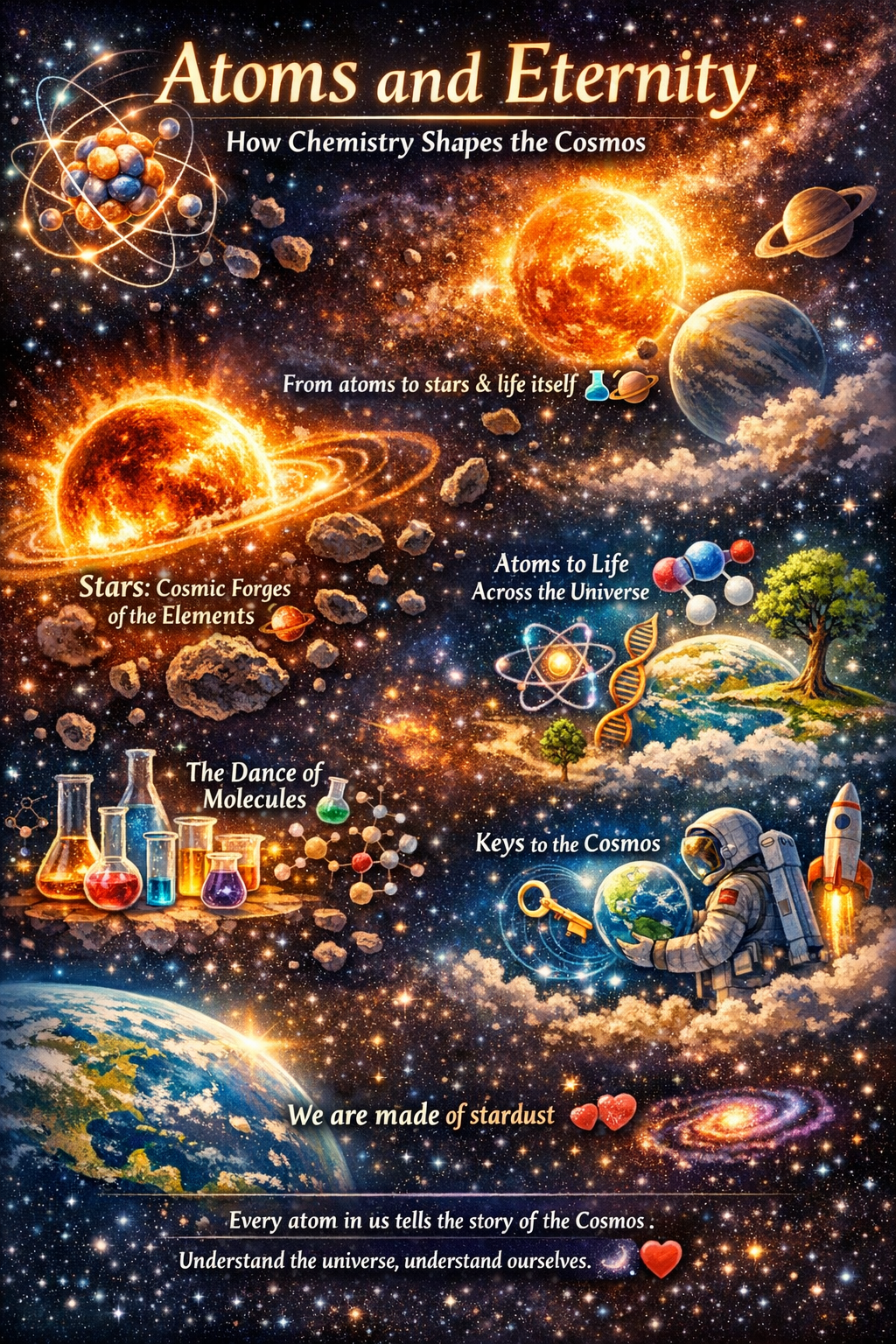
  • ACCL PORTAL DAY 118 TASK STORY POST @Badaruddin Suleman Atoms and Eternity: How Chemistry Shapes the Cosmos

    From the tiniest particles to the vast expanses of space, atoms form the very fabric of our universe. Each atom, composed of protons, neutrons, and electrons, acts like a building block, creating everything from stars and planets to life itself. The laws of chemistry govern how these atoms interact, bond, and transform, giving rise to the incredible diversity we see in the cosmos.

    Stars are not just shining lights; they are cosmic kitchens where atoms are forged. Through nuclear fusion, hydrogen atoms merge to form helium, releasing energy that powers the star and spreads elements across the universe. These elements eventually become part of planets, oceans, and even living beings, connecting every atom in existence to the lifecycle of the cosmos.

    Chemical reactions are the silent artists of the universe, shaping molecules and matter in ways both simple and complex. Water, carbon dioxide, and countless other compounds arise from these interactions, providing the conditions necessary for life. Even the air we breathe and the food we eat are the result of ancient chemical dances performed over billions of years.

    Understanding chemistry is like holding a key to the universe. By studying how atoms behave, scientists can predict cosmic events, create new materials, and even explore possibilities of life beyond Earth. This knowledge reminds us that we are not separate from the universe; we are an expression of its chemistry and eternity.

    Moral: Every atom in us carries the story of the cosmos; by appreciating chemistry, we understand both the universe and ourselves.
    ACCL PORTAL DAY 118 TASK STORY POST @Badaruddin Suleman Atoms and Eternity: How Chemistry Shapes the Cosmos ✨🪐 From the tiniest particles to the vast expanses of space, atoms form the very fabric of our universe. 🧪 Each atom, composed of protons, neutrons, and electrons, acts like a building block, creating everything from stars and planets to life itself. The laws of chemistry govern how these atoms interact, bond, and transform, giving rise to the incredible diversity we see in the cosmos. 🌌 Stars are not just shining lights; they are cosmic kitchens where atoms are forged. 🔥 Through nuclear fusion, hydrogen atoms merge to form helium, releasing energy that powers the star and spreads elements across the universe. These elements eventually become part of planets, oceans, and even living beings, connecting every atom in existence to the lifecycle of the cosmos. 🌟 Chemical reactions are the silent artists of the universe, shaping molecules and matter in ways both simple and complex. 🧬 Water, carbon dioxide, and countless other compounds arise from these interactions, providing the conditions necessary for life. Even the air we breathe and the food we eat are the result of ancient chemical dances performed over billions of years. 🌱 Understanding chemistry is like holding a key to the universe. 🗝️ By studying how atoms behave, scientists can predict cosmic events, create new materials, and even explore possibilities of life beyond Earth. This knowledge reminds us that we are not separate from the universe; we are an expression of its chemistry and eternity. 🌍💫 Moral: Every atom in us carries the story of the cosmos; by appreciating chemistry, we understand both the universe and ourselves. 🌌❤️
    0 Commenti 0 condivisioni 2723 Views

  • https://youtu.be/JAjk_TbGmLs
    #rsisb
    Roll no 159
    Foundation Level Student
    Date: 14 February 2026

    ❝Sorry – Tracing the Roots of Apology❞

    This discussion explores the profound significance behind the simple word “sorry”, tracing its emotional, social, and psychological roots. At first glance, saying sorry seems straightforward, a polite acknowledgment of a mistake, but when examined deeply, it emerges as a powerful act of vulnerability, empathy, and courage that can transform relationships and inner consciousness alike. The conversation examines how apology functions as an invisible bridge connecting human hearts, allowing individuals to acknowledge harm, restore trust, and re-establish shared understanding.

    We delve into how apologies vary across cultures, relationships, and contexts, reflecting differences in social norms, emotional expression, and moral expectations. From the first apology learned as a child to the most profound adult admissions of fault, each instance of saying sorry carries layers of personal growth, humility, and reflection. The discussion also highlights the challenges of apology, including ego, fear, delayed remorse, and self-forgiveness, revealing that true apologies require not only words but presence, sincerity, and often transformative change in behavior.

    Through 50 ultra-deep, reflective questions, this session encourages participants to:

    Explore the emotional anatomy of apology

    Understand the difference between genuine remorse and social obligation

    Recognize apology as a tool for healing, growth, and relational repair

    Examine the interplay between time, memory, and forgiveness

    Reflect on personal experiences of apology and self-forgiveness

    Ultimately, this discussion emphasizes that saying sorry is not just a social convention but a fundamental human practice, shaping emotional memory, fostering empathy, and creating opportunities for reconciliation, personal growth, and relational harmony. By engaging with these questions, participants are invited to experience apology as both an emotional art and a moral philosophy, understanding its power to influence hearts, relationships, and the very fabric of human connection.
    https://youtu.be/JAjk_TbGmLs #rsisb Roll no 159 Foundation Level Student Date: 14 February 2026 ❝Sorry – Tracing the Roots of Apology❞ This discussion explores the profound significance behind the simple word “sorry”, tracing its emotional, social, and psychological roots. At first glance, saying sorry seems straightforward, a polite acknowledgment of a mistake, but when examined deeply, it emerges as a powerful act of vulnerability, empathy, and courage that can transform relationships and inner consciousness alike. The conversation examines how apology functions as an invisible bridge connecting human hearts, allowing individuals to acknowledge harm, restore trust, and re-establish shared understanding. We delve into how apologies vary across cultures, relationships, and contexts, reflecting differences in social norms, emotional expression, and moral expectations. From the first apology learned as a child to the most profound adult admissions of fault, each instance of saying sorry carries layers of personal growth, humility, and reflection. The discussion also highlights the challenges of apology, including ego, fear, delayed remorse, and self-forgiveness, revealing that true apologies require not only words but presence, sincerity, and often transformative change in behavior. Through 50 ultra-deep, reflective questions, this session encourages participants to: Explore the emotional anatomy of apology Understand the difference between genuine remorse and social obligation Recognize apology as a tool for healing, growth, and relational repair Examine the interplay between time, memory, and forgiveness Reflect on personal experiences of apology and self-forgiveness Ultimately, this discussion emphasizes that saying sorry is not just a social convention but a fundamental human practice, shaping emotional memory, fostering empathy, and creating opportunities for reconciliation, personal growth, and relational harmony. By engaging with these questions, participants are invited to experience apology as both an emotional art and a moral philosophy, understanding its power to influence hearts, relationships, and the very fabric of human connection.
    0 Commenti 0 condivisioni 2095 Views
  • Inspired by Sir Rehan Allahwala prompt
    A hyper-realistic portrait of a uploaded lady face 100 percent reserved sitting on a tall black stool in a minimalist studio. She wears a modern charcoal-gray tailored suit with cropped trousers and a structured blazer with a high collar, paired with white sneakers. She sits with arms crossed, leaning slightly forward, looking off-camera with a serious, confident expression. Neutral-toned background enhances focus on the subject. Ultra-detailed fabric textures, realistic lighting, fashion editorial quality
    #gemini
    Inspired by Sir [rehan] prompt A hyper-realistic portrait of a uploaded lady face 100 percent reserved sitting on a tall black stool in a minimalist studio. She wears a modern charcoal-gray tailored suit with cropped trousers and a structured blazer with a high collar, paired with white sneakers. She sits with arms crossed, leaning slightly forward, looking off-camera with a serious, confident expression. Neutral-toned background enhances focus on the subject. Ultra-detailed fabric textures, realistic lighting, fashion editorial quality #gemini
    1
    0 Commenti 0 condivisioni 5092 Views