• #rsisb
    Roll no 159
    Foundation Level Student
    Date: April 4, 2026

    Description: “Air” – Breathing Life into Language

    Air is one of the most basic elements of human existence , yet its role goes far beyond simply keeping us alive. It is the invisible force that gives life to language, turning silent thoughts into spoken words . Every sentence we speak, every emotion we express, and every story we share begins with a single breath. Without air, language would remain locked inside us, unable to reach the world.

    Breathing is not just a physical act; it is deeply connected to how we communicate . The way we control our breath shapes our voice, tone, and clarity. A calm, steady breath creates confident and clear speech, while rapid or uneven breathing can reflect fear, anxiety, or excitement . In this way, air becomes more than a tool—it becomes a mirror of our inner state, revealing emotions even when words try to hide them.

    “Air” also highlights the powerful connection between body and mind . When we speak, our thoughts travel through breath and transform into sound. This process shows how closely language is tied to our physical existence. Even small changes in breath—like a sigh, a whisper, or a pause—can carry deep meaning without the need for complex words . Sometimes, a simple exhale can express more than a long explanation.

    In communication, breath creates rhythm and flow . It determines how fast or slow we speak, where we pause, and how we emphasize certain ideas. Great speakers, singers, and performers understand this and train their breathing to improve their expression . Through controlled breath, they are able to deliver words with power, emotion, and impact, making their message more effective and memorable.

    Moreover, air connects us to others in a subtle but meaningful way . When we speak, our breath carries our voice through space, reaching another person and creating understanding. Even in silence, shared breathing can create a sense of presence and connection. This shows that communication is not only about words but also about the unseen forces that carry them.

    In today’s fast-paced world , we often overlook the importance of breathing. We speak quickly, react instantly, and rarely pause to take a breath. However, learning to control and understand our breath can improve not only our communication but also our emotional balance and self-awareness . It allows us to speak with intention, listen more carefully, and respond more thoughtfully.

    In conclusion, “Air” is the foundation of language and expression . It transforms thoughts into voice, connects emotions with words, and links individuals through communication. By understanding the role of breath, we begin to see language not just as words, but as living expressions carried by the very air we breath


    https://youtu.be/C4pJTCX3Faw
    #rsisb Roll no 159 Foundation Level Student Date: April 4, 2026 Description: “Air” – Breathing Life into Language Air is one of the most basic elements of human existence 🌬️, yet its role goes far beyond simply keeping us alive. It is the invisible force that gives life to language, turning silent thoughts into spoken words 🗣️. Every sentence we speak, every emotion we express, and every story we share begins with a single breath. Without air, language would remain locked inside us, unable to reach the world. Breathing is not just a physical act; it is deeply connected to how we communicate 💭. The way we control our breath shapes our voice, tone, and clarity. A calm, steady breath creates confident and clear speech, while rapid or uneven breathing can reflect fear, anxiety, or excitement 😌😰. In this way, air becomes more than a tool—it becomes a mirror of our inner state, revealing emotions even when words try to hide them. “Air” also highlights the powerful connection between body and mind 🧠. When we speak, our thoughts travel through breath and transform into sound. This process shows how closely language is tied to our physical existence. Even small changes in breath—like a sigh, a whisper, or a pause—can carry deep meaning without the need for complex words 🤫. Sometimes, a simple exhale can express more than a long explanation. In communication, breath creates rhythm and flow 🎶. It determines how fast or slow we speak, where we pause, and how we emphasize certain ideas. Great speakers, singers, and performers understand this and train their breathing to improve their expression 🎤. Through controlled breath, they are able to deliver words with power, emotion, and impact, making their message more effective and memorable. Moreover, air connects us to others in a subtle but meaningful way 🤝. When we speak, our breath carries our voice through space, reaching another person and creating understanding. Even in silence, shared breathing can create a sense of presence and connection. This shows that communication is not only about words but also about the unseen forces that carry them. In today’s fast-paced world ⏳, we often overlook the importance of breathing. We speak quickly, react instantly, and rarely pause to take a breath. However, learning to control and understand our breath can improve not only our communication but also our emotional balance and self-awareness 🌱. It allows us to speak with intention, listen more carefully, and respond more thoughtfully. In conclusion, “Air” is the foundation of language and expression 🌍. It transforms thoughts into voice, connects emotions with words, and links individuals through communication. By understanding the role of breath, we begin to see language not just as words, but as living expressions carried by the very air we breath https://youtu.be/C4pJTCX3Faw
    0 Σχόλια 0 Μοιράστηκε 117 Views

  • #rsisb
    Roll no 159
    Foundation Level Student
    Date: April 4, 2026

    Description: “Air” – Breathing Life into Language

    Air is one of the most basic elements of human existence , yet its role goes far beyond simply keeping us alive. It is the invisible force that gives life to language, turning silent thoughts into spoken words . Every sentence we speak, every emotion we express, and every story we share begins with a single breath. Without air, language would remain locked inside us, unable to reach the world.

    Breathing is not just a physical act; it is deeply connected to how we communicate . The way we control our breath shapes our voice, tone, and clarity. A calm, steady breath creates confident and clear speech, while rapid or uneven breathing can reflect fear, anxiety, or excitement . In this way, air becomes more than a tool—it becomes a mirror of our inner state, revealing emotions even when words try to hide them.

    “Air” also highlights the powerful connection between body and mind . When we speak, our thoughts travel through breath and transform into sound. This process shows how closely language is tied to our physical existence. Even small changes in breath—like a sigh, a whisper, or a pause—can carry deep meaning without the need for complex words . Sometimes, a simple exhale can express more than a long explanation.

    In communication, breath creates rhythm and flow . It determines how fast or slow we speak, where we pause, and how we emphasize certain ideas. Great speakers, singers, and performers understand this and train their breathing to improve their expression . Through controlled breath, they are able to deliver words with power, emotion, and impact, making their message more effective and memorable.

    Moreover, air connects us to others in a subtle but meaningful way . When we speak, our breath carries our voice through space, reaching another person and creating understanding. Even in silence, shared breathing can create a sense of presence and connection. This shows that communication is not only about words but also about the unseen forces that carry them.

    In today’s fast-paced world , we often overlook the importance of breathing. We speak quickly, react instantly, and rarely pause to take a breath. However, learning to control and understand our breath can improve not only our communication but also our emotional balance and self-awareness . It allows us to speak with intention, listen more carefully, and respond more thoughtfully.

    In conclusion, “Air” is the foundation of language and expression . It transforms thoughts into voice, connects emotions with words, and links individuals through communication. By understanding the role of breath, we begin to see language not just as words, but as living expressions carried by the very air we breathe.

    Hashtags

    #Air #Breath #Language #Communication #Voice #Expression #MindAndBody #PublicSpeaking #SelfAwareness #DeepThinking #Silence #Speech #HumanConnection #Emotions #Life #Learning #FoundationLevel #RSISB


    https://youtu.be/C4pJTCX3Faw
    #rsisb Roll no 159 Foundation Level Student Date: April 4, 2026 Description: “Air” – Breathing Life into Language Air is one of the most basic elements of human existence 🌬️, yet its role goes far beyond simply keeping us alive. It is the invisible force that gives life to language, turning silent thoughts into spoken words 🗣️. Every sentence we speak, every emotion we express, and every story we share begins with a single breath. Without air, language would remain locked inside us, unable to reach the world. Breathing is not just a physical act; it is deeply connected to how we communicate 💭. The way we control our breath shapes our voice, tone, and clarity. A calm, steady breath creates confident and clear speech, while rapid or uneven breathing can reflect fear, anxiety, or excitement 😌😰. In this way, air becomes more than a tool—it becomes a mirror of our inner state, revealing emotions even when words try to hide them. “Air” also highlights the powerful connection between body and mind 🧠. When we speak, our thoughts travel through breath and transform into sound. This process shows how closely language is tied to our physical existence. Even small changes in breath—like a sigh, a whisper, or a pause—can carry deep meaning without the need for complex words 🤫. Sometimes, a simple exhale can express more than a long explanation. In communication, breath creates rhythm and flow 🎶. It determines how fast or slow we speak, where we pause, and how we emphasize certain ideas. Great speakers, singers, and performers understand this and train their breathing to improve their expression 🎤. Through controlled breath, they are able to deliver words with power, emotion, and impact, making their message more effective and memorable. Moreover, air connects us to others in a subtle but meaningful way 🤝. When we speak, our breath carries our voice through space, reaching another person and creating understanding. Even in silence, shared breathing can create a sense of presence and connection. This shows that communication is not only about words but also about the unseen forces that carry them. In today’s fast-paced world ⏳, we often overlook the importance of breathing. We speak quickly, react instantly, and rarely pause to take a breath. However, learning to control and understand our breath can improve not only our communication but also our emotional balance and self-awareness 🌱. It allows us to speak with intention, listen more carefully, and respond more thoughtfully. In conclusion, “Air” is the foundation of language and expression 🌍. It transforms thoughts into voice, connects emotions with words, and links individuals through communication. By understanding the role of breath, we begin to see language not just as words, but as living expressions carried by the very air we breathe. ✨ Hashtags #Air #Breath #Language #Communication #Voice #Expression #MindAndBody #PublicSpeaking #SelfAwareness #DeepThinking #Silence #Speech #HumanConnection #Emotions #Life #Learning #FoundationLevel #RSISB https://youtu.be/C4pJTCX3Faw
    0 Σχόλια 0 Μοιράστηκε 139 Views
  • #rsisb
    Roll no 159
    Foundation Level Student
    Date: April 4, 2026

    Description: “Air” – Breathing Life into Language

    Air is one of the most basic elements of human existence , yet its role goes far beyond simply keeping us alive. It is the invisible force that gives life to language, turning silent thoughts into spoken words . Every sentence we speak, every emotion we express, and every story we share begins with a single breath. Without air, language would remain locked inside us, unable to reach the world.

    Breathing is not just a physical act; it is deeply connected to how we communicate . The way we control our breath shapes our voice, tone, and clarity. A calm, steady breath creates confident and clear speech, while rapid or uneven breathing can reflect fear, anxiety, or excitement . In this way, air becomes more than a tool—it becomes a mirror of our inner state, revealing emotions even when words try to hide them.

    “Air” also highlights the powerful connection between body and mind . When we speak, our thoughts travel through breath and transform into sound. This process shows how closely language is tied to our physical existence. Even small changes in breath—like a sigh, a whisper, or a pause—can carry deep meaning without the need for complex words . Sometimes, a simple exhale can express more than a long explanation.

    In communication, breath creates rhythm and flow . It determines how fast or slow we speak, where we pause, and how we emphasize certain ideas. Great speakers, singers, and performers understand this and train their breathing to improve their expression . Through controlled breath, they are able to deliver words with power, emotion, and impact, making their message more effective and memorable.

    Moreover, air connects us to others in a subtle but meaningful way . When we speak, our breath carries our voice through space, reaching another person and creating understanding. Even in silence, shared breathing can create a sense of presence and connection. This shows that communication is not only about words but also about the unseen forces that carry them.

    In today’s fast-paced world , we often overlook the importance of breathing. We speak quickly, react instantly, and rarely pause to take a breath. However, learning to control and understand our breath can improve not only our communication but also our emotional balance and self-awareness . It allows us to speak with intention, listen more carefully, and respond more thoughtfully.

    In conclusion, “Air” is the foundation of language and expression . It transforms thoughts into voice, connects emotions with words, and links individuals through communication. By understanding the role of breath, we begin to see language not just as words, but as living expressions carried by the very air we breathe.

    Hashtags

    #Air #Breath #Language #Communication #Voice #Expression #MindAndBody #PublicSpeaking #SelfAwareness #DeepThinking #Silence #Speech #HumanConnection #Emotions #Life #Learning #FoundationLevel #RSISB
    https://youtu.be/C4pJTCX3Faw
    #rsisb Roll no 159 Foundation Level Student Date: April 4, 2026 Description: “Air” – Breathing Life into Language Air is one of the most basic elements of human existence 🌬️, yet its role goes far beyond simply keeping us alive. It is the invisible force that gives life to language, turning silent thoughts into spoken words 🗣️. Every sentence we speak, every emotion we express, and every story we share begins with a single breath. Without air, language would remain locked inside us, unable to reach the world. Breathing is not just a physical act; it is deeply connected to how we communicate 💭. The way we control our breath shapes our voice, tone, and clarity. A calm, steady breath creates confident and clear speech, while rapid or uneven breathing can reflect fear, anxiety, or excitement 😌😰. In this way, air becomes more than a tool—it becomes a mirror of our inner state, revealing emotions even when words try to hide them. “Air” also highlights the powerful connection between body and mind 🧠. When we speak, our thoughts travel through breath and transform into sound. This process shows how closely language is tied to our physical existence. Even small changes in breath—like a sigh, a whisper, or a pause—can carry deep meaning without the need for complex words 🤫. Sometimes, a simple exhale can express more than a long explanation. In communication, breath creates rhythm and flow 🎶. It determines how fast or slow we speak, where we pause, and how we emphasize certain ideas. Great speakers, singers, and performers understand this and train their breathing to improve their expression 🎤. Through controlled breath, they are able to deliver words with power, emotion, and impact, making their message more effective and memorable. Moreover, air connects us to others in a subtle but meaningful way 🤝. When we speak, our breath carries our voice through space, reaching another person and creating understanding. Even in silence, shared breathing can create a sense of presence and connection. This shows that communication is not only about words but also about the unseen forces that carry them. In today’s fast-paced world ⏳, we often overlook the importance of breathing. We speak quickly, react instantly, and rarely pause to take a breath. However, learning to control and understand our breath can improve not only our communication but also our emotional balance and self-awareness 🌱. It allows us to speak with intention, listen more carefully, and respond more thoughtfully. In conclusion, “Air” is the foundation of language and expression 🌍. It transforms thoughts into voice, connects emotions with words, and links individuals through communication. By understanding the role of breath, we begin to see language not just as words, but as living expressions carried by the very air we breathe. ✨ Hashtags #Air #Breath #Language #Communication #Voice #Expression #MindAndBody #PublicSpeaking #SelfAwareness #DeepThinking #Silence #Speech #HumanConnection #Emotions #Life #Learning #FoundationLevel #RSISB https://youtu.be/C4pJTCX3Faw
    0 Σχόλια 0 Μοιράστηκε 139 Views
  • #rsisb
    roll no 163
    song no 2

    Chemical reactions are the invisible forces that shape the world around us, quietly transforming matter and redistributing energy in countless ways every second. At the most fundamental level, a chemical reaction is a process where atoms rearrange themselves by breaking old bonds and forming new ones. This transformation creates entirely new substances with different structures, properties, and behaviors. From the rusting of iron to the digestion of food in our bodies, these reactions define both the physical and biological worlds.

    Energy is at the heart of every chemical reaction. When bonds are broken, energy is required, and when new bonds are formed, energy is released. This continuous exchange determines whether a reaction is exothermic (releasing energy ) or endothermic (absorbing energy ). These energy changes are not just scientific facts—they reflect a deeper principle of balance in nature. The universe constantly seeks stability, and chemical reactions are one of the ways it achieves equilibrium.

    From a philosophical viewpoint, chemical reactions symbolize transformation and the inevitability of change. Nothing in the universe remains static; everything is in a constant state of becoming something new. Matter is never truly created or destroyed—it simply changes form, following the law of conservation. This idea connects chemistry to broader philosophical questions about existence, identity, and continuity.

    Chemical reactions also reveal the deep interconnectedness of all things. The oxygen we breathe participates in reactions that sustain life, while plants use sunlight to drive photosynthesis, producing the very energy that fuels ecosystems. Even the stars in the universe are giant reactors, fusing elements and releasing energy that travels across space. In this way, chemistry links the microscopic world of atoms to the vastness of the cosmos.

    In everyday life, chemical transformations are everywhere. Cooking food, burning fuel, batteries powering devices, and medicines healing the body—all depend on precise chemical changes. Understanding these reactions empowers us to innovate, solve problems, and improve the quality of life.

    Ultimately, the study of chemical reactions is not just about memorizing equations—it is about understanding the dynamic nature of reality. Every reaction tells a story of change, energy flow, and the constant reshaping of matter. By exploring these processes, we gain a deeper appreciation of the universe and our place within it.


    #Chemistry #ChemicalReactions #EnergyAndMatter #Transformation #ScienceIsLife #Exothermic #Endothermic #Atoms #Molecules #ScientificThinking #STEMEducation #ExploreTheUniverse #NatureConnection #LearningJourney #KnowledgeIsPower #Innovation #ScienceLovers #Curiosity #FutureScientists

    https://youtu.be/24FFf5YuMX8?si=CjqXLJlb0-5T6PVV
    #rsisb roll no 163 song no 2 Chemical reactions are the invisible forces that shape the world around us, quietly transforming matter and redistributing energy in countless ways every second. 🌍⚛️ At the most fundamental level, a chemical reaction is a process where atoms rearrange themselves by breaking old bonds and forming new ones. This transformation creates entirely new substances with different structures, properties, and behaviors. From the rusting of iron to the digestion of food in our bodies, these reactions define both the physical and biological worlds. 🍎🔬 Energy is at the heart of every chemical reaction. ⚡ When bonds are broken, energy is required, and when new bonds are formed, energy is released. This continuous exchange determines whether a reaction is exothermic (releasing energy 🔥) or endothermic (absorbing energy ❄️). These energy changes are not just scientific facts—they reflect a deeper principle of balance in nature. The universe constantly seeks stability, and chemical reactions are one of the ways it achieves equilibrium. ⚖️✨ From a philosophical viewpoint, chemical reactions symbolize transformation and the inevitability of change. 🔄 Nothing in the universe remains static; everything is in a constant state of becoming something new. Matter is never truly created or destroyed—it simply changes form, following the law of conservation. This idea connects chemistry to broader philosophical questions about existence, identity, and continuity. 🌌💭 Chemical reactions also reveal the deep interconnectedness of all things. 🌱 The oxygen we breathe participates in reactions that sustain life, while plants use sunlight to drive photosynthesis, producing the very energy that fuels ecosystems. Even the stars in the universe are giant reactors, fusing elements and releasing energy that travels across space. 🌟🔥 In this way, chemistry links the microscopic world of atoms to the vastness of the cosmos. In everyday life, chemical transformations are everywhere. 🧪 Cooking food, burning fuel, batteries powering devices, and medicines healing the body—all depend on precise chemical changes. Understanding these reactions empowers us to innovate, solve problems, and improve the quality of life. 💡🚀 Ultimately, the study of chemical reactions is not just about memorizing equations—it is about understanding the dynamic nature of reality. Every reaction tells a story of change, energy flow, and the constant reshaping of matter. By exploring these processes, we gain a deeper appreciation of the universe and our place within it. 🌍💫 #Chemistry ⚗️ #ChemicalReactions 🔬 #EnergyAndMatter ⚡ #Transformation 🔄 #ScienceIsLife 🌍 #Exothermic 🔥 #Endothermic ❄️ #Atoms ⚛️ #Molecules 🧪 #ScientificThinking 💭 #STEMEducation 📚 #ExploreTheUniverse 🌌 #NatureConnection 🌱 #LearningJourney 🚀 #KnowledgeIsPower 📖 #Innovation 💡 #ScienceLovers ❤️ #Curiosity 🔍 #FutureScientists 👩‍🔬👨‍🔬 https://youtu.be/24FFf5YuMX8?si=CjqXLJlb0-5T6PVV
    0 Σχόλια 0 Μοιράστηκε 1886 Views
  • #rsisb
    roll no 163
    song no 2

    The relationship of molecules is one of the most fascinating concepts in the field of Chemistry, as it explains how the smallest units of matter come together to form everything we see and experience in our daily lives. From the air we breathe to the food we eat and even the cells in our bodies, molecules play a vital role in shaping the structure and function of all matter.

    A molecule is formed when two or more atoms bond together through a process known as Chemical Bonding. These bonds can be strong or weak, depending on how atoms share or transfer electrons. The most common types include covalent bonds (where electrons are shared) and ionic bonds (where electrons are transferred). This bonding creates stable structures that give substances their unique properties, such as color, texture, and state (solid, liquid, or gas).

    The relationship between molecules goes beyond just bonding—it also includes how molecules interact with each other. Forces like intermolecular attractions determine how substances behave under different conditions. For example, the reason water sticks together and forms droplets is due to these molecular interactions. These relationships are essential in understanding natural phenomena such as evaporation, condensation, and even weather patterns.

    In the human body, molecular relationships are even more complex and important. The process of Photosynthesis in plants and cellular respiration in humans both rely on precise molecular interactions to produce energy. Without these processes, life as we know it would not exist. Molecules like proteins, DNA, and enzymes work together in highly organized ways to support growth, repair, and survival.

    Molecular relationships also drive innovation in science and technology. By understanding how molecules behave, scientists can create new medicines, develop advanced materials, and solve environmental challenges. For example, designing drugs that target specific molecules in the body helps treat diseases more effectively.

    In simple terms, the relationship of molecules is the foundation of everything in the universe. When atoms connect, they form molecules—and when molecules interact, they create systems that support life and the world around us. Understanding these relationships not only helps us learn science but also opens the door to discovering new possibilities for the future.


    #Chemistry #Molecules #Science #ChemicalBonding #Atoms #STEM #Education #Biology #ExploreScience #Knowledge

    https://youtu.be/3PcRtIb7Xfw?si=x5JY_AJBzwfUIiwp
    #rsisb roll no 163 song no 2 The relationship of molecules is one of the most fascinating concepts in the field of Chemistry, as it explains how the smallest units of matter come together to form everything we see and experience in our daily lives. 🌍 From the air we breathe to the food we eat and even the cells in our bodies, molecules play a vital role in shaping the structure and function of all matter. A molecule is formed when two or more atoms bond together through a process known as Chemical Bonding. These bonds can be strong or weak, depending on how atoms share or transfer electrons. The most common types include covalent bonds (where electrons are shared) and ionic bonds (where electrons are transferred). ⚛️✨ This bonding creates stable structures that give substances their unique properties, such as color, texture, and state (solid, liquid, or gas). The relationship between molecules goes beyond just bonding—it also includes how molecules interact with each other. Forces like intermolecular attractions determine how substances behave under different conditions. For example, the reason water sticks together and forms droplets is due to these molecular interactions. 💧 These relationships are essential in understanding natural phenomena such as evaporation, condensation, and even weather patterns. 🌦️ In the human body, molecular relationships are even more complex and important. The process of Photosynthesis in plants and cellular respiration in humans both rely on precise molecular interactions to produce energy. 🧬 Without these processes, life as we know it would not exist. Molecules like proteins, DNA, and enzymes work together in highly organized ways to support growth, repair, and survival. Molecular relationships also drive innovation in science and technology. By understanding how molecules behave, scientists can create new medicines, develop advanced materials, and solve environmental challenges. 🌱 For example, designing drugs that target specific molecules in the body helps treat diseases more effectively. In simple terms, the relationship of molecules is the foundation of everything in the universe. When atoms connect, they form molecules—and when molecules interact, they create systems that support life and the world around us. 💡 Understanding these relationships not only helps us learn science but also opens the door to discovering new possibilities for the future. 🚀 #Chemistry 🧪 #Molecules ⚛️ #Science 🌍 #ChemicalBonding 💫 #Atoms 🔬 #STEM 🚀 #Education 📚 #Biology 🧬 #ExploreScience 🌟 #Knowledge 💡 https://youtu.be/3PcRtIb7Xfw?si=x5JY_AJBzwfUIiwp
    0 Σχόλια 0 Μοιράστηκε 3859 Views
  • How Does Pollution Affect Our Planet?

    Pollution happens when harmful substances like smoke, chemicals, and waste enter the air, water, or land. These pollutants come from factories, cars, plastic waste, and burning fuels. Pollution makes the air dirty, the water unsafe, and the soil unhealthy. When pollution increases, plants and animals struggle to survive, and many natural habitats are damaged.

    Pollution also affects human health and the climate of our planet. Dirty air can cause breathing problems, while polluted water can spread diseases. It also contributes to global warming, which leads to melting ice, rising sea levels, and extreme weather. Reducing pollution by recycling, saving energy, and planting trees can help protect our Earth.
    https://youtu.be/xrMHWKHoLlI
    🌍 How Does Pollution Affect Our Planet? 🌫️ Pollution happens when harmful substances like smoke, chemicals, and waste enter the air, water, or land. 🚗🏭 These pollutants come from factories, cars, plastic waste, and burning fuels. Pollution makes the air dirty, the water unsafe, and the soil unhealthy. 🌫️💧 When pollution increases, plants and animals struggle to survive, and many natural habitats are damaged. Pollution also affects human health and the climate of our planet. 🌡️🌎 Dirty air can cause breathing problems, while polluted water can spread diseases. It also contributes to global warming, which leads to melting ice, rising sea levels, and extreme weather. ❄️🌊🌪️ Reducing pollution by recycling, saving energy, and planting trees can help protect our Earth. 🌱♻️ https://youtu.be/xrMHWKHoLlI
    0 Σχόλια 0 Μοιράστηκε 900 Views
  • What Happens in Our Body When We Exercise?

    When we exercise, our body becomes very active and starts working harder! Many amazing changes happen inside us.

    First, our heart beats faster to pump more blood. Blood carries oxygen to our muscles so they can work properly.

    Second, our breathing becomes faster because our body needs more oxygen. Our lungs work harder to bring in fresh air.

    Our muscles move and stretch . Tiny muscle fibers work together, and over time they become stronger and bigger.

    We also burn energy (calories) to fuel our movements. This helps us stay healthy and maintain a good weight.

    When we exercise, our brain releases happy chemicals called endorphins . That is why we often feel good and relaxed after exercise.

    We may sweat to cool down our body because our temperature rises. Sweating helps keep us from overheating.

    Over time, regular exercise makes:

    A stronger heart

    Stronger muscles

    Stronger bones

    Better focus and memory

    Better mood

    Exercise keeps our whole body healthy and active!
    https://youtu.be/636O4Oo2PxU
    🏃‍♀️ What Happens in Our Body When We Exercise? 💪 When we exercise, our body becomes very active and starts working harder! 🚀 Many amazing changes happen inside us. First, our heart beats faster ❤️ to pump more blood. Blood carries oxygen to our muscles so they can work properly. 🩸💨 Second, our breathing becomes faster 🌬️ because our body needs more oxygen. Our lungs work harder to bring in fresh air. 🫁 Our muscles move and stretch 💪🦵. Tiny muscle fibers work together, and over time they become stronger and bigger. We also burn energy (calories) 🔥 to fuel our movements. This helps us stay healthy and maintain a good weight. When we exercise, our brain releases happy chemicals called endorphins 😊🧠. That is why we often feel good and relaxed after exercise. We may sweat 💧 to cool down our body because our temperature rises. Sweating helps keep us from overheating. Over time, regular exercise makes: ❤️ A stronger heart 💪 Stronger muscles 🦴 Stronger bones 🧠 Better focus and memory 😄 Better mood Exercise keeps our whole body healthy and active! 🌟 https://youtu.be/636O4Oo2PxU
    0 Σχόλια 0 Μοιράστηκε 856 Views
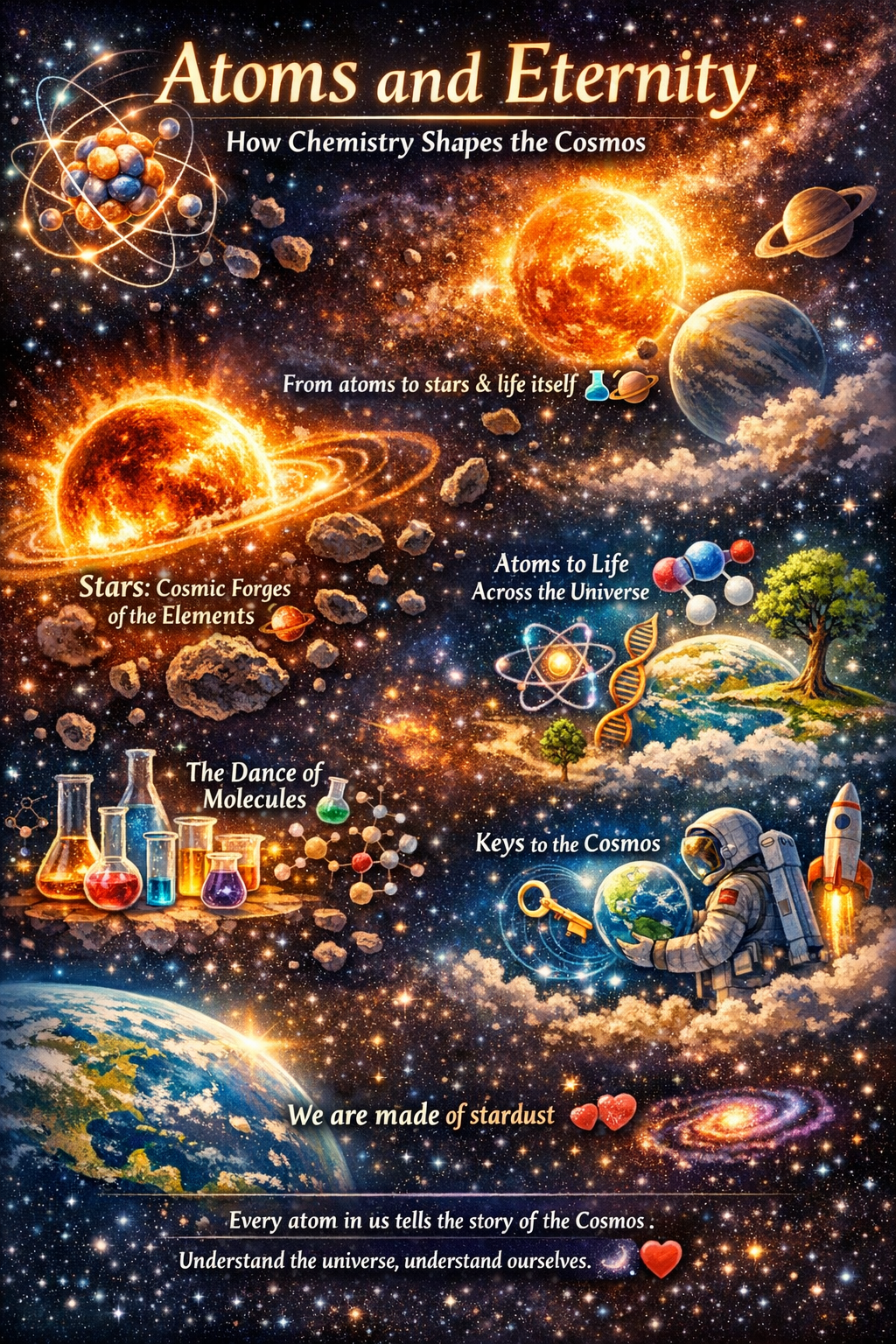
  • ACCL PORTAL DAY 118 TASK STORY POST @Badaruddin Suleman Atoms and Eternity: How Chemistry Shapes the Cosmos

    From the tiniest particles to the vast expanses of space, atoms form the very fabric of our universe. Each atom, composed of protons, neutrons, and electrons, acts like a building block, creating everything from stars and planets to life itself. The laws of chemistry govern how these atoms interact, bond, and transform, giving rise to the incredible diversity we see in the cosmos.

    Stars are not just shining lights; they are cosmic kitchens where atoms are forged. Through nuclear fusion, hydrogen atoms merge to form helium, releasing energy that powers the star and spreads elements across the universe. These elements eventually become part of planets, oceans, and even living beings, connecting every atom in existence to the lifecycle of the cosmos.

    Chemical reactions are the silent artists of the universe, shaping molecules and matter in ways both simple and complex. Water, carbon dioxide, and countless other compounds arise from these interactions, providing the conditions necessary for life. Even the air we breathe and the food we eat are the result of ancient chemical dances performed over billions of years.

    Understanding chemistry is like holding a key to the universe. By studying how atoms behave, scientists can predict cosmic events, create new materials, and even explore possibilities of life beyond Earth. This knowledge reminds us that we are not separate from the universe; we are an expression of its chemistry and eternity.

    Moral: Every atom in us carries the story of the cosmos; by appreciating chemistry, we understand both the universe and ourselves.
    ACCL PORTAL DAY 118 TASK STORY POST @Badaruddin Suleman Atoms and Eternity: How Chemistry Shapes the Cosmos ✨🪐 From the tiniest particles to the vast expanses of space, atoms form the very fabric of our universe. 🧪 Each atom, composed of protons, neutrons, and electrons, acts like a building block, creating everything from stars and planets to life itself. The laws of chemistry govern how these atoms interact, bond, and transform, giving rise to the incredible diversity we see in the cosmos. 🌌 Stars are not just shining lights; they are cosmic kitchens where atoms are forged. 🔥 Through nuclear fusion, hydrogen atoms merge to form helium, releasing energy that powers the star and spreads elements across the universe. These elements eventually become part of planets, oceans, and even living beings, connecting every atom in existence to the lifecycle of the cosmos. 🌟 Chemical reactions are the silent artists of the universe, shaping molecules and matter in ways both simple and complex. 🧬 Water, carbon dioxide, and countless other compounds arise from these interactions, providing the conditions necessary for life. Even the air we breathe and the food we eat are the result of ancient chemical dances performed over billions of years. 🌱 Understanding chemistry is like holding a key to the universe. 🗝️ By studying how atoms behave, scientists can predict cosmic events, create new materials, and even explore possibilities of life beyond Earth. This knowledge reminds us that we are not separate from the universe; we are an expression of its chemistry and eternity. 🌍💫 Moral: Every atom in us carries the story of the cosmos; by appreciating chemistry, we understand both the universe and ourselves. 🌌❤️
    0 Σχόλια 0 Μοιράστηκε 2722 Views
  • #rsisb
    Story Post No 111
    Roll No 58
    When the world grows quiet and the sky turns dark, the night reveals its most beautiful stories. Stellar Stories: Navigating the Night Sky is an invitation to slow down, look up, and reconnect with the universe above us. From sparkling constellations to the gentle glow of the moon, every star has a story waiting to be discovered.

    The night sky reminds us how vast the universe is and how small yet meaningful our place within it can be. As we trace patterns among the stars and learn to navigate the heavens, we also find clarity, wonder, and inspiration within ourselves. Whether you’re a passionate stargazer or simply someone who enjoys peaceful moments under the stars, this journey through the cosmos encourages curiosity, imagination, and reflection.

    Take a moment tonight to step outside, breathe deeply, and let the stars guide your thoughts. The universe has been telling stories for billions of years—are you ready to listen?

    Hashtags:
    #StellarStories #NightSky #Stargazing #CosmicJourney #UniverseWonder #StarLovers #AstronomyLife #CelestialBeauty #ExploreTheSky #NightVibes #LookUp #SpaceInspiration

    Emojis:
    #rsisb Story Post No 111 Roll No 58 When the world grows quiet and the sky turns dark, the night reveals its most beautiful stories. Stellar Stories: Navigating the Night Sky is an invitation to slow down, look up, and reconnect with the universe above us. From sparkling constellations to the gentle glow of the moon, every star has a story waiting to be discovered. The night sky reminds us how vast the universe is and how small yet meaningful our place within it can be. As we trace patterns among the stars and learn to navigate the heavens, we also find clarity, wonder, and inspiration within ourselves. Whether you’re a passionate stargazer or simply someone who enjoys peaceful moments under the stars, this journey through the cosmos encourages curiosity, imagination, and reflection. Take a moment tonight to step outside, breathe deeply, and let the stars guide your thoughts. The universe has been telling stories for billions of years—are you ready to listen? Hashtags: #StellarStories #NightSky #Stargazing #CosmicJourney #UniverseWonder #StarLovers #AstronomyLife #CelestialBeauty #ExploreTheSky #NightVibes #LookUp #SpaceInspiration Emojis: 🌌✨🌙⭐🔭🧭💫🌠📖🚀
    0 Σχόλια 0 Μοιράστηκε 9421 Views
  • #rsisb
    Roll No 138
    story No 20

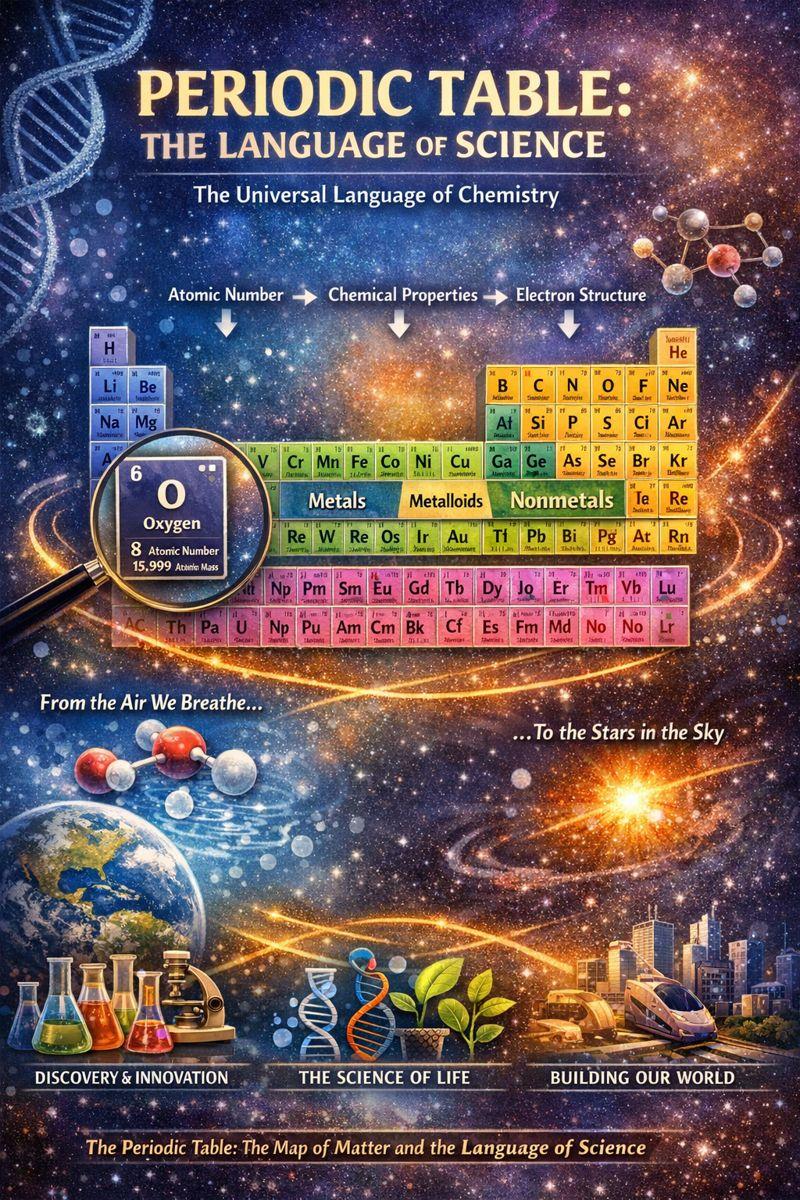
    Periodic Table: The Language of Science

    The periodic table is often called the language of science because it organizes all known chemical elements in a clear, logical system that scientists around the world understand and use. Just like letters form words and sentences, elements in the periodic table combine to form everything in the universe—from the air we breathe to the stars in the sky.

    This powerful table arranges elements by their atomic number, chemical properties, and electron structure, revealing patterns that help scientists predict how elements will react with each other. Metals, non-metals, and metalloids each have their own place, making the table a map of matter itself.

    More than just a chart, the periodic table tells a story of discovery, innovation, and human curiosity. It helps students learn the basics of chemistry, supports researchers in creating new materials and medicines, and connects physics, biology, and environmental science under one universal system.

    In short, the periodic table is not just a scientific tool—it is a universal language that explains how the world is built, how it changes, and how we can understand it.
    #rsisb Roll No 138 story No 20 🧪 Periodic Table: The Language of Science The periodic table is often called the language of science because it organizes all known chemical elements in a clear, logical system that scientists around the world understand and use. Just like letters form words and sentences, elements in the periodic table combine to form everything in the universe—from the air we breathe to the stars in the sky. This powerful table arranges elements by their atomic number, chemical properties, and electron structure, revealing patterns that help scientists predict how elements will react with each other. Metals, non-metals, and metalloids each have their own place, making the table a map of matter itself. More than just a chart, the periodic table tells a story of discovery, innovation, and human curiosity. It helps students learn the basics of chemistry, supports researchers in creating new materials and medicines, and connects physics, biology, and environmental science under one universal system. In short, the periodic table is not just a scientific tool—it is a universal language that explains how the world is built, how it changes, and how we can understand it. 🌍✨
    1
    0 Σχόλια 0 Μοιράστηκε 2510 Views
Αναζήτηση αποτελεσμάτων