• #rsisb
    roll no 163
    song no 2

    Chemical reactions are the invisible forces that shape the world around us, quietly transforming matter and redistributing energy in countless ways every second. At the most fundamental level, a chemical reaction is a process where atoms rearrange themselves by breaking old bonds and forming new ones. This transformation creates entirely new substances with different structures, properties, and behaviors. From the rusting of iron to the digestion of food in our bodies, these reactions define both the physical and biological worlds.

    Energy is at the heart of every chemical reaction. When bonds are broken, energy is required, and when new bonds are formed, energy is released. This continuous exchange determines whether a reaction is exothermic (releasing energy ) or endothermic (absorbing energy ). These energy changes are not just scientific facts—they reflect a deeper principle of balance in nature. The universe constantly seeks stability, and chemical reactions are one of the ways it achieves equilibrium.

    From a philosophical viewpoint, chemical reactions symbolize transformation and the inevitability of change. Nothing in the universe remains static; everything is in a constant state of becoming something new. Matter is never truly created or destroyed—it simply changes form, following the law of conservation. This idea connects chemistry to broader philosophical questions about existence, identity, and continuity.

    Chemical reactions also reveal the deep interconnectedness of all things. The oxygen we breathe participates in reactions that sustain life, while plants use sunlight to drive photosynthesis, producing the very energy that fuels ecosystems. Even the stars in the universe are giant reactors, fusing elements and releasing energy that travels across space. In this way, chemistry links the microscopic world of atoms to the vastness of the cosmos.

    In everyday life, chemical transformations are everywhere. Cooking food, burning fuel, batteries powering devices, and medicines healing the body—all depend on precise chemical changes. Understanding these reactions empowers us to innovate, solve problems, and improve the quality of life.

    Ultimately, the study of chemical reactions is not just about memorizing equations—it is about understanding the dynamic nature of reality. Every reaction tells a story of change, energy flow, and the constant reshaping of matter. By exploring these processes, we gain a deeper appreciation of the universe and our place within it.


    #Chemistry #ChemicalReactions #EnergyAndMatter #Transformation #ScienceIsLife #Exothermic #Endothermic #Atoms #Molecules #ScientificThinking #STEMEducation #ExploreTheUniverse #NatureConnection #LearningJourney #KnowledgeIsPower #Innovation #ScienceLovers #Curiosity #FutureScientists

    https://youtu.be/24FFf5YuMX8?si=CjqXLJlb0-5T6PVV

    #rsisb roll no 163 song no 2 Chemical reactions are the invisible forces that shape the world around us, quietly transforming matter and redistributing energy in countless ways every second. 🌍⚛️ At the most fundamental level, a chemical reaction is a process where atoms rearrange themselves by breaking old bonds and forming new ones. This transformation creates entirely new substances with different structures, properties, and behaviors. From the rusting of iron to the digestion of food in our bodies, these reactions define both the physical and biological worlds. 🍎🔬 Energy is at the heart of every chemical reaction. ⚡ When bonds are broken, energy is required, and when new bonds are formed, energy is released. This continuous exchange determines whether a reaction is exothermic (releasing energy 🔥) or endothermic (absorbing energy ❄️). These energy changes are not just scientific facts—they reflect a deeper principle of balance in nature. The universe constantly seeks stability, and chemical reactions are one of the ways it achieves equilibrium. ⚖️✨ From a philosophical viewpoint, chemical reactions symbolize transformation and the inevitability of change. 🔄 Nothing in the universe remains static; everything is in a constant state of becoming something new. Matter is never truly created or destroyed—it simply changes form, following the law of conservation. This idea connects chemistry to broader philosophical questions about existence, identity, and continuity. 🌌💭 Chemical reactions also reveal the deep interconnectedness of all things. 🌱 The oxygen we breathe participates in reactions that sustain life, while plants use sunlight to drive photosynthesis, producing the very energy that fuels ecosystems. Even the stars in the universe are giant reactors, fusing elements and releasing energy that travels across space. 🌟🔥 In this way, chemistry links the microscopic world of atoms to the vastness of the cosmos. In everyday life, chemical transformations are everywhere. 🧪 Cooking food, burning fuel, batteries powering devices, and medicines healing the body—all depend on precise chemical changes. Understanding these reactions empowers us to innovate, solve problems, and improve the quality of life. 💡🚀 Ultimately, the study of chemical reactions is not just about memorizing equations—it is about understanding the dynamic nature of reality. Every reaction tells a story of change, energy flow, and the constant reshaping of matter. By exploring these processes, we gain a deeper appreciation of the universe and our place within it. 🌍💫 #Chemistry ⚗️ #ChemicalReactions 🔬 #EnergyAndMatter ⚡ #Transformation 🔄 #ScienceIsLife 🌍 #Exothermic 🔥 #Endothermic ❄️ #Atoms ⚛️ #Molecules 🧪 #ScientificThinking 💭 #STEMEducation 📚 #ExploreTheUniverse 🌌 #NatureConnection 🌱 #LearningJourney 🚀 #KnowledgeIsPower 📖 #Innovation 💡 #ScienceLovers ❤️ #Curiosity 🔍 #FutureScientists 👩‍🔬👨‍🔬 https://youtu.be/24FFf5YuMX8?si=CjqXLJlb0-5T6PVV
    0 Kommentare 0 Anteile 976 Ansichten
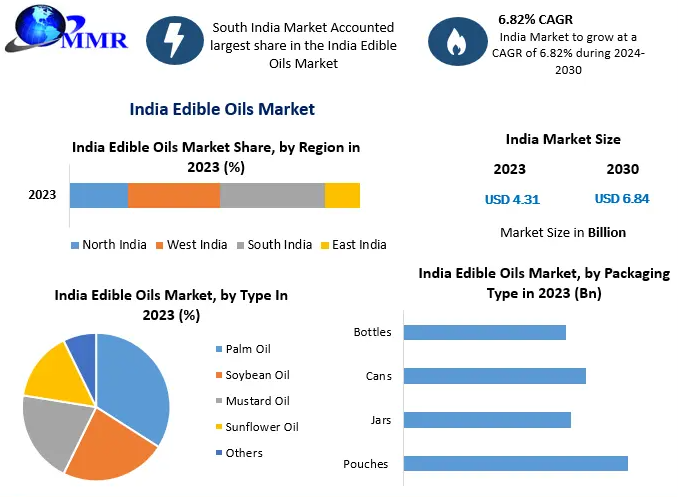
  • The India Edible Oils Market continues to demonstrate robust expansion, supported by evolving dietary habits, rising population, and increasing awareness of health and nutrition. According to recent industry analysis, the market was valued at US$ 4.31 billion in 2023 and is projected to grow at a compound annual growth rate (CAGR) of 6.82% from 2024 to 2030, reaching nearly US$ 6.84 billion by 2030. This growth trajectory reflects both structural demand fundamentals and ongoing transformation across production, processing, and consumption patterns in the country.

    Download Sample Pages of Research Overview: https://www.maximizemarketresearch.com/request-sample/125654/

    Market Overview
    Edible oils form a critical component of India’s agricultural and food processing ecosystem. The country is among the leading producers of oilseeds globally, cultivating a diverse range of crops such as groundnut, soybean, rapeseed, sunflower, sesame, and castor across its varied agro-climatic zones. Coconut and oil palm cultivation also contribute significantly, particularly in southern and coastal regions.

    Market Size and Growth Dynamics
    India’s edible oils market has witnessed consistent expansion over the past decade, driven by population growth, urbanization, and rising disposable incomes. Per capita consumption has increased significantly—from approximately 15 kg per year in 2012–13 to around 19 kg per year in 2015–16—indicating a steady rise in household usage.

    Download Sample Pages of Research Overview: https://www.maximizemarketresearch.com/request-sample/125654/

    Consumer Trends and Segment Share
    Consumer preferences in the edible oils market are evolving rapidly, influenced by health awareness, lifestyle changes, and product innovation. There is a noticeable shift toward oils perceived as healthier, such as soybean, sunflower, and rice bran oil. Rice bran oil, in particular, is gaining traction among urban consumers due to its potential health benefits, including cholesterol management and reduced risk of cardiovascular diseases.

    The market is broadly segmented into refined oils, raw oils, and vanaspati. Refined oils dominate the market with an estimated 60% share, followed by raw oils at 35%, and vanaspati at around 5%. The dominance of refined oils is attributed to their longer shelf life, improved quality, and growing consumer preference for convenience and safety.

    Urbanization and the expansion of organized retail have also played a crucial role in shaping consumption patterns. Supermarkets and hypermarkets, along with e-commerce platforms, are becoming increasingly important distribution channels, offering a wide variety of branded and value-added products.

    Government Initiatives and Import Dependence
    India’s edible oils sector is heavily reliant on imports, with approximately 56% of domestic demand met through imports. In 2019 alone, the country imported around 15 million tonnes of edible oils, accounting for a significant portion of the agricultural import bill. Palm oil constitutes the largest share of imports at about 62%, followed by soybean oil (21%) and sunflower oil (16%).

    To reduce import dependence and enhance self-sufficiency, the government has introduced several initiatives aimed at boosting domestic production. These include promoting oilseed cultivation, encouraging the adoption of high-yielding seed varieties, and expanding oil palm plantations, particularly in states such as Andhra Pradesh, Karnataka, Tamil Nadu, and the northeastern region.

    Download Sample Pages of Research Overview: https://www.maximizemarketresearch.com/request-sample/125654/

    Key Market Players and Competitive Landscape

    Prominent players in the market include Ruchi Soya Industries Ltd, Gokul Agro Resources Ltd., Gujarat Ambuja Exports Ltd., BCL Industries Ltd., Agro Tech Foods Ltd., and Anik Industries Ltd. These companies are actively engaged in refining, processing, and marketing a wide range of edible oil products.

    In addition to these, well-known consumer brands such as Fortune (Adani Group), Sundrop (Agro Tech Foods), Dhara (Mother Dairy), and Dalda (Bunge Limited) have a strong presence in the retail segment. Global players like Cargill also play a significant role, offering multiple brands including Gemini, Nature Fresh, and Sweekar.

    Connect With Us:

    MAXIMIZE MARKET RESEARCH PVT. LTD.
    2nd Floor, Navale IT park Phase 3,
    Pune Banglore Highway, Narhe
    Pune, Maharashtra 411041, India.
    +91 9607365656
    sales@maximizemarketresearch.com

    About Maximize Market Research:

    Maximize Market Research is one of the fastest-growing market research and business consulting firms serving clients globally. Our revenue impact and focused growth-driven research initiatives make us a proud partner of majority of the Fortune 500 companies. We have a diversified portfolio and serve a variety of industries such as IT & telecom, chemical, food & beverage, aerospace & defense, healthcare and others.
    The India Edible Oils Market continues to demonstrate robust expansion, supported by evolving dietary habits, rising population, and increasing awareness of health and nutrition. According to recent industry analysis, the market was valued at US$ 4.31 billion in 2023 and is projected to grow at a compound annual growth rate (CAGR) of 6.82% from 2024 to 2030, reaching nearly US$ 6.84 billion by 2030. This growth trajectory reflects both structural demand fundamentals and ongoing transformation across production, processing, and consumption patterns in the country. Download Sample Pages of Research Overview: https://www.maximizemarketresearch.com/request-sample/125654/ Market Overview Edible oils form a critical component of India’s agricultural and food processing ecosystem. The country is among the leading producers of oilseeds globally, cultivating a diverse range of crops such as groundnut, soybean, rapeseed, sunflower, sesame, and castor across its varied agro-climatic zones. Coconut and oil palm cultivation also contribute significantly, particularly in southern and coastal regions. Market Size and Growth Dynamics India’s edible oils market has witnessed consistent expansion over the past decade, driven by population growth, urbanization, and rising disposable incomes. Per capita consumption has increased significantly—from approximately 15 kg per year in 2012–13 to around 19 kg per year in 2015–16—indicating a steady rise in household usage. Download Sample Pages of Research Overview: https://www.maximizemarketresearch.com/request-sample/125654/ Consumer Trends and Segment Share Consumer preferences in the edible oils market are evolving rapidly, influenced by health awareness, lifestyle changes, and product innovation. There is a noticeable shift toward oils perceived as healthier, such as soybean, sunflower, and rice bran oil. Rice bran oil, in particular, is gaining traction among urban consumers due to its potential health benefits, including cholesterol management and reduced risk of cardiovascular diseases. The market is broadly segmented into refined oils, raw oils, and vanaspati. Refined oils dominate the market with an estimated 60% share, followed by raw oils at 35%, and vanaspati at around 5%. The dominance of refined oils is attributed to their longer shelf life, improved quality, and growing consumer preference for convenience and safety. Urbanization and the expansion of organized retail have also played a crucial role in shaping consumption patterns. Supermarkets and hypermarkets, along with e-commerce platforms, are becoming increasingly important distribution channels, offering a wide variety of branded and value-added products. Government Initiatives and Import Dependence India’s edible oils sector is heavily reliant on imports, with approximately 56% of domestic demand met through imports. In 2019 alone, the country imported around 15 million tonnes of edible oils, accounting for a significant portion of the agricultural import bill. Palm oil constitutes the largest share of imports at about 62%, followed by soybean oil (21%) and sunflower oil (16%). To reduce import dependence and enhance self-sufficiency, the government has introduced several initiatives aimed at boosting domestic production. These include promoting oilseed cultivation, encouraging the adoption of high-yielding seed varieties, and expanding oil palm plantations, particularly in states such as Andhra Pradesh, Karnataka, Tamil Nadu, and the northeastern region. Download Sample Pages of Research Overview: https://www.maximizemarketresearch.com/request-sample/125654/ Key Market Players and Competitive Landscape Prominent players in the market include Ruchi Soya Industries Ltd, Gokul Agro Resources Ltd., Gujarat Ambuja Exports Ltd., BCL Industries Ltd., Agro Tech Foods Ltd., and Anik Industries Ltd. These companies are actively engaged in refining, processing, and marketing a wide range of edible oil products. In addition to these, well-known consumer brands such as Fortune (Adani Group), Sundrop (Agro Tech Foods), Dhara (Mother Dairy), and Dalda (Bunge Limited) have a strong presence in the retail segment. Global players like Cargill also play a significant role, offering multiple brands including Gemini, Nature Fresh, and Sweekar. Connect With Us: MAXIMIZE MARKET RESEARCH PVT. LTD. 2nd Floor, Navale IT park Phase 3, Pune Banglore Highway, Narhe Pune, Maharashtra 411041, India. +91 9607365656 sales@maximizemarketresearch.com About Maximize Market Research: Maximize Market Research is one of the fastest-growing market research and business consulting firms serving clients globally. Our revenue impact and focused growth-driven research initiatives make us a proud partner of majority of the Fortune 500 companies. We have a diversified portfolio and serve a variety of industries such as IT & telecom, chemical, food & beverage, aerospace & defense, healthcare and others.
    0 Kommentare 0 Anteile 2559 Ansichten
  • Wafer Fab Equipment (WFE) Market to Reach USD 138250 Million by 2034 as Advanced Semiconductor Manufacturing Scales
    Global Wafer Fab Equipment (WFE) Market was valued at 87310 million in 2023 and is projected to reach 138250 million USD by 2030, registering a CAGR of 7.5% during the forecast period 2026–2034. The market is on a sustained growth trajectory, driven by rising semiconductor demand, advanced node migration, and increasing automation across wafer fabrication facilities.
    Wafer Fab Equipment (WFE) refers to the specialized machinery used in front-end semiconductor manufacturing, covering more than 50 equipment models across multiple process steps. These systems enable the transformation of silicon wafers into integrated circuits through lithography, etching, deposition, ion implantation, polishing, cleaning, inspection, and thermal processing.
    Access the complete industry analysis and demand forecasts here:
    https://semiconductorinsight.com/report/wafer-fab-equipment-wfe-market/
    Wafer Fab Equipment (WFE) Market to Reach USD 138250 Million by 2034 as Advanced Semiconductor Manufacturing Scales Global Wafer Fab Equipment (WFE) Market was valued at 87310 million in 2023 and is projected to reach 138250 million USD by 2030, registering a CAGR of 7.5% during the forecast period 2026–2034. The market is on a sustained growth trajectory, driven by rising semiconductor demand, advanced node migration, and increasing automation across wafer fabrication facilities. Wafer Fab Equipment (WFE) refers to the specialized machinery used in front-end semiconductor manufacturing, covering more than 50 equipment models across multiple process steps. These systems enable the transformation of silicon wafers into integrated circuits through lithography, etching, deposition, ion implantation, polishing, cleaning, inspection, and thermal processing. 👉 Access the complete industry analysis and demand forecasts here: https://semiconductorinsight.com/report/wafer-fab-equipment-wfe-market/
    Wafer Fab Equipment (WFE) Market, Global Outlook and Forecast 2025-2032
    0 Kommentare 0 Anteile 902 Ansichten
  • Analog and Mixed Signal Device Market to Reach USD 68,260 Million by 2034 as IoT and Automotive Electronics Sustain
    Global Analog and Mixed Signal Device Market was valued at USD 55,660 million in 2025 and is projected to reach USD 68,260 million by 2033, exhibiting a CAGR of 3.0% during the forecast period 2026–2034. The market reflects stable expansion, supported by sustained demand from consumer electronics, automotive transformation, and telecom infrastructure upgrades.
    Analog and mixed signal devices serve as essential semiconductor components that translate real-world physical inputs into digital signals for processing. These devices regulate parameters such as temperature, sound, voltage, and current while integrating analog and digital functions on a single chip. Unlike purely digital semiconductors, mixed-signal solutions enable seamless interaction between electronic systems and their operating environments.
    Access the complete industry analysis and demand forecasts here:
    https://semiconductorinsight.com/report/analog-and-mixed-signal-device-market/
    Analog and Mixed Signal Device Market to Reach USD 68,260 Million by 2034 as IoT and Automotive Electronics Sustain Global Analog and Mixed Signal Device Market was valued at USD 55,660 million in 2025 and is projected to reach USD 68,260 million by 2033, exhibiting a CAGR of 3.0% during the forecast period 2026–2034. The market reflects stable expansion, supported by sustained demand from consumer electronics, automotive transformation, and telecom infrastructure upgrades. Analog and mixed signal devices serve as essential semiconductor components that translate real-world physical inputs into digital signals for processing. These devices regulate parameters such as temperature, sound, voltage, and current while integrating analog and digital functions on a single chip. Unlike purely digital semiconductors, mixed-signal solutions enable seamless interaction between electronic systems and their operating environments. 👉 Access the complete industry analysis and demand forecasts here: https://semiconductorinsight.com/report/analog-and-mixed-signal-device-market/
    Analog and Mixed Signal Device Market, Global Business Strategies 2026-2033
    0 Kommentare 0 Anteile 670 Ansichten
  • Will Digital Transformation and Sustainability Initiatives Propel the Management Consulting Market at a 5.1% CAGR?
    According to a new report from Intel Market Research, the global Management Consulting Services market was valued at USD 160,900 million in 2026 and is projected to reach USD 225,890 million by 2034, growing at a notable CAGR of 5.1% during the forecast period (2025–2032). This sustained expansion is driven by the pervasive need for expert guidance in navigating business complexities, the accelerating demand for digital transformation initiatives, and an increasing corporate focus on sustainability and regulatory compliance that demands specialized advisory support.
    https://www.intelmarketresearch.com/download-free-sample/15434/management-consulting-services-market
    Will Digital Transformation and Sustainability Initiatives Propel the Management Consulting Market at a 5.1% CAGR? According to a new report from Intel Market Research, the global Management Consulting Services market was valued at USD 160,900 million in 2026 and is projected to reach USD 225,890 million by 2034, growing at a notable CAGR of 5.1% during the forecast period (2025–2032). This sustained expansion is driven by the pervasive need for expert guidance in navigating business complexities, the accelerating demand for digital transformation initiatives, and an increasing corporate focus on sustainability and regulatory compliance that demands specialized advisory support. https://www.intelmarketresearch.com/download-free-sample/15434/management-consulting-services-market
    0 Kommentare 0 Anteile 1630 Ansichten
  • ACCL PORTAL DAY 125 TASK STORY POST @Badaruddin Chai wala Why Frogs? Understanding the Anatomy of Life

    Frogs are small, colorful creatures that live both in water and on land. Their bodies are built perfectly for this dual life: webbed feet for swimming, strong legs for jumping, and a long sticky tongue for catching insects. This shows how nature designs each being to survive and thrive in its environment.

    The life of a frog is a journey of change. From tiny eggs in a pond to tadpoles swimming freely, and finally to adult frogs leaping on lily pads, they remind us that transformation is a part of life. Change can be uncomfortable, but it often leads to growth and strength.

    Frogs also play an important role in the ecosystem. They eat pests, serve as food for other animals, and indicate a healthy environment. This teaches us that even small creatures have big impacts. Just like frogs, everyone has a role to play in the world around them.

    Finally, frogs inspire us to embrace our surroundings and adapt to challenges. Life may be full of ups and downs, just like the journey from tadpole to frog, but resilience and patience bring rewards.

    Moral: Life is about growth, change, and understanding your role in the world. Embrace every stage, just like a frog does.
    ACCL PORTAL DAY 125 TASK STORY POST @Badaruddin Chai wala Why Frogs? Understanding the Anatomy of Life 🐸🌿 Frogs are small, colorful creatures that live both in water and on land. 🌊🏞️ Their bodies are built perfectly for this dual life: webbed feet for swimming, strong legs for jumping, and a long sticky tongue for catching insects. 🦟 This shows how nature designs each being to survive and thrive in its environment. 🌱 The life of a frog is a journey of change. 🐸➡️🐛 From tiny eggs in a pond to tadpoles swimming freely, and finally to adult frogs leaping on lily pads, they remind us that transformation is a part of life. 🌼 Change can be uncomfortable, but it often leads to growth and strength. 💪 Frogs also play an important role in the ecosystem. 🌏 They eat pests, serve as food for other animals, and indicate a healthy environment. 🍃 This teaches us that even small creatures have big impacts. Just like frogs, everyone has a role to play in the world around them. 🌟 Finally, frogs inspire us to embrace our surroundings and adapt to challenges. 🌦️ Life may be full of ups and downs, just like the journey from tadpole to frog, but resilience and patience bring rewards. 🐸💚 Moral: Life is about growth, change, and understanding your role in the world. Embrace every stage, just like a frog does. 🌱🐸✨
    0 Kommentare 0 Anteile 1228 Ansichten
  • Display IC Market Projected to Hit USD 34.84 Billion by 2032 as OLED Adoption and Automotive Display Revolution Redefine Semiconductor Demand
    global Display IC Market was valued at USD 19.73 billion in 2024 and is projected to reach USD 34.84 billion by 2032, registering a CAGR of 6.9% over the forecast period 2026–2034. Growth is propelled by accelerating OLED penetration across consumer electronics, the automotive digital cockpit transformation, and the emergence of AI-integrated display processing architectures.
    Display ICs are semiconductor components that collectively manage every aspect of modern panel operation. Display Driver ICs convert digital signals into precise pixel voltages; Timing Controllers (TCONs) synchronize data flow between the graphics processor and panel; and Power Management ICs regulate voltage delivery to maximize efficiency and display longevity.
    Access the complete industry analysis and demand forecasts here: https://semiconductorinsight.com/report/global-display-ic-market/
    Display IC Market Projected to Hit USD 34.84 Billion by 2032 as OLED Adoption and Automotive Display Revolution Redefine Semiconductor Demand global Display IC Market was valued at USD 19.73 billion in 2024 and is projected to reach USD 34.84 billion by 2032, registering a CAGR of 6.9% over the forecast period 2026–2034. Growth is propelled by accelerating OLED penetration across consumer electronics, the automotive digital cockpit transformation, and the emergence of AI-integrated display processing architectures. Display ICs are semiconductor components that collectively manage every aspect of modern panel operation. Display Driver ICs convert digital signals into precise pixel voltages; Timing Controllers (TCONs) synchronize data flow between the graphics processor and panel; and Power Management ICs regulate voltage delivery to maximize efficiency and display longevity. 👉 Access the complete industry analysis and demand forecasts here: https://semiconductorinsight.com/report/global-display-ic-market/
    Global Display IC Market Research Report 2025(Status and Outlook)
    0 Kommentare 0 Anteile 1758 Ansichten
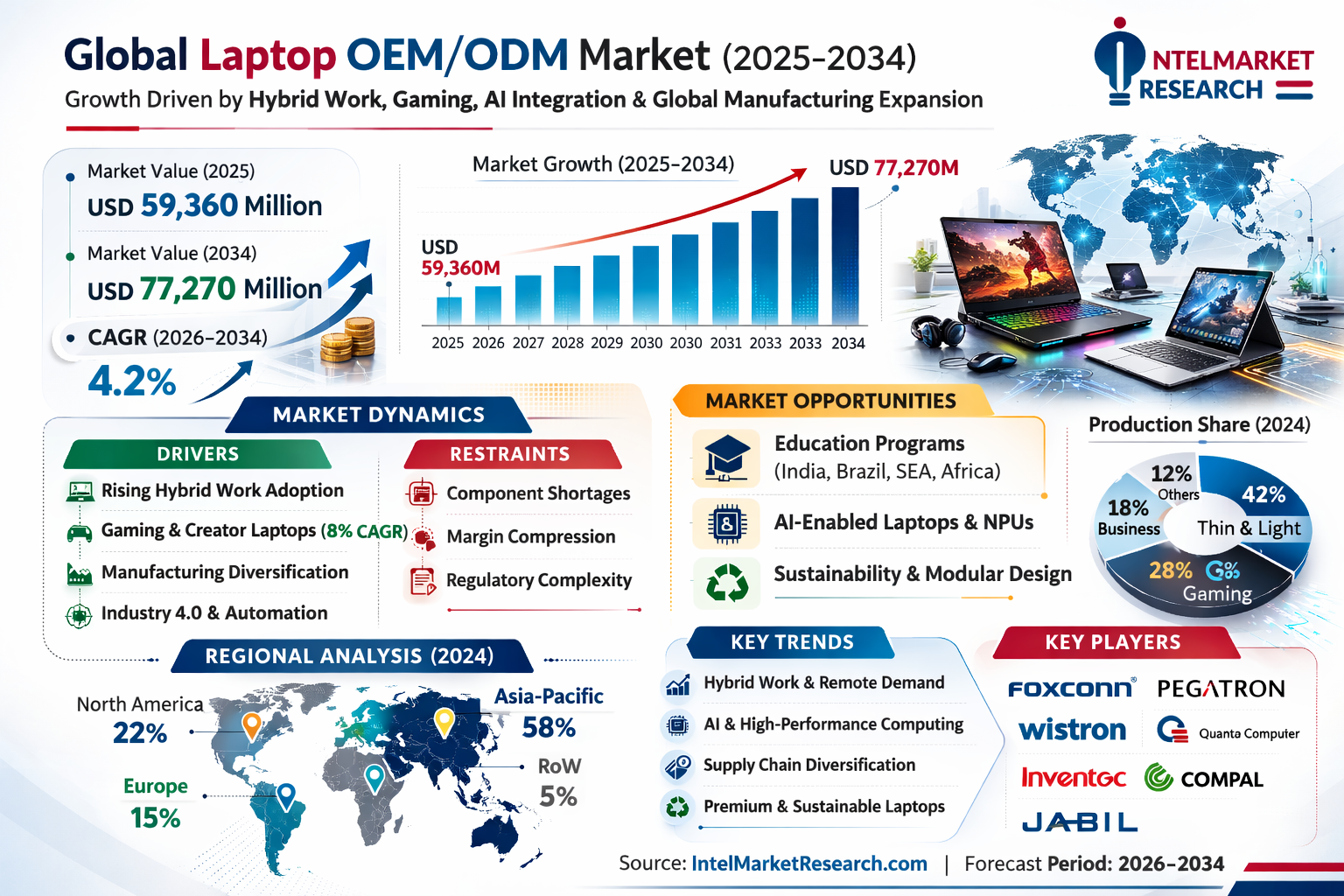
  • How Will Enterprise Digital Transformation Propel the Laptop OEM/ODM Market to USD 77.27 Billion by 2034 at a 4.2% CAGR?
    The global Laptop OEM/ODM market was valued at USD 59,360 million in 2025 and is projected to grow from USD 63,910 million in 2026 to USD 77,270 million by 2034, exhibiting a CAGR of 4.2% during the forecast period (2026–2034).
    Laptop OEM (Original Equipment Manufacturer) and ODM (Original Design Manufacturer) models enable global brands to outsource manufacturing and, in some cases, product design to specialized third-party producers. This structure allows brands to focus on marketing, distribution, and ecosystem development while leveraging large-scale production expertise, supply chain efficiency, and quality control capabilities of dedicated manufacturers.
    As of 2024, thin and light laptops account for approximately 42–45% of total production, while gaming laptops hold around 28% share, reflecting strong demand for portable and high-performance computing devices. Growth is primarily driven by hybrid work adoption, enterprise digital transformation, and expanding education digitization initiatives worldwide.
    Full Report Access:
    http://intelmarketresearch.com/laptop-oemodm-2025-2032-639-4498
    How Will Enterprise Digital Transformation Propel the Laptop OEM/ODM Market to USD 77.27 Billion by 2034 at a 4.2% CAGR? The global Laptop OEM/ODM market was valued at USD 59,360 million in 2025 and is projected to grow from USD 63,910 million in 2026 to USD 77,270 million by 2034, exhibiting a CAGR of 4.2% during the forecast period (2026–2034). Laptop OEM (Original Equipment Manufacturer) and ODM (Original Design Manufacturer) models enable global brands to outsource manufacturing and, in some cases, product design to specialized third-party producers. This structure allows brands to focus on marketing, distribution, and ecosystem development while leveraging large-scale production expertise, supply chain efficiency, and quality control capabilities of dedicated manufacturers. As of 2024, thin and light laptops account for approximately 42–45% of total production, while gaming laptops hold around 28% share, reflecting strong demand for portable and high-performance computing devices. Growth is primarily driven by hybrid work adoption, enterprise digital transformation, and expanding education digitization initiatives worldwide. 🔗 Full Report Access: http://intelmarketresearch.com/laptop-oemodm-2025-2032-639-4498
    0 Kommentare 0 Anteile 2861 Ansichten
  • Is the Optical Transceivers Market Set to Reach USD 11.33 Billion by 2034 at a 7.1% CAGR Amid Rising Data Traffic and 5G Expansion?
    The global optical transceivers market was valued at USD 7.06 billion in 2025 and is projected to reach USD 11.33 billion by 2034, exhibiting a CAGR of 7.1% during the forecast period (2026–2034).
    Optical transceivers, also known as fiber optic transmitters and receivers, are critical networking components that perform photoelectric conversion—transforming electrical signals into optical signals for transmission via fiber optic cables and converting them back into electrical signals at the receiving end. These modules integrate both transmitter and receiver circuitry within a single device, enabling high-speed bidirectional communication across telecommunications networks and data centers.
    The market is experiencing strong growth driven by exponential increases in global data traffic, rapid data center expansion, widespread 5G deployment, and rising adoption of cloud computing, IoT, and AI workloads. The ongoing migration toward 100G, 200G, 400G, 800G, and emerging 1.6T transceivers is further accelerating industry transformation.
    Full Report Access:
    https://www.intelmarketresearch.com/optical-transceivers-market-13887
    Is the Optical Transceivers Market Set to Reach USD 11.33 Billion by 2034 at a 7.1% CAGR Amid Rising Data Traffic and 5G Expansion? The global optical transceivers market was valued at USD 7.06 billion in 2025 and is projected to reach USD 11.33 billion by 2034, exhibiting a CAGR of 7.1% during the forecast period (2026–2034). Optical transceivers, also known as fiber optic transmitters and receivers, are critical networking components that perform photoelectric conversion—transforming electrical signals into optical signals for transmission via fiber optic cables and converting them back into electrical signals at the receiving end. These modules integrate both transmitter and receiver circuitry within a single device, enabling high-speed bidirectional communication across telecommunications networks and data centers. The market is experiencing strong growth driven by exponential increases in global data traffic, rapid data center expansion, widespread 5G deployment, and rising adoption of cloud computing, IoT, and AI workloads. The ongoing migration toward 100G, 200G, 400G, 800G, and emerging 1.6T transceivers is further accelerating industry transformation. 🔗 Full Report Access: https://www.intelmarketresearch.com/optical-transceivers-market-13887
    0 Kommentare 0 Anteile 1048 Ansichten
  • https://youtu.be/0p7kNHxLaVg


    #rsisb
    Roll no 159
    Foundation Level Student
    Date: 19 February 2026

    Description:
    The song “The Story of Elements: From Carbon to Gold” takes listeners on a fascinating journey through the building blocks of the universe. It explores how simple elements like carbon form the foundation of life, while rare elements like gold symbolize beauty, strength, and transformation. The song blends science with emotion, showing how elements created in stars eventually become part of our world and even our bodies. It reflects on the connection between the cosmos and human existence, reminding us that everything in life is made from the same universal matter. With a thoughtful and inspiring theme, the song highlights growth, evolution, and the wonder of creation, encouraging listeners to see life as a grand story written in the language of elements.
    https://youtu.be/0p7kNHxLaVg #rsisb Roll no 159 Foundation Level Student Date: 19 February 2026 Description: The song “The Story of Elements: From Carbon to Gold” takes listeners on a fascinating journey through the building blocks of the universe. It explores how simple elements like carbon form the foundation of life, while rare elements like gold symbolize beauty, strength, and transformation. The song blends science with emotion, showing how elements created in stars eventually become part of our world and even our bodies. It reflects on the connection between the cosmos and human existence, reminding us that everything in life is made from the same universal matter. With a thoughtful and inspiring theme, the song highlights growth, evolution, and the wonder of creation, encouraging listeners to see life as a grand story written in the language of elements.
    0 Kommentare 0 Anteile 1063 Ansichten
Suchergebnis