• ACCL PORTAL DAY 153 TASK STORY POST @Badaruddin Chai wala The Force Behind Motion: Understanding Newton’s Laws
    Paragraph 1:
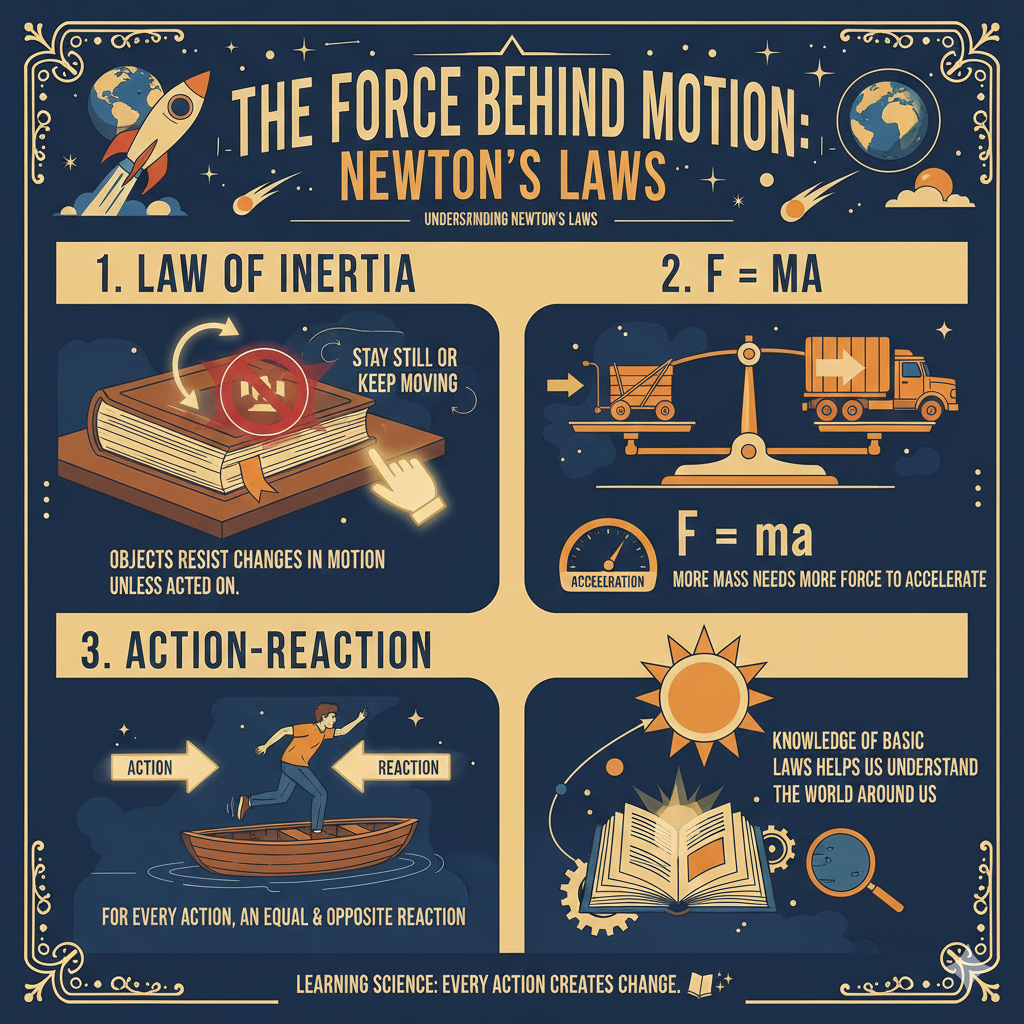
    In the 17th century, the brilliant scientist Isaac Newton introduced three important laws that explain how and why objects move. These laws, known as Newton’s Laws of Motion, help us understand everything from a rolling football to planets orbiting the sun . His discoveries became the foundation of classical physics and are still studied in schools today .
    Paragraph 2:
    The First Law, also called the Law of Inertia, states that an object will remain at rest or continue moving at the same speed and direction unless acted upon by an external force . For example, a book on a table stays still until someone pushes it. This law teaches us that forces are needed to change motion.
    Paragraph 3:
    The Second Law explains that force equals mass times acceleration (F = ma) . This means that heavier objects need more force to move, and stronger forces cause faster acceleration . For instance, pushing a small cart is easier than pushing a heavy truck because the truck has more mass.
    Paragraph 4:
    The Third Law states that for every action, there is an equal and opposite reaction . When you jump off a small boat, you push the boat backward while you move forward . This law shows that forces always come in pairs and interact with one another.
    Moral of the Topic:
    Knowledge of basic laws helps us understand the world around us. Just like Newton discovered the rules behind motion, learning science teaches us that every action has a consequence and every force creates change.
    ACCL PORTAL DAY 153 TASK STORY POST @Badaruddin Chai wala 🌍 The Force Behind Motion: Understanding Newton’s Laws πŸš€ Paragraph 1: In the 17th century, the brilliant scientist Isaac Newton introduced three important laws that explain how and why objects move. These laws, known as Newton’s Laws of Motion, help us understand everything from a rolling football to planets orbiting the sun 🌞. His discoveries became the foundation of classical physics and are still studied in schools today πŸ“š. Paragraph 2: The First Law, also called the Law of Inertia, states that an object will remain at rest or continue moving at the same speed and direction unless acted upon by an external force πŸ›‘βž‘οΈ. For example, a book on a table stays still until someone pushes it. This law teaches us that forces are needed to change motion. Paragraph 3: The Second Law explains that force equals mass times acceleration (F = ma) βš–οΈ. This means that heavier objects need more force to move, and stronger forces cause faster acceleration πŸš—πŸ’¨. For instance, pushing a small cart is easier than pushing a heavy truck because the truck has more mass. Paragraph 4: The Third Law states that for every action, there is an equal and opposite reaction πŸ”„. When you jump off a small boat, you push the boat backward while you move forward 🚣‍♂️. This law shows that forces always come in pairs and interact with one another. 🌟 Moral of the Topic: Knowledge of basic laws helps us understand the world around us. Just like Newton discovered the rules behind motion, learning science teaches us that every action has a consequence and every force creates change. πŸ“–βœ¨
    0 Commenti 0 condivisioni 6 Views

  • ACCL PORTAL DAY 132 TASK STORY POST Badaruddin Chai wala Peering Inside: The Role of Dissections in Understanding Life
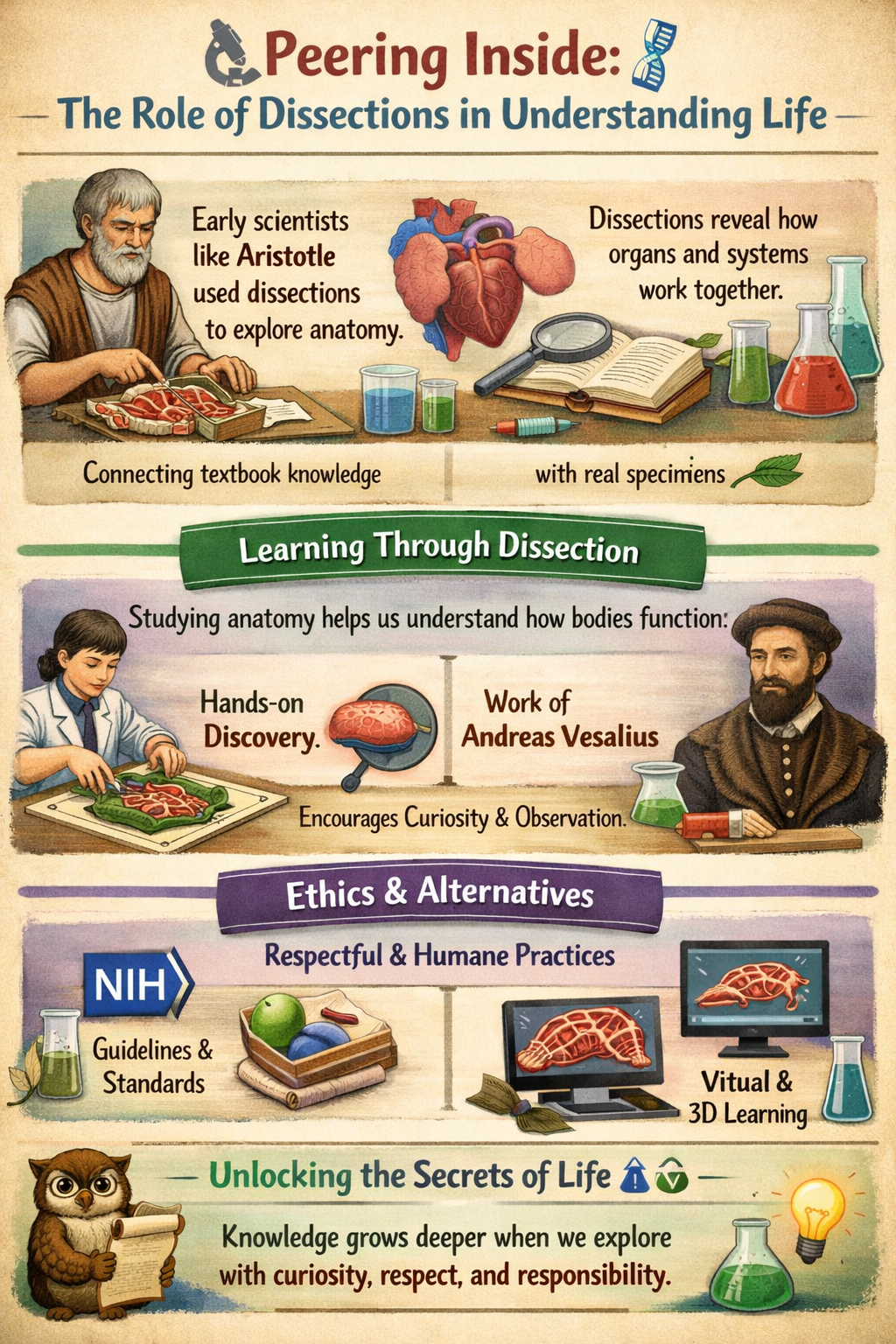
    Dissection has long been an important method for learning about the structure of living organisms. From studying plants to examining animals, it allows students to explore how different organs and systems work together. Early scientists like Aristotle used observation and simple dissections to understand life. By carefully examining internal structures, learners can connect textbook knowledge with real-life examples, making science more meaningful and engaging.
    In biology classes, dissections help students understand complex systems such as the circulatory, respiratory, and nervous systems. For example, studying the anatomy of a frog or fish shows how organs are arranged and how they function together. Scientists such as Andreas Vesalius improved medical knowledge through detailed anatomical studies. Dissections encourage curiosity and careful observation, which are essential skills in science.
    However, dissections also raise ethical questions. Schools and laboratories must follow strict guidelines to treat specimens respectfully and responsibly. Many institutions, including organizations like National Institutes of Health, support ethical research standards and humane treatment in scientific studies. Today, virtual dissection software and 3D models are also used to reduce harm while still providing valuable learning experiences.
    Overall, dissections play a key role in understanding life by allowing students to see the hidden complexity inside living beings. They build knowledge, develop practical skills, and inspire future scientists and doctors. When done ethically and thoughtfully, dissections become a bridge between theory and discovery.
    Moral: Knowledge grows deeper when we explore with curiosity, respect, and responsibility.
    ACCL PORTAL DAY 132 TASK STORY POST Badaruddin Chai wala Peering Inside: The Role of Dissections in Understanding Life πŸ”¬πŸ§¬ Dissection has long been an important method for learning about the structure of living organisms. From studying plants to examining animals, it allows students to explore how different organs and systems work together. Early scientists like Aristotle used observation and simple dissections to understand life. By carefully examining internal structures, learners can connect textbook knowledge with real-life examples, making science more meaningful and engaging. πŸ“šβœ¨ In biology classes, dissections help students understand complex systems such as the circulatory, respiratory, and nervous systems. For example, studying the anatomy of a frog or fish shows how organs are arranged and how they function together. Scientists such as Andreas Vesalius improved medical knowledge through detailed anatomical studies. Dissections encourage curiosity and careful observation, which are essential skills in science. πŸΈπŸ” However, dissections also raise ethical questions. Schools and laboratories must follow strict guidelines to treat specimens respectfully and responsibly. Many institutions, including organizations like National Institutes of Health, support ethical research standards and humane treatment in scientific studies. Today, virtual dissection software and 3D models are also used to reduce harm while still providing valuable learning experiences. πŸ’»πŸŒ± Overall, dissections play a key role in understanding life by allowing students to see the hidden complexity inside living beings. They build knowledge, develop practical skills, and inspire future scientists and doctors. When done ethically and thoughtfully, dissections become a bridge between theory and discovery. 🌍πŸ§ͺ Moral: Knowledge grows deeper when we explore with curiosity, respect, and responsibility. 🌟
    0 Commenti 0 condivisioni 16 Views
  • La sesión de fotos Madrid es una experiencia diseñada para capturar tu mejor versión en una de las ciudades más dinámicas y creativas de España. Ya sea para un book profesional, fotografía corporativa, retratos personales, moda o contenido para redes sociales, una sesión bien planificada combina dirección experta, iluminación adecuada y escenarios estratégicos que potencian tu imagen.
    Madrid ofrece una enorme variedad de localizaciones: desde espacios urbanos modernos y minimalistas hasta calles clásicas, parques naturales y arquitectura histórica que aportan carácter y personalidad a cada fotografía. Además, la opción de realizar la sesión en estudio permite un control total de la luz y el fondo, ideal para headshots profesionales, castings o perfiles corporativos.
    Una sesión de fotos profesional en Madrid no solo se centra en la técnica, sino también en la experiencia. La preparación previa —elección de vestuario, definición de estilo, objetivos y tipo de público al que te diriges— es clave para obtener resultados coherentes y estratégicos. Durante la sesión, la dirección del fotógrafo ayuda a lograr poses naturales, expresiones auténticas y una narrativa visual alineada con tu marca personal o profesional.
    Invertir en una sesión de fotos en Madrid es apostar por una imagen cuidada, competitiva y adaptada a un mercado exigente, donde la primera impresión puede marcar la diferencia entre una oportunidad y otra. For more info - https://shorturl.at/eRnPL

    La sesión de fotos Madrid es una experiencia diseñada para capturar tu mejor versión en una de las ciudades más dinámicas y creativas de España. Ya sea para un book profesional, fotografía corporativa, retratos personales, moda o contenido para redes sociales, una sesión bien planificada combina dirección experta, iluminación adecuada y escenarios estratégicos que potencian tu imagen. Madrid ofrece una enorme variedad de localizaciones: desde espacios urbanos modernos y minimalistas hasta calles clásicas, parques naturales y arquitectura histórica que aportan carácter y personalidad a cada fotografía. Además, la opción de realizar la sesión en estudio permite un control total de la luz y el fondo, ideal para headshots profesionales, castings o perfiles corporativos. Una sesión de fotos profesional en Madrid no solo se centra en la técnica, sino también en la experiencia. La preparación previa —elección de vestuario, definición de estilo, objetivos y tipo de público al que te diriges— es clave para obtener resultados coherentes y estratégicos. Durante la sesión, la dirección del fotógrafo ayuda a lograr poses naturales, expresiones auténticas y una narrativa visual alineada con tu marca personal o profesional. Invertir en una sesión de fotos en Madrid es apostar por una imagen cuidada, competitiva y adaptada a un mercado exigente, donde la primera impresión puede marcar la diferencia entre una oportunidad y otra. For more info - https://shorturl.at/eRnPL
    0 Commenti 0 condivisioni 263 Views
  • ACCL PORTAL DAY 83 TASK STORY POST @ Badaruddin Suleman The Wonders of Geometry: Shapes and Philosophy

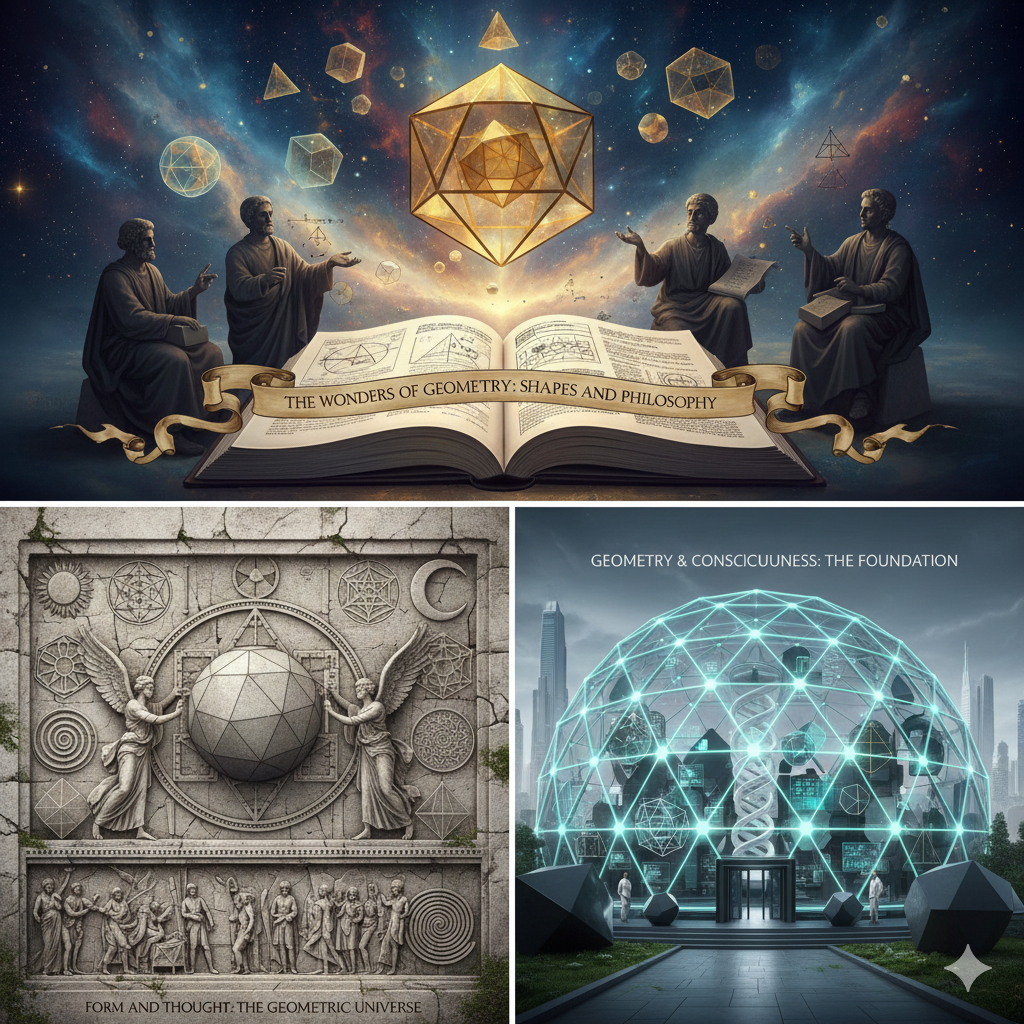
    Geometry is more than just lines and angles; it is the language of shapes that helps us understand the world around us. From the perfect circle of the sun to the strong triangular structure of bridges , geometry exists everywhere. The ancient Greek mathematician Euclid, often called the “Father of Geometry,” organized geometric knowledge in his famous book Elements. Through geometry, we learn how simple shapes can build complex designs and explain natural patterns.

    Shapes are not only mathematical figures; they also carry deep philosophical meanings. The circle represents unity and eternity because it has no beginning and no end. The triangle symbolizes strength and balance, often used in architecture and art. The square stands for stability and fairness. Philosophers like Plato believed that geometric forms were connected to the deeper reality of the universe. He thought that these perfect shapes existed beyond the physical world, representing truth and harmony.

    Geometry also teaches logical thinking and problem-solving skills . When students study angles, symmetry, and patterns, they develop reasoning abilities that help them in science, engineering, and daily life. Modern architects and engineers use geometric principles to design buildings, machines, and technology. Even in nature , we see beautiful geometric patterns in flowers, snowflakes , and honeycombs .

    In conclusion, geometry is not just a branch of mathematics but a bridge between numbers and philosophy. It connects the physical world with abstract thinking, helping us see order and beauty in everything. By understanding shapes, we better understand the universe and our place within it .

    Moral:

    Geometry teaches us that balance, harmony, and logical thinking can help us build a stronger and wiser life.
    ACCL PORTAL DAY 83 TASK STORY POST @ Badaruddin Suleman πŸ“ The Wonders of Geometry: Shapes and Philosophy ✨ Geometry is more than just lines and angles; it is the language of shapes that helps us understand the world around us. From the perfect circle of the sun 🌞 to the strong triangular structure of bridges πŸŒ‰, geometry exists everywhere. The ancient Greek mathematician Euclid, often called the “Father of Geometry,” organized geometric knowledge in his famous book Elements. Through geometry, we learn how simple shapes can build complex designs and explain natural patterns. Shapes are not only mathematical figures; they also carry deep philosophical meanings. The circle πŸ”΅ represents unity and eternity because it has no beginning and no end. The triangle πŸ”Ί symbolizes strength and balance, often used in architecture and art. The square 🟦 stands for stability and fairness. Philosophers like Plato believed that geometric forms were connected to the deeper reality of the universe. He thought that these perfect shapes existed beyond the physical world, representing truth and harmony. Geometry also teaches logical thinking and problem-solving skills 🧠. When students study angles, symmetry, and patterns, they develop reasoning abilities that help them in science, engineering, and daily life. Modern architects and engineers use geometric principles to design buildings, machines, and technology. Even in nature 🌿, we see beautiful geometric patterns in flowers, snowflakes ❄️, and honeycombs 🍯. In conclusion, geometry is not just a branch of mathematics but a bridge between numbers and philosophy. It connects the physical world with abstract thinking, helping us see order and beauty in everything. By understanding shapes, we better understand the universe and our place within it 🌍. 🌟 Moral: Geometry teaches us that balance, harmony, and logical thinking can help us build a stronger and wiser life.
    0 Commenti 0 condivisioni 538 Views
  • USB Hubs Market Forecast to Achieve USD 1.2 Billion by 2034 Powered by USB-C Proliferation
    Global USB Hubs market was valued at USD 674 million in 2025 and is expected to reach USD 1.2 billion by 2034, growing at a CAGR of 7.3% during 2026-2034. Expansion aligns with 65% USB-C adoption and 12% shipment rises from multi-device setups.
    The adoption of USB4 and Thunderbolt 3/4 technologies has boosted demand for high-speed hubs capable of data transfer rates up to 40Gbps. These advanced USB hubs also support power delivery up to 100W, making them essential for modern ultrabooks and tablets. Over 65% of new USB hubs in 2023 were USB-C compatible, aligning with industry shifts.
    Emerging IoT applications further contribute to market expansion, as USB hubs serve as central connection points for smart devices in home automation and industrial settings.
    Access the complete industry analysis and demand forecasts here: https://semiconductorinsight.com/report/usb-hubs-market/
    USB Hubs Market Forecast to Achieve USD 1.2 Billion by 2034 Powered by USB-C Proliferation Global USB Hubs market was valued at USD 674 million in 2025 and is expected to reach USD 1.2 billion by 2034, growing at a CAGR of 7.3% during 2026-2034. Expansion aligns with 65% USB-C adoption and 12% shipment rises from multi-device setups. The adoption of USB4 and Thunderbolt 3/4 technologies has boosted demand for high-speed hubs capable of data transfer rates up to 40Gbps. These advanced USB hubs also support power delivery up to 100W, making them essential for modern ultrabooks and tablets. Over 65% of new USB hubs in 2023 were USB-C compatible, aligning with industry shifts. Emerging IoT applications further contribute to market expansion, as USB hubs serve as central connection points for smart devices in home automation and industrial settings. πŸ‘‰ Access the complete industry analysis and demand forecasts here: https://semiconductorinsight.com/report/usb-hubs-market/
    USB Hubs Market, Size, Trends, Business Strategies 2026-2033
    0 Commenti 0 condivisioni 998 Views
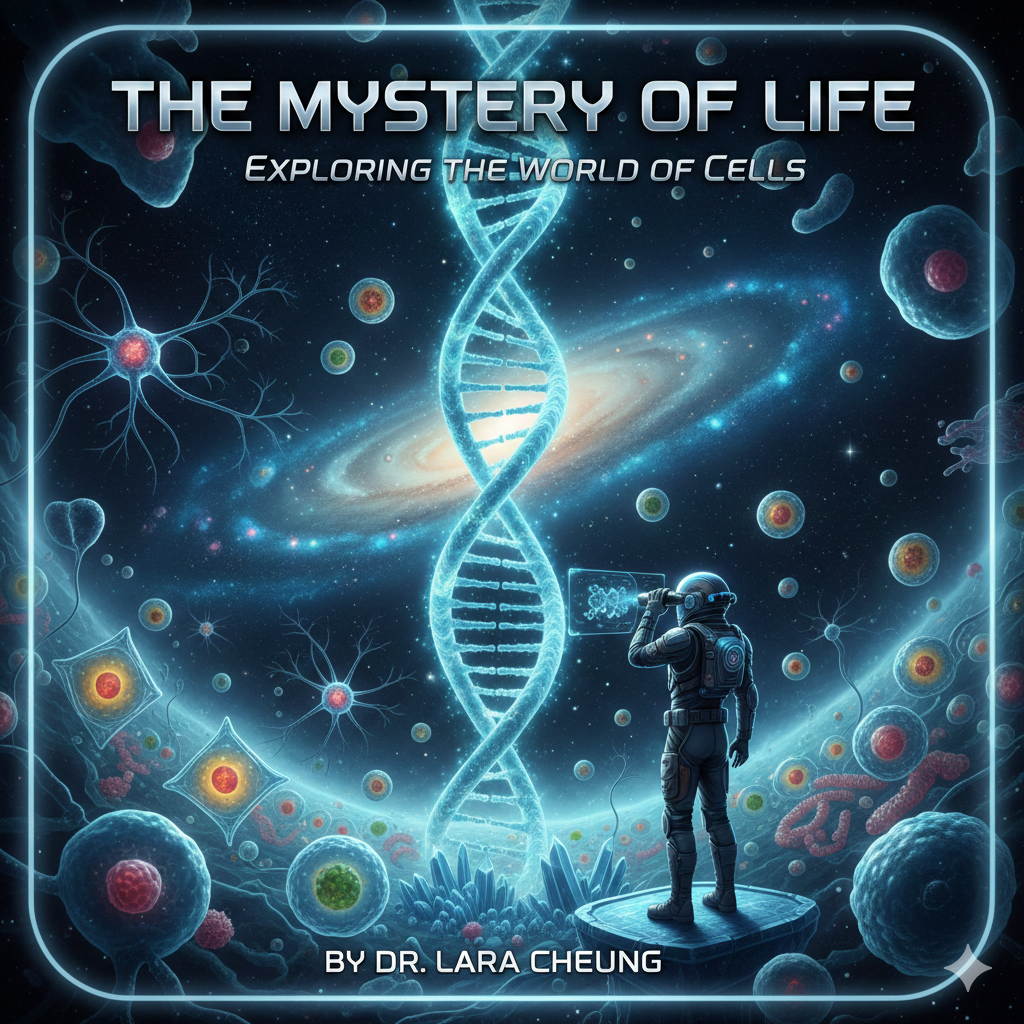
  • Day 41: The Mystery of Life: Exploring the World of Cells
    Description: Complete the task: The Mystery of Life: Exploring the World of Cells

    **The Mystery of Life: Exploring the World of Cells**

    Ayaan had always been curious about life. Sitting in his classroom one day, he wondered, “What really makes us alive?” His teacher smiled and said, “The answer lies in something so small, you can’t even see it—cells.”
    That night, as Ayaan read his science book, he imagined shrinking smaller and smaller until he entered a hidden world inside his own body. Suddenly, he found himself surrounded by tiny, busy structures moving in every direction. It looked like a bustling city.
    A small, glowing figure approached him and said, “Welcome! I am a cell.”
    Ayaan was amazed. “You’re so tiny… but everything here looks so important!”
    The cell smiled and replied, “We may be small, but we are the building blocks of life. Some of us carry oxygen, some fight diseases, and others help you grow and heal. Together, we keep your body working every second.”
    As Ayaan explored further, he saw cells working together like a perfect team—communicating, repairing, and protecting. He realized that every living thing, from the tallest tree to the smallest insect, depends on these invisible units.
    Suddenly, Ayaan was back in his room, holding his book. He looked at his hands with a new sense of wonder.
    He smiled and whispered, “Life really is a mystery… but a beautiful one.”
    Moral: Even the smallest parts of life hold the greatest importance.
    Day 41: The Mystery of Life: Exploring the World of Cells Description: Complete the task: The Mystery of Life: Exploring the World of Cells **The Mystery of Life: Exploring the World of Cells** Ayaan had always been curious about life. Sitting in his classroom one day, he wondered, “What really makes us alive?” His teacher smiled and said, “The answer lies in something so small, you can’t even see it—cells.” That night, as Ayaan read his science book, he imagined shrinking smaller and smaller until he entered a hidden world inside his own body. Suddenly, he found himself surrounded by tiny, busy structures moving in every direction. It looked like a bustling city. A small, glowing figure approached him and said, “Welcome! I am a cell.” Ayaan was amazed. “You’re so tiny… but everything here looks so important!” The cell smiled and replied, “We may be small, but we are the building blocks of life. Some of us carry oxygen, some fight diseases, and others help you grow and heal. Together, we keep your body working every second.” As Ayaan explored further, he saw cells working together like a perfect team—communicating, repairing, and protecting. He realized that every living thing, from the tallest tree to the smallest insect, depends on these invisible units. Suddenly, Ayaan was back in his room, holding his book. He looked at his hands with a new sense of wonder. He smiled and whispered, “Life really is a mystery… but a beautiful one.” Moral: Even the smallest parts of life hold the greatest importance.
    0 Commenti 0 condivisioni 613 Views
  • Maps don’t just show places — they tell stories about history . Long ago, people made maps to record what they knew about the world . These maps show old borders, trade routes, cities, and kingdoms , helping us understand how people lived and traveled in the past.

    Historical maps also reveal power and culture . The size of countries, the names of places, and the drawings on maps tell us who was important at that time. For example, ancient maps from the time of the Roman Empire show roads and cities that helped control a vast land .

    Maps can even show change over time . By comparing old maps with modern ones, we can see how borders moved, cities grew, and landscapes changed . In this way, maps act like history books made with pictures, helping us learn about the past in a visual and exciting way .
    https://youtu.be/p-y5Yn5nCHQ
    Maps don’t just show places — they tell stories about history πŸ—ΊοΈπŸ“œ. Long ago, people made maps to record what they knew about the world 🌍. These maps show old borders, trade routes, cities, and kingdoms 🏰🚒, helping us understand how people lived and traveled in the past. Historical maps also reveal power and culture πŸ‘‘πŸŽ­. The size of countries, the names of places, and the drawings on maps tell us who was important at that time. For example, ancient maps from the time of the Roman Empire show roads and cities that helped control a vast land πŸ›£οΈπŸ›οΈ. Maps can even show change over time β³πŸ”„. By comparing old maps with modern ones, we can see how borders moved, cities grew, and landscapes changed πŸŒ†πŸŒΏ. In this way, maps act like history books made with pictures, helping us learn about the past in a visual and exciting way πŸ“–βœ¨. https://youtu.be/p-y5Yn5nCHQ
    0 Commenti 0 condivisioni 309 Views
  • #rsisb
    Roll No 178
    Day 1: Create Gmail Account
    I successfully created a Gmail account by completing the required setup steps, including providing personal details, setting a secure password, and configuring account recovery options. I also reviewed and adjusted basic privacy and security settings to ensure safe usage. This task helped me understand the importance of account security, proper credential management, and email setup, which are essential skills for effective digital communication. I completed this task with guidance from AI while ensuring I understood each step of the process.
    https://www.facebook.com/share/p/17uXvvJG5Q/
    #rsisb Roll No 178 Day 1: Create Gmail Account I successfully created a Gmail account by completing the required setup steps, including providing personal details, setting a secure password, and configuring account recovery options. I also reviewed and adjusted basic privacy and security settings to ensure safe usage. This task helped me understand the importance of account security, proper credential management, and email setup, which are essential skills for effective digital communication. I completed this task with guidance from AI while ensuring I understood each step of the process. https://www.facebook.com/share/p/17uXvvJG5Q/
    0 Commenti 0 condivisioni 602 Views
  • Day 3: Follow Rehan Allahwala & Make 10 Mutual Friends
    Description: Log in to Facebook Search “Rehan Allahwala” Click Follow Go to his friends list → send friend requests to at least 10 people Once accepted, you’ll have 10 new mutual friends.

    I recently followed **Rehan Allahwala** and connected with his network by adding 10 of his friends. It’s great to expand my circle and connect with like-minded people. Now we have 10 mutual friends, which makes the connection even stronger. Looking forward to learning, engaging, and growing through this network!
    Day 3: Follow Rehan Allahwala & Make 10 Mutual Friends Description: Log in to Facebook Search “Rehan Allahwala” Click Follow Go to his friends list → send friend requests to at least 10 people Once accepted, you’ll have 10 new mutual friends. I recently followed **Rehan Allahwala** and connected with his network by adding 10 of his friends. It’s great to expand my circle and connect with like-minded people. Now we have 10 mutual friends, which makes the connection even stronger. Looking forward to learning, engaging, and growing through this network! πŸš€
    0 Commenti 0 condivisioni 327 Views
  • Today, we bring you a special and inspiring interview with Nitin Boys to explore his life journey and daily routine. In this interview, we talk about his background, struggles, habits, mindset, and the discipline that shapes his everyday life.
    This conversation is full of motivation and real-life lessons for young people who want to improve themselves, stay focused, and build a successful future.
    If you enjoy honest talks, life experiences, and motivational content, this interview is a must-watch

    Hashtags (with Emojis)

    #Interview
    #LifeJourney
    #DailyRoutine
    #YouthMotivation
    #Inspiration
    #RealLifeStories
    #PositiveMindset
    #HardWork
    #SuccessHabits
    #LearningEveryday
    #MotivationalTalk

    If you want, I can also tailor this for YouTube, Instagram, or Facebook captions

    Unit Converter Give me a description, description, and hashtags with emojis
    Unit Converter – Description

    The Unit Converter is a simple, fast, and user-friendly tool designed to make everyday calculations effortless. It allows users to convert values between different units such as length, weight, temperature, time, speed, and more with just a few clicks.
    Whether you are a student, teacher, traveler, or professional, this tool helps you save time, avoid mistakes, and get accurate results instantly. With a clean interface and precise calculations, the Unit Converter is perfect for learning, work, and daily life needs.


    #UnitConverter
    #SmartTools
    #EasyConversion
    #MathMadeEasy
    #StudentLife
    #DailyUseTool
    #QuickCalculations
    #AccurateResults
    #LearningTech
    #ProductivityBoost

    Today, we bring you a special and inspiring interview with Nitin Boys to explore his life journey and daily routine. In this interview, we talk about his background, struggles, habits, mindset, and the discipline that shapes his everyday life.
    This conversation is full of motivation and real-life lessons for young people who want to improve themselves, stay focused, and build a successful future.
    If you enjoy honest talks, life experiences, and motivational content, this interview is a must-watch


    #Interview
    #LifeJourney
    #DailyRoutine
    #YouthMotivation
    #Inspiration
    #RealLifeStories
    #PositiveMindset
    #HardWork
    #SuccessHabits
    #LearningEveryday
    #MotivationalTalk

    https://youtu.be/HJpj0TB8SZE?si=hr8jDNsAtlPiM-Qk
    Today, we bring you a special and inspiring interview with Nitin Boys to explore his life journey and daily routine. In this interview, we talk about his background, struggles, habits, mindset, and the discipline that shapes his everyday life. This conversation is full of motivation and real-life lessons for young people who want to improve themselves, stay focused, and build a successful future. If you enjoy honest talks, life experiences, and motivational content, this interview is a must-watch 🌟 πŸ”– Hashtags (with Emojis) #Interview 🎀 #LifeJourney πŸ“– #DailyRoutine ⏰ #YouthMotivation πŸ”₯ #Inspiration 🌟 #RealLifeStories πŸ’¬ #PositiveMindset 😊 #HardWork πŸ’ͺ #SuccessHabits πŸ† #LearningEveryday πŸ“š #MotivationalTalk πŸš€ If you want, I can also tailor this for YouTube, Instagram, or Facebook captions πŸ‘ Unit Converter Give me a description, description, and hashtags with emojis πŸ“Œ Unit Converter – Description The Unit Converter is a simple, fast, and user-friendly tool designed to make everyday calculations effortless. It allows users to convert values between different units such as length, weight, temperature, time, speed, and more with just a few clicks. Whether you are a student, teacher, traveler, or professional, this tool helps you save time, avoid mistakes, and get accurate results instantly. With a clean interface and precise calculations, the Unit Converter is perfect for learning, work, and daily life needs. 🌍✨ #UnitConverter πŸ”„ #SmartTools 🧠 #EasyConversion βš™οΈ #MathMadeEasy βž— #StudentLife πŸ“š #DailyUseTool πŸ“± #QuickCalculations ⏱️ #AccurateResults βœ… #LearningTech πŸ’‘ #ProductivityBoost πŸš€ Today, we bring you a special and inspiring interview with Nitin Boys to explore his life journey and daily routine. In this interview, we talk about his background, struggles, habits, mindset, and the discipline that shapes his everyday life. This conversation is full of motivation and real-life lessons for young people who want to improve themselves, stay focused, and build a successful future. If you enjoy honest talks, life experiences, and motivational content, this interview is a must-watch 🌟 #Interview 🎀 #LifeJourney πŸ“– #DailyRoutine ⏰ #YouthMotivation πŸ”₯ #Inspiration 🌟 #RealLifeStories πŸ’¬ #PositiveMindset 😊 #HardWork πŸ’ͺ #SuccessHabits πŸ† #LearningEveryday πŸ“š #MotivationalTalk πŸš€ https://youtu.be/HJpj0TB8SZE?si=hr8jDNsAtlPiM-Qk
    0 Commenti 0 condivisioni 4220 Views
Pagine in Evidenza