• ACCL PORTAL DAY 118 TASK STORY POST @Badaruddin Suleman Atoms and Eternity: How Chemistry Shapes the Cosmos

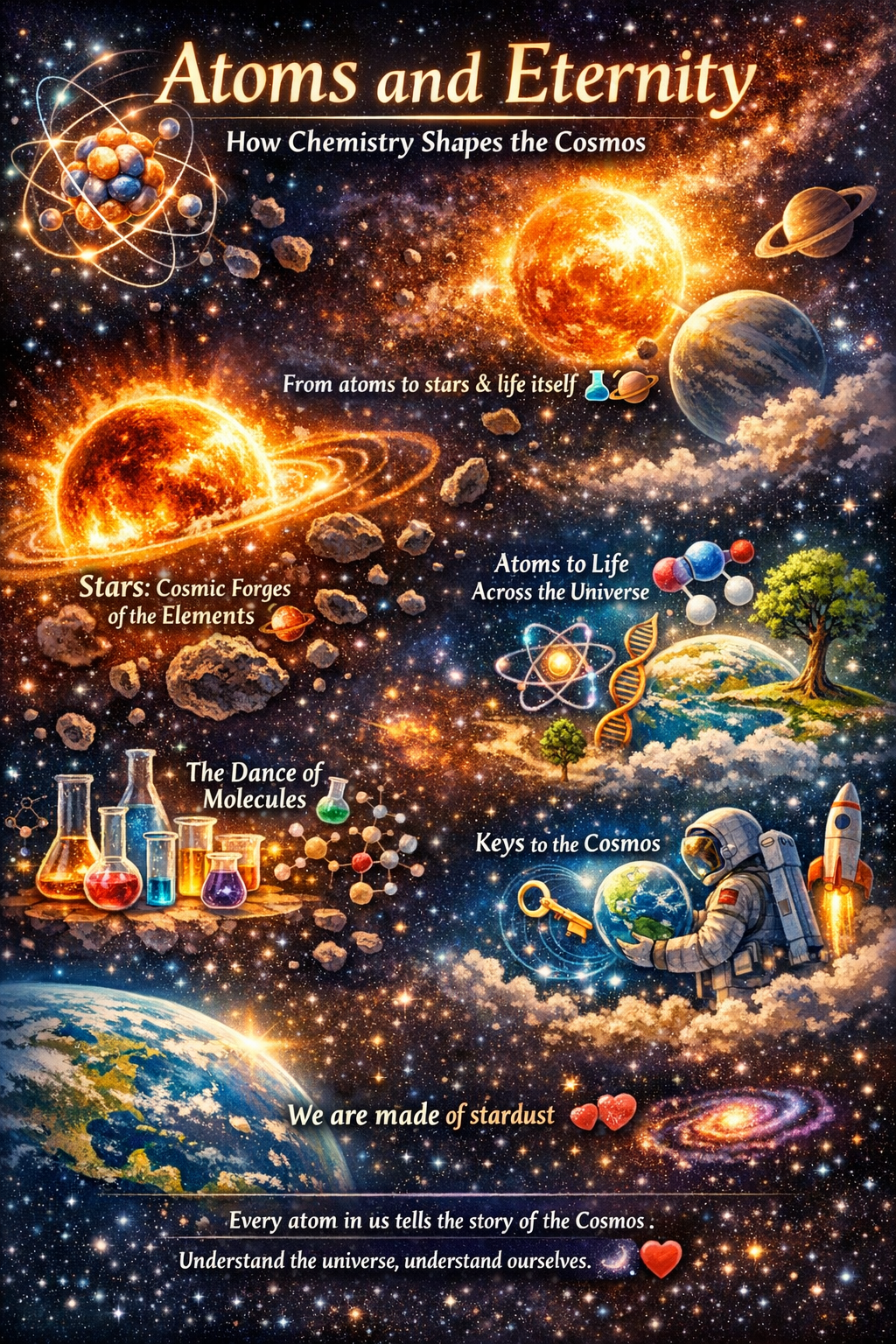
    From the tiniest particles to the vast expanses of space, atoms form the very fabric of our universe. Each atom, composed of protons, neutrons, and electrons, acts like a building block, creating everything from stars and planets to life itself. The laws of chemistry govern how these atoms interact, bond, and transform, giving rise to the incredible diversity we see in the cosmos.

    Stars are not just shining lights; they are cosmic kitchens where atoms are forged. Through nuclear fusion, hydrogen atoms merge to form helium, releasing energy that powers the star and spreads elements across the universe. These elements eventually become part of planets, oceans, and even living beings, connecting every atom in existence to the lifecycle of the cosmos.

    Chemical reactions are the silent artists of the universe, shaping molecules and matter in ways both simple and complex. Water, carbon dioxide, and countless other compounds arise from these interactions, providing the conditions necessary for life. Even the air we breathe and the food we eat are the result of ancient chemical dances performed over billions of years.

    Understanding chemistry is like holding a key to the universe. By studying how atoms behave, scientists can predict cosmic events, create new materials, and even explore possibilities of life beyond Earth. This knowledge reminds us that we are not separate from the universe; we are an expression of its chemistry and eternity.

    Moral: Every atom in us carries the story of the cosmos; by appreciating chemistry, we understand both the universe and ourselves.
    ACCL PORTAL DAY 118 TASK STORY POST @Badaruddin Suleman Atoms and Eternity: How Chemistry Shapes the Cosmos ✨🪐 From the tiniest particles to the vast expanses of space, atoms form the very fabric of our universe. 🧪 Each atom, composed of protons, neutrons, and electrons, acts like a building block, creating everything from stars and planets to life itself. The laws of chemistry govern how these atoms interact, bond, and transform, giving rise to the incredible diversity we see in the cosmos. 🌌 Stars are not just shining lights; they are cosmic kitchens where atoms are forged. 🔥 Through nuclear fusion, hydrogen atoms merge to form helium, releasing energy that powers the star and spreads elements across the universe. These elements eventually become part of planets, oceans, and even living beings, connecting every atom in existence to the lifecycle of the cosmos. 🌟 Chemical reactions are the silent artists of the universe, shaping molecules and matter in ways both simple and complex. 🧬 Water, carbon dioxide, and countless other compounds arise from these interactions, providing the conditions necessary for life. Even the air we breathe and the food we eat are the result of ancient chemical dances performed over billions of years. 🌱 Understanding chemistry is like holding a key to the universe. 🗝️ By studying how atoms behave, scientists can predict cosmic events, create new materials, and even explore possibilities of life beyond Earth. This knowledge reminds us that we are not separate from the universe; we are an expression of its chemistry and eternity. 🌍💫 Moral: Every atom in us carries the story of the cosmos; by appreciating chemistry, we understand both the universe and ourselves. 🌌❤️
    0 Commentarii 0 Distribuiri 28 Views
  • ACCL PORTAL DAY 111 TASK STORY POST @Badruddin chaiwala The Evolution Paradox: Bridging Theories of Life with Divine Design

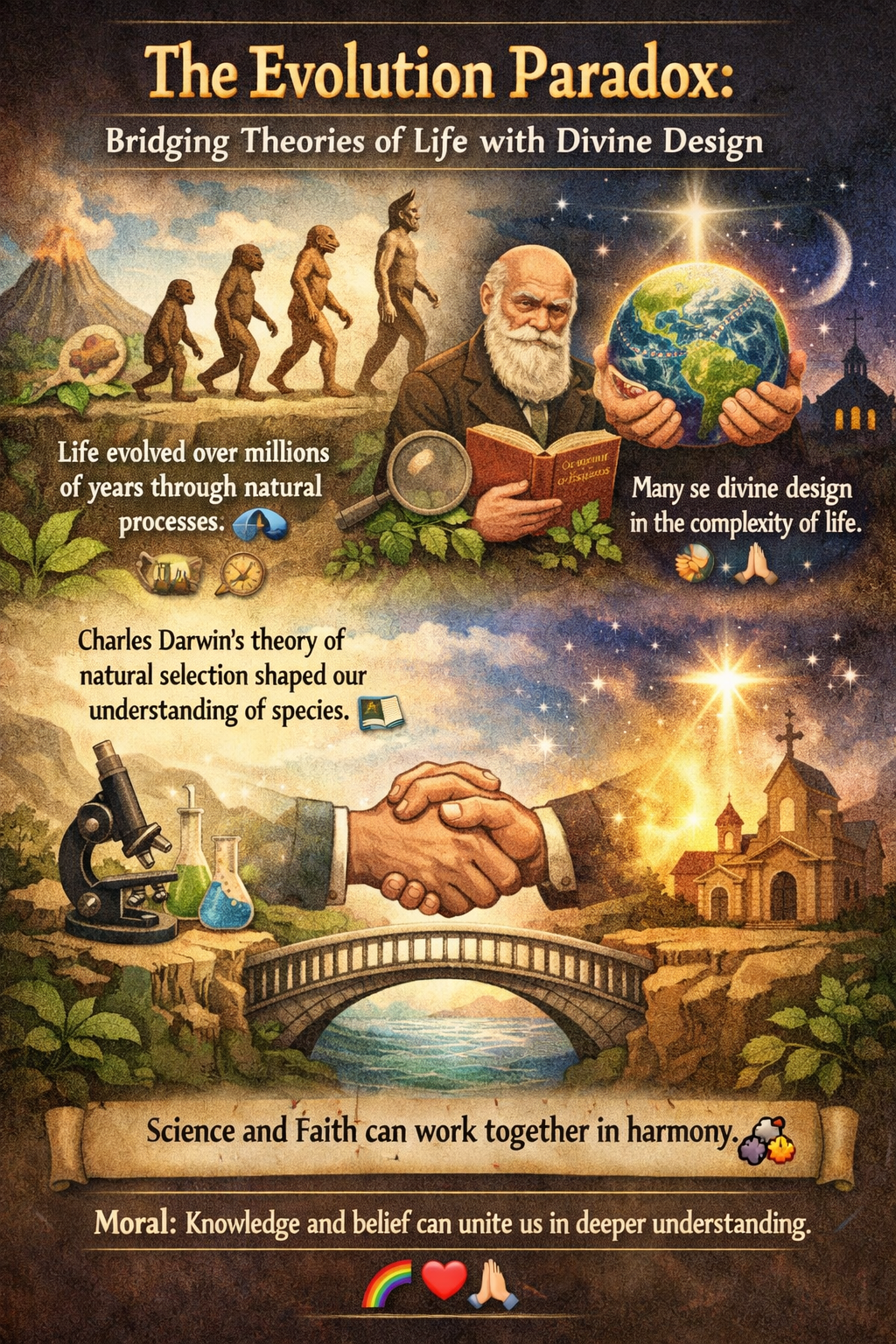
    Life on Earth has always inspired curiosity and wonder. Scientific theories of evolution explain how living organisms gradually changed over millions of years, adapting to their environments through natural processes. From simple single-celled organisms to complex human beings, evolution presents a detailed narrative of development and survival. It highlights the beauty of natural laws and the intricate systems that govern life.

    One of the key figures behind evolutionary theory is Charles Darwin, who proposed the idea of natural selection. According to his observations, species evolve over time because individuals with favorable traits are more likely to survive and reproduce. His work, especially in On the Origin of Species, transformed biological science and provided a framework for understanding biodiversity.

    On the other hand, many people believe that life reflects intentional divine design. This perspective suggests that the complexity and harmony found in nature are signs of a higher purpose. From the precise structure of DNA to the balance of ecosystems, believers see evidence of wisdom and planning. Rather than contradicting science, some thinkers argue that evolution could be the method through which divine will unfolds.

    Bridging these ideas encourages respectful dialogue between science and faith. Instead of seeing them as opposing forces, they can be viewed as complementary ways of exploring truth. Science explains the “how” of life’s processes, while faith often addresses the “why” behind existence. Together, they inspire humility, curiosity, and deeper appreciation for the mystery of life.

    Moral: Knowledge and belief do not have to compete; when we approach both with open minds and respect, we discover greater understanding and harmony.
    ACCL PORTAL DAY 111 TASK STORY POST @Badruddin chaiwala The Evolution Paradox: Bridging Theories of Life with Divine Design 🌍🧬 Life on Earth has always inspired curiosity and wonder. Scientific theories of evolution explain how living organisms gradually changed over millions of years, adapting to their environments through natural processes. From simple single-celled organisms to complex human beings, evolution presents a detailed narrative of development and survival. It highlights the beauty of natural laws and the intricate systems that govern life. 🧫✨ One of the key figures behind evolutionary theory is Charles Darwin, who proposed the idea of natural selection. According to his observations, species evolve over time because individuals with favorable traits are more likely to survive and reproduce. His work, especially in On the Origin of Species, transformed biological science and provided a framework for understanding biodiversity. 🌿📖 On the other hand, many people believe that life reflects intentional divine design. This perspective suggests that the complexity and harmony found in nature are signs of a higher purpose. From the precise structure of DNA to the balance of ecosystems, believers see evidence of wisdom and planning. Rather than contradicting science, some thinkers argue that evolution could be the method through which divine will unfolds. 🌌🙏 Bridging these ideas encourages respectful dialogue between science and faith. Instead of seeing them as opposing forces, they can be viewed as complementary ways of exploring truth. Science explains the “how” of life’s processes, while faith often addresses the “why” behind existence. Together, they inspire humility, curiosity, and deeper appreciation for the mystery of life. 🌟🤝 Moral: Knowledge and belief do not have to compete; when we approach both with open minds and respect, we discover greater understanding and harmony. 🌈
    0 Commentarii 0 Distribuiri 40 Views
  • ACCL PORTAL DAY 104 TASK STORY POST @Badruddin chaiwala The Blueprint of Existence: Unraveling DNA and the Origins of Life
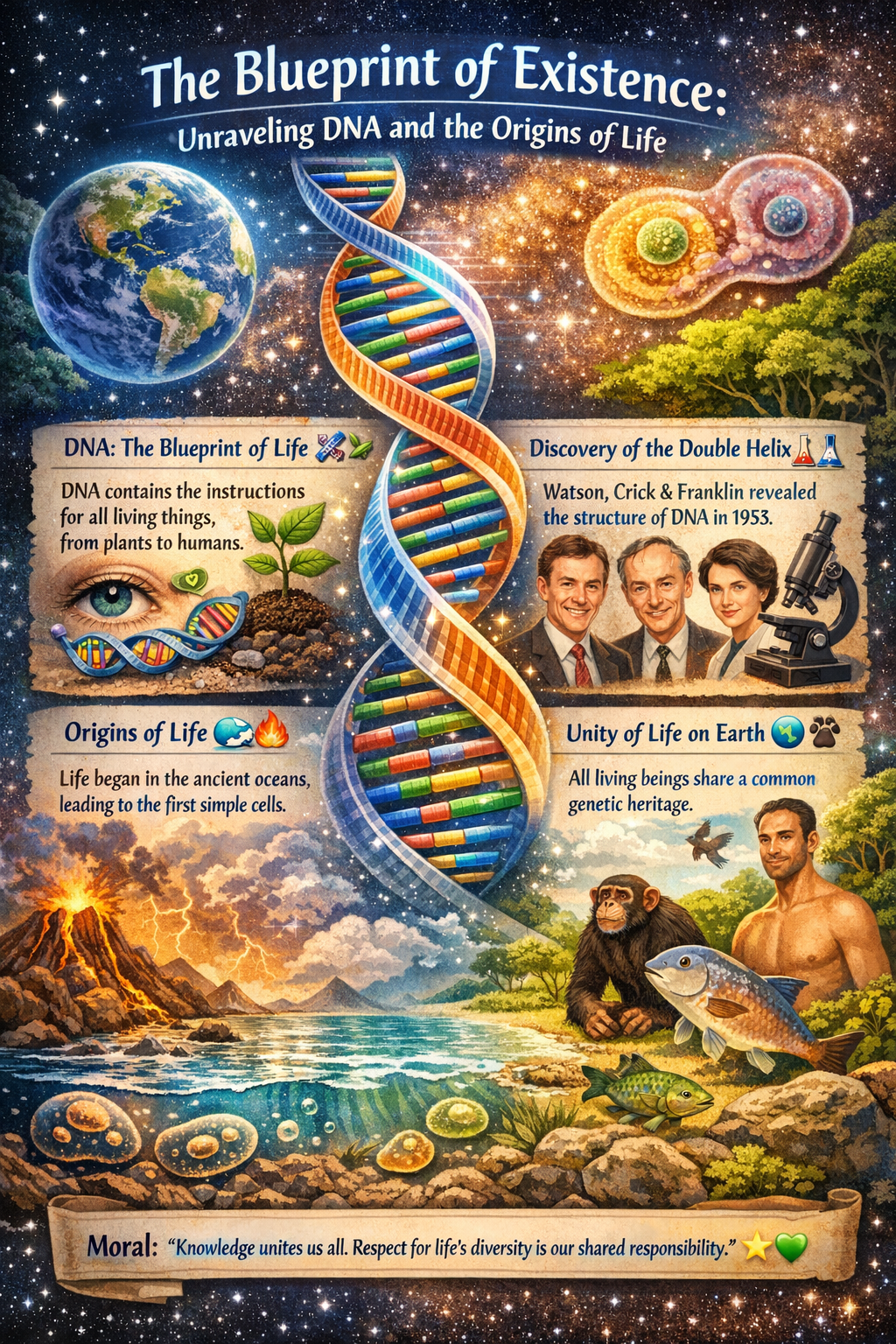
    Life on Earth begins with a tiny but powerful molecule called DNA . Deoxyribonucleic acid carries the instructions that guide how living organisms grow, function, and reproduce. From the color of our eyes to the way plants perform photosynthesis , DNA acts like a biological blueprint. Inside every cell, this twisted ladder-shaped structure stores information that has been passed down for billions of years, connecting all living things in one great chain of life.
    The discovery of DNA’s structure by scientists like James Watson and Francis Crick in 1953 was a turning point in science . Their work, along with crucial contributions from Rosalind Franklin, revealed the double-helix structure of DNA. This discovery helped scientists understand how genetic information is copied and inherited. It opened doors to modern genetics, medicine, and biotechnology, allowing us to study diseases and even explore genetic engineering.
    But DNA’s story goes back even further—back to the origins of life itself . Scientists believe that life may have started in Earth’s early oceans, where simple molecules combined to form more complex compounds. Over time, these molecules developed the ability to replicate, leading to the first simple cells. Through evolution, guided by natural selection, these early life forms gradually became the diverse plants, animals, and humans we see today .
    Understanding DNA reminds us that all living beings share a common origin . Whether it is a tiny bacterium or a human being, the same genetic code forms the foundation of life. This knowledge not only deepens our respect for science but also strengthens our appreciation for the unity and diversity of life on Earth.
    Moral :
    Knowledge is the key to understanding our existence. When we explore the secrets of nature with curiosity and respect, we discover that all life is connected, and every living being deserves care and responsibility.
    ACCL PORTAL DAY 104 TASK STORY POST @Badruddin chaiwala The Blueprint of Existence: Unraveling DNA and the Origins of Life 🧬🌍 Life on Earth begins with a tiny but powerful molecule called DNA 🧬. Deoxyribonucleic acid carries the instructions that guide how living organisms grow, function, and reproduce. From the color of our eyes to the way plants perform photosynthesis 🌱, DNA acts like a biological blueprint. Inside every cell, this twisted ladder-shaped structure stores information that has been passed down for billions of years, connecting all living things in one great chain of life. The discovery of DNA’s structure by scientists like James Watson and Francis Crick in 1953 was a turning point in science 🔬. Their work, along with crucial contributions from Rosalind Franklin, revealed the double-helix structure of DNA. This discovery helped scientists understand how genetic information is copied and inherited. It opened doors to modern genetics, medicine, and biotechnology, allowing us to study diseases and even explore genetic engineering. But DNA’s story goes back even further—back to the origins of life itself 🌊🔥. Scientists believe that life may have started in Earth’s early oceans, where simple molecules combined to form more complex compounds. Over time, these molecules developed the ability to replicate, leading to the first simple cells. Through evolution, guided by natural selection, these early life forms gradually became the diverse plants, animals, and humans we see today 🐾🌿. Understanding DNA reminds us that all living beings share a common origin 🌎✨. Whether it is a tiny bacterium or a human being, the same genetic code forms the foundation of life. This knowledge not only deepens our respect for science but also strengthens our appreciation for the unity and diversity of life on Earth. Moral 🌟: Knowledge is the key to understanding our existence. When we explore the secrets of nature with curiosity and respect, we discover that all life is connected, and every living being deserves care and responsibility.
    0 Commentarii 0 Distribuiri 63 Views
  • Will Rising Health Awareness Drive India’s Herbal Medicine Market at an 8.0% CAGR?
    According to a new report from Intel Market Research, the India herbal medicine market was valued at USD 4.56 billion in 2026 and is projected to reach USD 7.23 billion by 2034, growing at a steady CAGR of 8.0% during the forecast period (2026-2034). This growth reflects the country's increasingly health-conscious population and expanding government support for traditional medicine systems.
    https://www.intelmarketresearch.com/download-sample/10362/global-india-herbal-medicine-forecast-2025-2032-126
    Will Rising Health Awareness Drive India’s Herbal Medicine Market at an 8.0% CAGR? According to a new report from Intel Market Research, the India herbal medicine market was valued at USD 4.56 billion in 2026 and is projected to reach USD 7.23 billion by 2034, growing at a steady CAGR of 8.0% during the forecast period (2026-2034). This growth reflects the country's increasingly health-conscious population and expanding government support for traditional medicine systems. https://www.intelmarketresearch.com/download-sample/10362/global-india-herbal-medicine-forecast-2025-2032-126
    Download Free Sample : Herbal Medicine Market
    Free Sample Report Preview: India Herbal Medicine Market, Outlook and Forecast 2025-2032
    0 Commentarii 0 Distribuiri 74 Views
  • Will Infrastructure and Energy Projects Drive the EPC Services Market at a 2.9% CAGR by 2034?
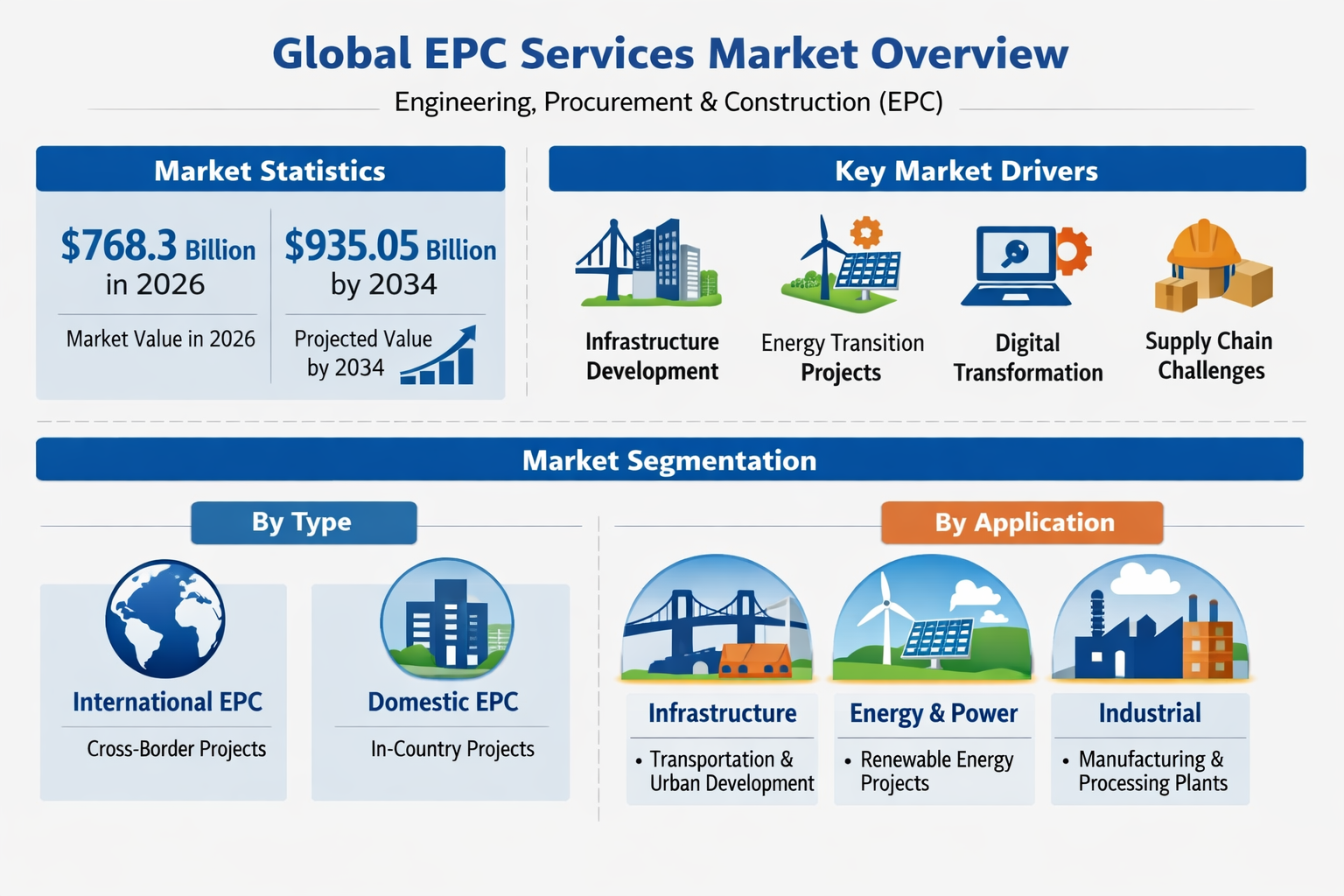
    According to a new report from Intel Market Research, the global Engineering, Procurement and Construction (EPC) Services market was valued at USD 768.3 billion in 2026 and is projected to reach USD 935.05 billion by 2034, growing at a CAGR of 2.9% during the forecast period (2026–2034). This growth is propelled by increasing global infrastructure development initiatives, energy transition projects, urbanization trends, and government investments in transportation and housing infrastructure.
    https://www.intelmarketresearch.com/download-free-sample/3843/engineering-procurementconstruction-services-market
    Will Infrastructure and Energy Projects Drive the EPC Services Market at a 2.9% CAGR by 2034? According to a new report from Intel Market Research, the global Engineering, Procurement and Construction (EPC) Services market was valued at USD 768.3 billion in 2026 and is projected to reach USD 935.05 billion by 2034, growing at a CAGR of 2.9% during the forecast period (2026–2034). This growth is propelled by increasing global infrastructure development initiatives, energy transition projects, urbanization trends, and government investments in transportation and housing infrastructure. https://www.intelmarketresearch.com/download-free-sample/3843/engineering-procurementconstruction-services-market
    0 Commentarii 0 Distribuiri 101 Views
  • Can the Package Substrates Market Reach USD 22.19 Billion by 2033 at 8.7% CAGR?
    Global Package Substrates Market was valued at USD 12.18 billion in 2026 and is projected to reach USD 22.19 billion by 2033, registering a Compound Annual Growth Rate (CAGR) of 8.7% over the forecast period 2026–2034. This robust expansion trajectory is underpinned by accelerating investment in artificial intelligence infrastructure, next-generation data center architectures, and the proliferation of heterogeneous chip integration technologies that demand increasingly sophisticated substrate solutions.
    Package substrates are precision-engineered multilayer interconnect structures that serve as the critical electrical and mechanical interface between semiconductor dies and printed circuit boards. Far more than passive carriers, modern package substrates perform four simultaneous engineering functions — electrical signal routing at fine line/space geometries, power distribution with minimal impedance, thermal dissipation away from the die junction, and mechanical support to protect fragile silicon from environmental and handling stress
    Access the complete industry analysis and demand forecasts here: https://semiconductorinsight.com/report/package-substrates-market/
    Can the Package Substrates Market Reach USD 22.19 Billion by 2033 at 8.7% CAGR? Global Package Substrates Market was valued at USD 12.18 billion in 2026 and is projected to reach USD 22.19 billion by 2033, registering a Compound Annual Growth Rate (CAGR) of 8.7% over the forecast period 2026–2034. This robust expansion trajectory is underpinned by accelerating investment in artificial intelligence infrastructure, next-generation data center architectures, and the proliferation of heterogeneous chip integration technologies that demand increasingly sophisticated substrate solutions. Package substrates are precision-engineered multilayer interconnect structures that serve as the critical electrical and mechanical interface between semiconductor dies and printed circuit boards. Far more than passive carriers, modern package substrates perform four simultaneous engineering functions — electrical signal routing at fine line/space geometries, power distribution with minimal impedance, thermal dissipation away from the die junction, and mechanical support to protect fragile silicon from environmental and handling stress 👉 Access the complete industry analysis and demand forecasts here: https://semiconductorinsight.com/report/package-substrates-market/
    Package Substrates Market, Trends, Business Strategies 2026-2033
    0 Commentarii 0 Distribuiri 536 Views
  • Will the Humanoid Robot-Specific Chip Market Reach USD 3.30 Billion by 2034 at 27.1% CAGR Amid AI Robotics Growth?
    global Humanoid Robot-Specific Chip Market was valued at USD 626 million in 2024 and is projected to reach USD 3.30 billion by 2032, registering a CAGR of 27.1% over the forecast period 2026–2034 — placing it among the fastest-expanding segments in the entire semiconductor industry as humanoid robotics transitions from laboratory demonstration to commercial deployment at scale.
    Humanoid robot-specific chips are specialized integrated circuits engineered to serve as the computational core of bipedal robotic platforms, simultaneously handling real-time motion control, multi-sensor environment perception, and autonomous AI decision processing within strict power and thermal budgets. Unlike general-purpose processors, these chips must deliver deterministic.
    Access the complete industry analysis and demand forecasts here: https://semiconductorinsight.com/report/humanoid-robot-specific-chip-market/
    Will the Humanoid Robot-Specific Chip Market Reach USD 3.30 Billion by 2034 at 27.1% CAGR Amid AI Robotics Growth? global Humanoid Robot-Specific Chip Market was valued at USD 626 million in 2024 and is projected to reach USD 3.30 billion by 2032, registering a CAGR of 27.1% over the forecast period 2026–2034 — placing it among the fastest-expanding segments in the entire semiconductor industry as humanoid robotics transitions from laboratory demonstration to commercial deployment at scale. Humanoid robot-specific chips are specialized integrated circuits engineered to serve as the computational core of bipedal robotic platforms, simultaneously handling real-time motion control, multi-sensor environment perception, and autonomous AI decision processing within strict power and thermal budgets. Unlike general-purpose processors, these chips must deliver deterministic. 👉 Access the complete industry analysis and demand forecasts here: https://semiconductorinsight.com/report/humanoid-robot-specific-chip-market/
    Humanoid Robot-Specific Chip Market, Trends, Business Strategies 2025-2032
    0 Commentarii 0 Distribuiri 547 Views
  • Flat Panel Display Photomask Market to Reach USD 2.49 Billion by 2032 Driven by OLED Expansion and Automotive Display Demand
    global Flat Panel Display Photomask Market was valued at USD 1.67 billion in 2024 and is projected to reach USD 2.49 billion by 2032, at a CAGR of 5.67% over the forecast period 2026–2034. Growth is anchored by escalating display resolution demands, rapid OLED capacity expansion, and emerging micro-LED architectures requiring next-generation lithographic precision.
    Photomasks are high-precision quartz or glass plates carrying microscopic circuit patterns used as stencils during photolithography to transfer designs onto flat panel display substrates — defining every pixel structure, TFT array, and interconnect layer in LCD, OLED, and micro-LED panels. As pixel densities exceed 500 ppi in smartphones and panel sizes surpass 75 inches in premium televisions, photomask specifications are tightening dramatically, concentrating supply among manufacturers capable of sub-10 micron precision for micro-LED and fine metal mask OLED patterning.
    Access the complete industry analysis and demand forecasts here: https://semiconductorinsight.com/report/flat-panel-display-photomask-market/
    Flat Panel Display Photomask Market to Reach USD 2.49 Billion by 2032 Driven by OLED Expansion and Automotive Display Demand global Flat Panel Display Photomask Market was valued at USD 1.67 billion in 2024 and is projected to reach USD 2.49 billion by 2032, at a CAGR of 5.67% over the forecast period 2026–2034. Growth is anchored by escalating display resolution demands, rapid OLED capacity expansion, and emerging micro-LED architectures requiring next-generation lithographic precision. Photomasks are high-precision quartz or glass plates carrying microscopic circuit patterns used as stencils during photolithography to transfer designs onto flat panel display substrates — defining every pixel structure, TFT array, and interconnect layer in LCD, OLED, and micro-LED panels. As pixel densities exceed 500 ppi in smartphones and panel sizes surpass 75 inches in premium televisions, photomask specifications are tightening dramatically, concentrating supply among manufacturers capable of sub-10 micron precision for micro-LED and fine metal mask OLED patterning. 👉 Access the complete industry analysis and demand forecasts here: https://semiconductorinsight.com/report/flat-panel-display-photomask-market/
    Flat Panel Display Photomask Market Emerging Trends, Technological Advancements, and Business Strategies (2024-2030)
    0 Commentarii 0 Distribuiri 467 Views
  • Display IC Market Projected to Hit USD 34.84 Billion by 2032 as OLED Adoption and Automotive Display Revolution Redefine Semiconductor Demand
    global Display IC Market was valued at USD 19.73 billion in 2024 and is projected to reach USD 34.84 billion by 2032, registering a CAGR of 6.9% over the forecast period 2026–2034. Growth is propelled by accelerating OLED penetration across consumer electronics, the automotive digital cockpit transformation, and the emergence of AI-integrated display processing architectures.
    Display ICs are semiconductor components that collectively manage every aspect of modern panel operation. Display Driver ICs convert digital signals into precise pixel voltages; Timing Controllers (TCONs) synchronize data flow between the graphics processor and panel; and Power Management ICs regulate voltage delivery to maximize efficiency and display longevity.
    Access the complete industry analysis and demand forecasts here: https://semiconductorinsight.com/report/global-display-ic-market/
    Display IC Market Projected to Hit USD 34.84 Billion by 2032 as OLED Adoption and Automotive Display Revolution Redefine Semiconductor Demand global Display IC Market was valued at USD 19.73 billion in 2024 and is projected to reach USD 34.84 billion by 2032, registering a CAGR of 6.9% over the forecast period 2026–2034. Growth is propelled by accelerating OLED penetration across consumer electronics, the automotive digital cockpit transformation, and the emergence of AI-integrated display processing architectures. Display ICs are semiconductor components that collectively manage every aspect of modern panel operation. Display Driver ICs convert digital signals into precise pixel voltages; Timing Controllers (TCONs) synchronize data flow between the graphics processor and panel; and Power Management ICs regulate voltage delivery to maximize efficiency and display longevity. 👉 Access the complete industry analysis and demand forecasts here: https://semiconductorinsight.com/report/global-display-ic-market/
    Global Display IC Market Research Report 2025(Status and Outlook)
    0 Commentarii 0 Distribuiri 482 Views
  • APD Avalanche Photodiode Market on a Steady Growth Path, Projected to Reach USD 184 Million by 2033 Driven by LiDAR Expansion and Quantum Technology Emergence
    The global APD Avalanche Photodiode Market was valued at USD 142 million in 2025 and is projected to reach USD 184 million by 2033, registering a CAGR of 3.9% over the forecast period 2026–2034. While modest in scale relative to broader semiconductor markets, this segment demonstrates structural resilience anchored by expanding deployment across autonomous mobility, high-speed optical communications, and emerging quantum sensing applications.
    APD Avalanche Photodiodes are highly sensitive semiconductor devices that convert incident photons into amplified electrical signals through a process known as avalanche multiplication. By applying a high reverse bias voltage below the breakdown threshold, these devices exploit impact ionization within the semiconductor lattice to achieve internal current gain — functioning as the solid-state equivalent of photomultiplier tubes without the bulk and fragility of vacuum-based alternatives.
    Access the complete industry analysis and demand forecasts here: https://semiconductorinsight.com/report/apd-avalanche-photodiode-market/
    APD Avalanche Photodiode Market on a Steady Growth Path, Projected to Reach USD 184 Million by 2033 Driven by LiDAR Expansion and Quantum Technology Emergence The global APD Avalanche Photodiode Market was valued at USD 142 million in 2025 and is projected to reach USD 184 million by 2033, registering a CAGR of 3.9% over the forecast period 2026–2034. While modest in scale relative to broader semiconductor markets, this segment demonstrates structural resilience anchored by expanding deployment across autonomous mobility, high-speed optical communications, and emerging quantum sensing applications. APD Avalanche Photodiodes are highly sensitive semiconductor devices that convert incident photons into amplified electrical signals through a process known as avalanche multiplication. By applying a high reverse bias voltage below the breakdown threshold, these devices exploit impact ionization within the semiconductor lattice to achieve internal current gain — functioning as the solid-state equivalent of photomultiplier tubes without the bulk and fragility of vacuum-based alternatives. 👉 Access the complete industry analysis and demand forecasts here: https://semiconductorinsight.com/report/apd-avalanche-photodiode-market/
    APD Avalanche Photodiode Market, Global Business Strategies 2026-2033
    0 Commentarii 0 Distribuiri 456 Views
Sponsorizeaza Paginile