• ACCL PORTAL DAY 104 TASK STORY POST @Badruddin chaiwala The Blueprint of Existence: Unraveling DNA and the Origins of Life
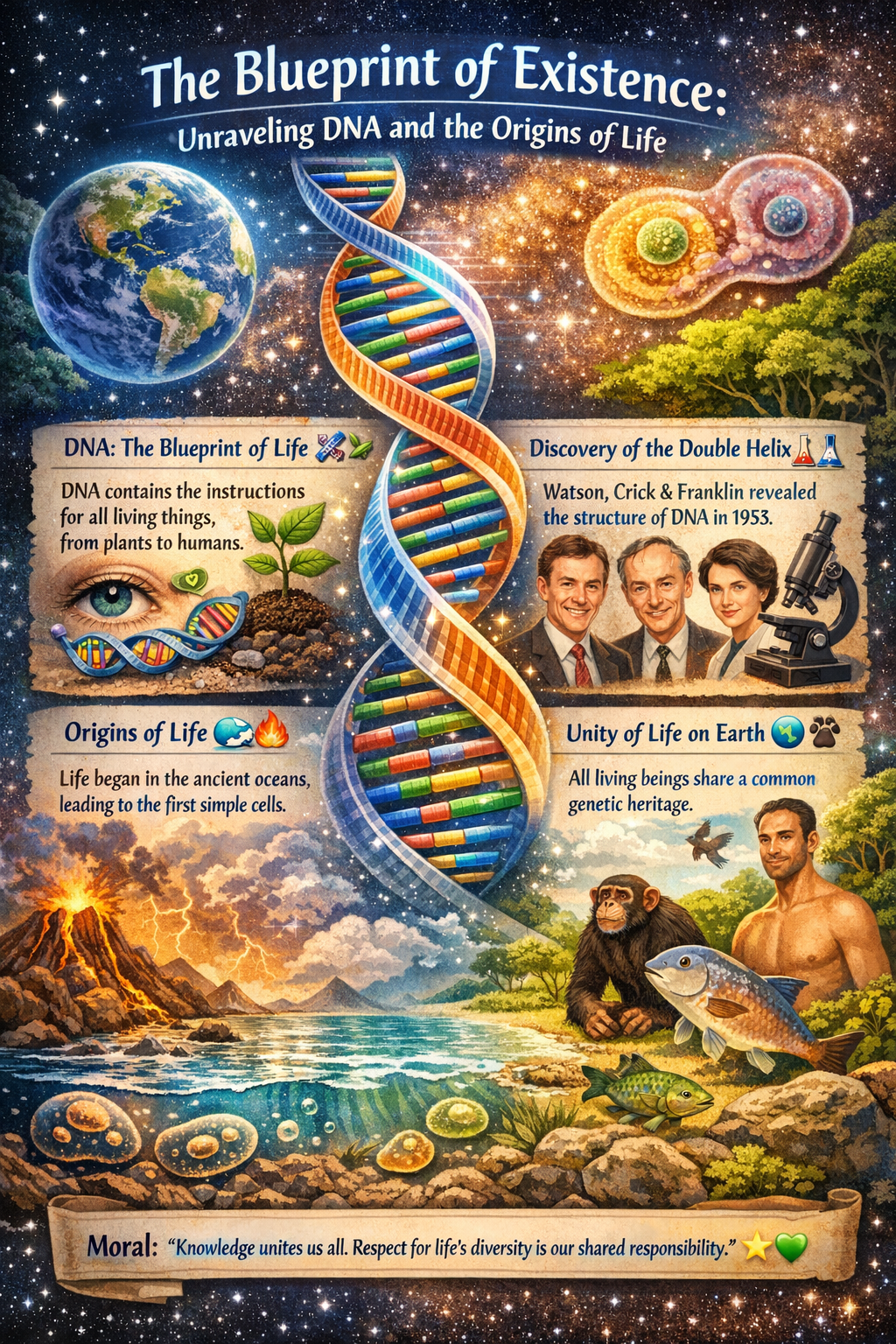
    Life on Earth begins with a tiny but powerful molecule called DNA . Deoxyribonucleic acid carries the instructions that guide how living organisms grow, function, and reproduce. From the color of our eyes to the way plants perform photosynthesis , DNA acts like a biological blueprint. Inside every cell, this twisted ladder-shaped structure stores information that has been passed down for billions of years, connecting all living things in one great chain of life.
    The discovery of DNA’s structure by scientists like James Watson and Francis Crick in 1953 was a turning point in science . Their work, along with crucial contributions from Rosalind Franklin, revealed the double-helix structure of DNA. This discovery helped scientists understand how genetic information is copied and inherited. It opened doors to modern genetics, medicine, and biotechnology, allowing us to study diseases and even explore genetic engineering.
    But DNA’s story goes back even further—back to the origins of life itself . Scientists believe that life may have started in Earth’s early oceans, where simple molecules combined to form more complex compounds. Over time, these molecules developed the ability to replicate, leading to the first simple cells. Through evolution, guided by natural selection, these early life forms gradually became the diverse plants, animals, and humans we see today .
    Understanding DNA reminds us that all living beings share a common origin . Whether it is a tiny bacterium or a human being, the same genetic code forms the foundation of life. This knowledge not only deepens our respect for science but also strengthens our appreciation for the unity and diversity of life on Earth.
    Moral :
    Knowledge is the key to understanding our existence. When we explore the secrets of nature with curiosity and respect, we discover that all life is connected, and every living being deserves care and responsibility.
    ACCL PORTAL DAY 104 TASK STORY POST @Badruddin chaiwala The Blueprint of Existence: Unraveling DNA and the Origins of Life ๐Ÿงฌ๐ŸŒ Life on Earth begins with a tiny but powerful molecule called DNA ๐Ÿงฌ. Deoxyribonucleic acid carries the instructions that guide how living organisms grow, function, and reproduce. From the color of our eyes to the way plants perform photosynthesis ๐ŸŒฑ, DNA acts like a biological blueprint. Inside every cell, this twisted ladder-shaped structure stores information that has been passed down for billions of years, connecting all living things in one great chain of life. The discovery of DNA’s structure by scientists like James Watson and Francis Crick in 1953 was a turning point in science ๐Ÿ”ฌ. Their work, along with crucial contributions from Rosalind Franklin, revealed the double-helix structure of DNA. This discovery helped scientists understand how genetic information is copied and inherited. It opened doors to modern genetics, medicine, and biotechnology, allowing us to study diseases and even explore genetic engineering. But DNA’s story goes back even further—back to the origins of life itself ๐ŸŒŠ๐Ÿ”ฅ. Scientists believe that life may have started in Earth’s early oceans, where simple molecules combined to form more complex compounds. Over time, these molecules developed the ability to replicate, leading to the first simple cells. Through evolution, guided by natural selection, these early life forms gradually became the diverse plants, animals, and humans we see today ๐Ÿพ๐ŸŒฟ. Understanding DNA reminds us that all living beings share a common origin ๐ŸŒŽโœจ. Whether it is a tiny bacterium or a human being, the same genetic code forms the foundation of life. This knowledge not only deepens our respect for science but also strengthens our appreciation for the unity and diversity of life on Earth. Moral ๐ŸŒŸ: Knowledge is the key to understanding our existence. When we explore the secrets of nature with curiosity and respect, we discover that all life is connected, and every living being deserves care and responsibility.
    0 Reacties 0 aandelen 281 Views
  • #rsisb
    #rollno13
    #coding No 2
    MADE BY ME
    Excited to share my latest mini project!
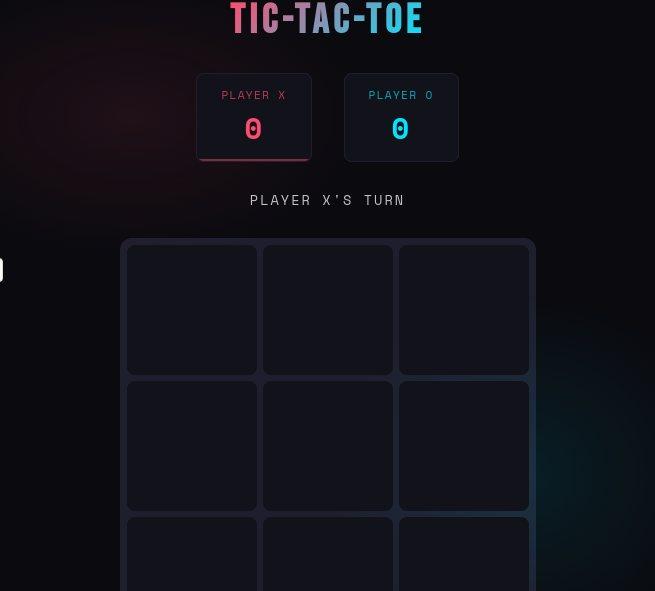
    I used Claude.ai to create a fully functional Tic-Tac-Toe game for two players. The prompt was simple:
    "Make a Tic-Tac-Toe game for two players."
    And just like that — AI helped turn a simple idea into a working interactive game!
    This classic 3x3 grid game allows two players to take turns placing and , testing strategy and quick thinking. It’s a great example of how AI can assist in building real, usable projects with minimal instructions.
    @followers
    Asma Shaheen EducationWali
    Sana Khilji
    Saima Happinesswali
    Rehan School Islamabad Campus
    Rehan Foundation
    #AIInnovation #ClaudeAI #GameProject #TechJourney #BuildInPublic #FutureOfCoding #AIDevelopment #CreativeTech #DigitalSkills
    #rsisb #rollno13 #coding No 2 MADE BY ME ๐ŸŽฎ Excited to share my latest mini project! I used Claude.ai ๐Ÿค– to create a fully functional Tic-Tac-Toe game for two players. The prompt was simple: ๐Ÿ“ "Make a Tic-Tac-Toe game for two players." And just like that — AI helped turn a simple idea into a working interactive game! ๐Ÿ’ปโœจ This classic 3x3 grid game allows two players to take turns placing โŒ and โญ•, testing strategy and quick thinking. It’s a great example of how AI can assist in building real, usable projects with minimal instructions. ๐Ÿš€ @followers Asma Shaheen EducationWali Sana Khilji Saima Happinesswali Rehan School Islamabad Campus Rehan Foundation #AIInnovation #ClaudeAI #GameProject #TechJourney #BuildInPublic #FutureOfCoding #AIDevelopment #CreativeTech #DigitalSkills
    2
    1 Reacties 0 aandelen 1612 Views
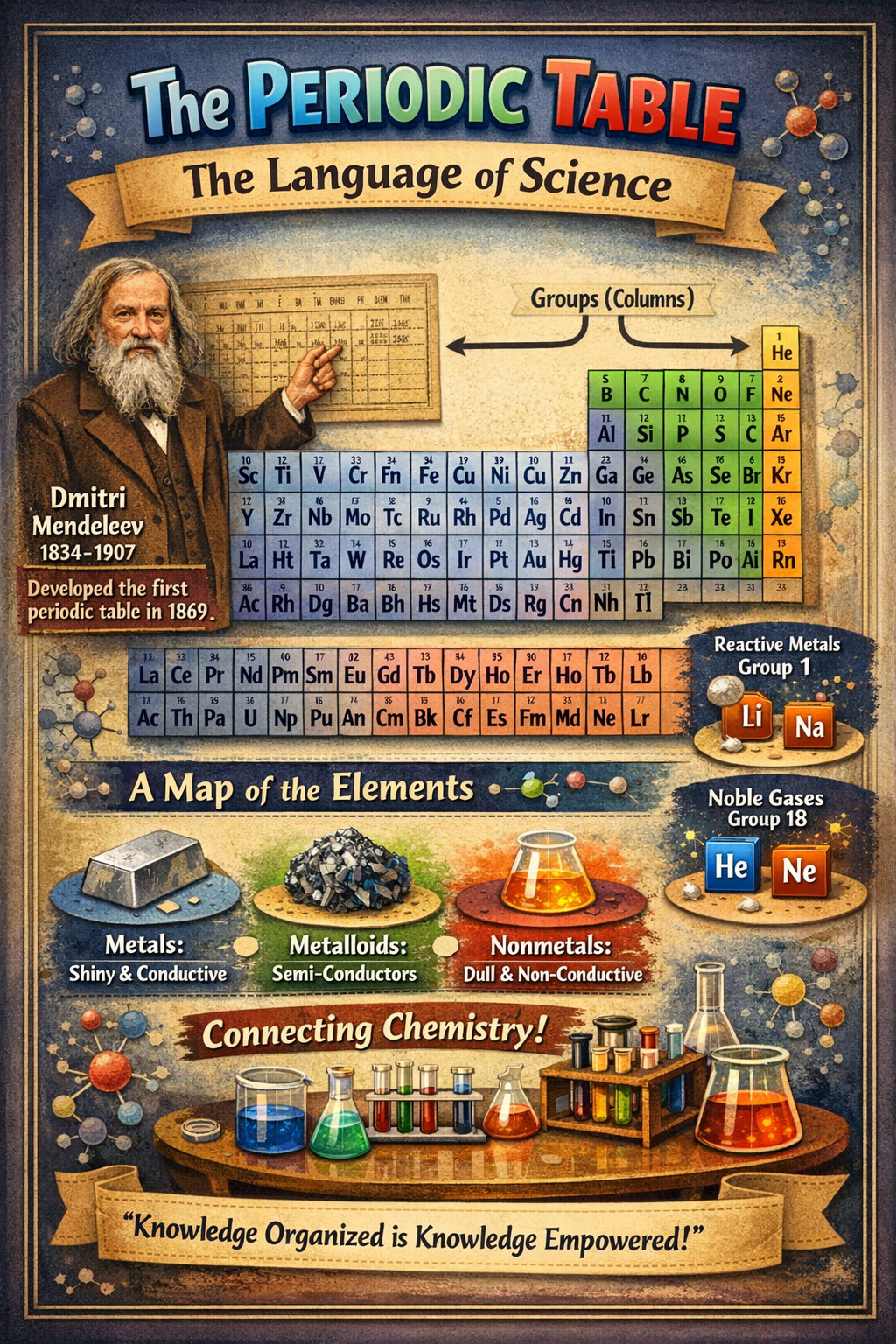
  • ACCL PORTAL DAY 62 task story post Badaruddin Chai wala Periodic Table: The Language of Science
    The Periodic Table is one of the most important tools in science. It organizes all known chemical elements in a systematic way. It was first developed by Dmitri Mendeleev in 1869. He arranged elements according to their atomic mass and noticed repeating patterns in their properties. Today, the modern periodic table is arranged by atomic number, which makes it even more accurate.
    The periodic table is divided into rows called periods and columns called groups. Elements in the same group have similar chemical properties. For example, Group 1 contains highly reactive metals like lithium and sodium, while Group 18 contains noble gases that are very stable and do not react easily. This arrangement helps scientists predict how elements will behave in chemical reactions.
    The table is also divided into different types of elements: metals, nonmetals, and metalloids. Metals are usually shiny, good conductors of heat and electricity, and malleable. Nonmetals have opposite properties, and metalloids share characteristics of both. This classification makes the periodic table easier to understand and use in experiments and research.
    In simple words, the periodic table is like a map of the elements. It helps scientists, teachers, and students understand the building blocks of matter. Without the periodic table, studying chemistry would be much more difficult. It truly acts as the language of science, connecting different concepts in a clear and organized way.
    Moral:
    Knowledge becomes powerful when it is organized and understood clearly.
    ACCL PORTAL DAY 62 task story post Badaruddin Chai wala ๐Ÿงช Periodic Table: The Language of Science The Periodic Table is one of the most important tools in science. It organizes all known chemical elements in a systematic way. It was first developed by Dmitri Mendeleev in 1869. He arranged elements according to their atomic mass and noticed repeating patterns in their properties. Today, the modern periodic table is arranged by atomic number, which makes it even more accurate. The periodic table is divided into rows called periods and columns called groups. Elements in the same group have similar chemical properties. For example, Group 1 contains highly reactive metals like lithium and sodium, while Group 18 contains noble gases that are very stable and do not react easily. This arrangement helps scientists predict how elements will behave in chemical reactions. The table is also divided into different types of elements: metals, nonmetals, and metalloids. Metals are usually shiny, good conductors of heat and electricity, and malleable. Nonmetals have opposite properties, and metalloids share characteristics of both. This classification makes the periodic table easier to understand and use in experiments and research. In simple words, the periodic table is like a map of the elements. It helps scientists, teachers, and students understand the building blocks of matter. Without the periodic table, studying chemistry would be much more difficult. It truly acts as the language of science, connecting different concepts in a clear and organized way. ๐ŸŒŸ Moral: Knowledge becomes powerful when it is organized and understood clearly.
    0 Reacties 0 aandelen 555 Views
  • #rsisb
    Roll no 159
    Foundation Level Student
    Date: 21-02-2026

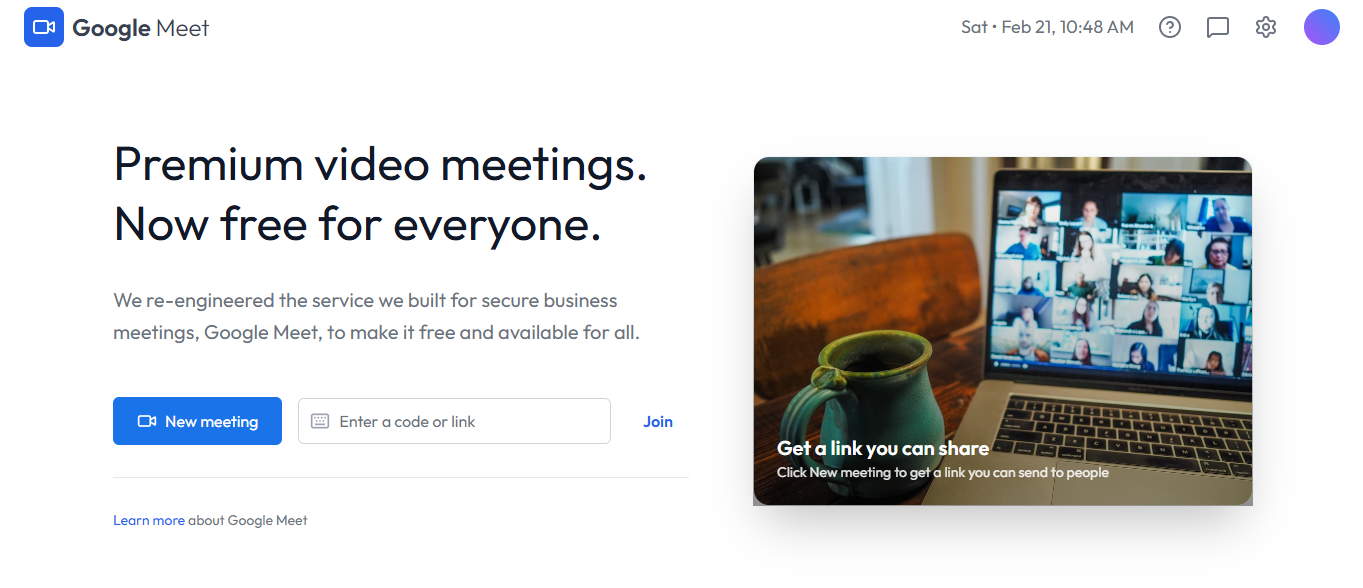
    This is a screenshot of the Google Meet homepage, showcasing its service for video conferencing. The page highlights that premium video meetings are now free for everyone, emphasizing accessibility and security for all users, not just businesses.

    On the left side, there is a clear call-to-action area where users can:

    Start a new meeting by clicking the blue “New meeting” button.

    Join an existing meeting by entering a code or link in the input field and clicking “Join.”

    A smaller text below explains that Google Meet was originally built for secure business meetings but is now available for free to the public.

    On the right side, there is an image showing a laptop screen with a virtual meeting in progress, displaying multiple participants in a grid view. A coffee mug is placed next to the laptop, giving a casual and approachable feel. Text on the image says: “Get a link you can share – Click New meeting to get a link you can send to people.”

    Overall, the screenshot demonstrates Google Meet’s user-friendly interface and its aim to make video meetings simple, accessible, and shareable for everyone.
    #rsisb Roll no 159 Foundation Level Student Date: 21-02-2026 This is a screenshot of the Google Meet homepage, showcasing its service for video conferencing. The page highlights that premium video meetings are now free for everyone, emphasizing accessibility and security for all users, not just businesses. On the left side, there is a clear call-to-action area where users can: Start a new meeting by clicking the blue “New meeting” button. Join an existing meeting by entering a code or link in the input field and clicking “Join.” A smaller text below explains that Google Meet was originally built for secure business meetings but is now available for free to the public. On the right side, there is an image showing a laptop screen with a virtual meeting in progress, displaying multiple participants in a grid view. A coffee mug is placed next to the laptop, giving a casual and approachable feel. Text on the image says: “Get a link you can share – Click New meeting to get a link you can send to people.” Overall, the screenshot demonstrates Google Meet’s user-friendly interface and its aim to make video meetings simple, accessible, and shareable for everyone.
    0 Reacties 0 aandelen 774 Views
  • Pharmaceutical Gelatin Market Size, Share & Growth Analysis 2032

    The global Pharmaceutical Gelatin Market is witnessing substantial growth driven by expanding pharmaceutical manufacturing and increasing demand for advanced drug delivery systems. Pharmaceutical gelatin plays a vital role in capsules, tablets, vaccines, and hemostatic agents, offering biocompatibility and safety. Rising healthcare spending and aging populations worldwide further accelerate market expansion.

    View Full Report:
    https://growthmarketreports.com/report/pharmaceutical-gelatin-market-global-industry-analysis
    Pharmaceutical Gelatin Market Size, Share & Growth Analysis 2032 The global Pharmaceutical Gelatin Market is witnessing substantial growth driven by expanding pharmaceutical manufacturing and increasing demand for advanced drug delivery systems. Pharmaceutical gelatin plays a vital role in capsules, tablets, vaccines, and hemostatic agents, offering biocompatibility and safety. Rising healthcare spending and aging populations worldwide further accelerate market expansion. View Full Report: https://growthmarketreports.com/report/pharmaceutical-gelatin-market-global-industry-analysis
    GROWTHMARKETREPORTS.COM
    Pharmaceutical Gelatin Market Research Report 2033
    According to the latest research conducted in 2025, the global pharmaceutical gelatin market size reached USD 1.25 billion in 2024, demonstrating a robust performance driven by increasing demand across pharmaceutical applications.
    0 Reacties 0 aandelen 1076 Views
  • How Will Enterprise Digital Transformation Propel the Laptop OEM/ODM Market to USD 77.27 Billion by 2034 at a 4.2% CAGR?
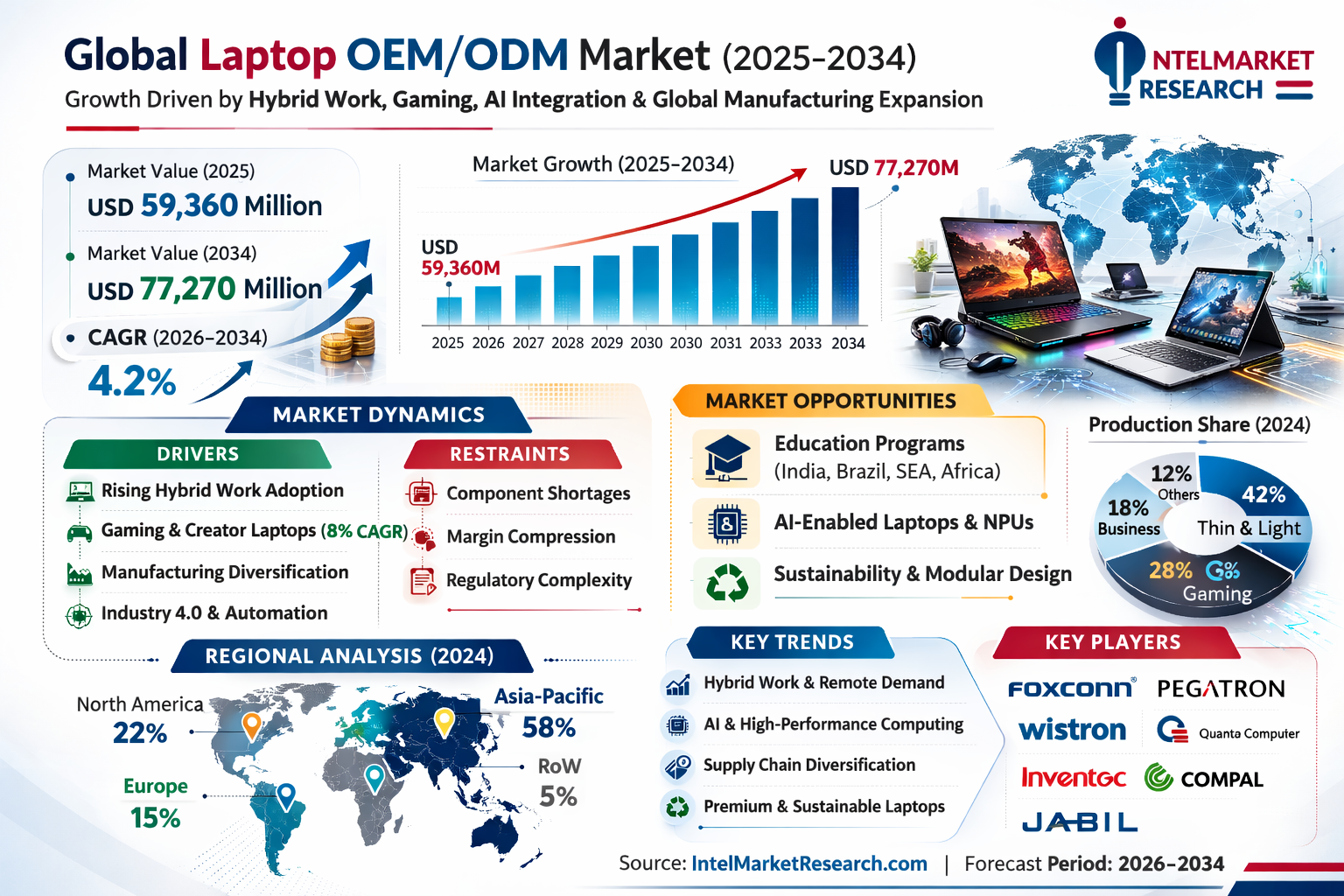
    The global Laptop OEM/ODM market was valued at USD 59,360 million in 2025 and is projected to grow from USD 63,910 million in 2026 to USD 77,270 million by 2034, exhibiting a CAGR of 4.2% during the forecast period (2026–2034).
    Laptop OEM (Original Equipment Manufacturer) and ODM (Original Design Manufacturer) models enable global brands to outsource manufacturing and, in some cases, product design to specialized third-party producers. This structure allows brands to focus on marketing, distribution, and ecosystem development while leveraging large-scale production expertise, supply chain efficiency, and quality control capabilities of dedicated manufacturers.
    As of 2024, thin and light laptops account for approximately 42–45% of total production, while gaming laptops hold around 28% share, reflecting strong demand for portable and high-performance computing devices. Growth is primarily driven by hybrid work adoption, enterprise digital transformation, and expanding education digitization initiatives worldwide.
    Full Report Access:
    http://intelmarketresearch.com/laptop-oemodm-2025-2032-639-4498
    How Will Enterprise Digital Transformation Propel the Laptop OEM/ODM Market to USD 77.27 Billion by 2034 at a 4.2% CAGR? The global Laptop OEM/ODM market was valued at USD 59,360 million in 2025 and is projected to grow from USD 63,910 million in 2026 to USD 77,270 million by 2034, exhibiting a CAGR of 4.2% during the forecast period (2026–2034). Laptop OEM (Original Equipment Manufacturer) and ODM (Original Design Manufacturer) models enable global brands to outsource manufacturing and, in some cases, product design to specialized third-party producers. This structure allows brands to focus on marketing, distribution, and ecosystem development while leveraging large-scale production expertise, supply chain efficiency, and quality control capabilities of dedicated manufacturers. As of 2024, thin and light laptops account for approximately 42–45% of total production, while gaming laptops hold around 28% share, reflecting strong demand for portable and high-performance computing devices. Growth is primarily driven by hybrid work adoption, enterprise digital transformation, and expanding education digitization initiatives worldwide. ๐Ÿ”— Full Report Access: http://intelmarketresearch.com/laptop-oemodm-2025-2032-639-4498
    0 Reacties 0 aandelen 1151 Views
  • Day 9: How to use streamyard for interviews?
    Description: Go to www.streamyard.com → Sign up / log in Click Create a Broadcast, choose platform, and title Enter studio → allow camera and mic Invite guest with share link Click Go Live to start End broadcast when done

    Excited to share that I’ve downloaded and started using **StreamYard**! I’ve been exploring its features and learning how to create live streams and online broadcasts. It’s a great tool for connecting with an audience and sharing content in real time. I’m really enjoying the experience so far and discovering new possibilities. Looking forward to using it more and improving my live sessions. Stay tuned for more updates!
    Day 9: How to use streamyard for interviews? Description: Go to www.streamyard.com → Sign up / log in Click Create a Broadcast, choose platform, and title Enter studio → allow camera and mic Invite guest with share link Click Go Live to start End broadcast when done Excited to share that I’ve downloaded and started using **StreamYard**! ๐ŸŽฅโœจ I’ve been exploring its features and learning how to create live streams and online broadcasts. It’s a great tool for connecting with an audience and sharing content in real time. I’m really enjoying the experience so far and discovering new possibilities. Looking forward to using it more and improving my live sessions. Stay tuned for more updates! ๐Ÿš€
    0 Reacties 0 aandelen 766 Views
  • ## What Lessons Can We Learn from Past Pandemics?

    Past pandemics like the *Black Death, **Spanish Flu, and **COVID-19* have taught humanity many powerful lessons. These global health crises showed us how diseases can spread quickly across countries because of travel and trade.

    One important lesson is the value of *hygiene and cleanliness*. ๐Ÿซง Washing hands, keeping surroundings clean, and practicing good health habits can save millions of lives.

    Another lesson is the importance of *science and medical research*. Vaccines and medicines help control and prevent deadly diseases. Governments and scientists must work together to protect people.

    Pandemics also teach us about *teamwork and global cooperation*. Countries must share information and support each other during crises.

    We also learn the importance of *preparedness*. Having strong healthcare systems, emergency plans, and trained medical staff helps reduce damage.

    Finally, pandemics remind us to care for one another. Helping the elderly, supporting the sick, and staying calm during difficult times makes society stronger.
    https://youtu.be/l7FaKth1zgk
    ## ๐ŸŒ What Lessons Can We Learn from Past Pandemics? ๐Ÿฆ  Past pandemics like the *Black Death, **Spanish Flu, and **COVID-19* have taught humanity many powerful lessons. ๐Ÿ“š These global health crises showed us how diseases can spread quickly across countries because of travel and trade. โœˆ๏ธ๐Ÿšข One important lesson is the value of *hygiene and cleanliness*. ๐Ÿงผ๐Ÿซง Washing hands, keeping surroundings clean, and practicing good health habits can save millions of lives. Another lesson is the importance of *science and medical research*. ๐Ÿ”ฌ๐Ÿ’‰ Vaccines and medicines help control and prevent deadly diseases. Governments and scientists must work together to protect people. ๐Ÿ‘ฉ‍โš•๏ธ๐Ÿ‘จ‍๐Ÿ”ฌ Pandemics also teach us about *teamwork and global cooperation*. ๐Ÿค๐ŸŒŽ Countries must share information and support each other during crises. We also learn the importance of *preparedness*. ๐Ÿฅ Having strong healthcare systems, emergency plans, and trained medical staff helps reduce damage. Finally, pandemics remind us to care for one another. โค๏ธ Helping the elderly, supporting the sick, and staying calm during difficult times makes society stronger. ๐Ÿ’ชโœจ https://youtu.be/l7FaKth1zgk
    0 Reacties 0 aandelen 714 Views
  • Global Wet Process Equipment Market size was valued at USD 6,730 million in 2026 and is projected to reach USD 10,240 million by 2032, at a CAGR of 5.87% during the forecast period (2026-2034). Semiconductor fab expansions (35% wafer growth) and <5nm nodes propel cleaning/etching demand.
    Wet Process Equipment refers to specialized machinery for semiconductor wafer cleaning, etching, surface treatment using liquid chemicals/solvents. Types include single/multi-chamber automatic systems, spin rinse dryers, plating tools for 300mm wafers (dominant).

    Advancements in 3D NAND and DRAM Technologies Accelerating Market Growth
    The memory sector is undergoing significant technological transitions, with 3D NAND layer counts exceeding 200 layers and DRAM moving beyond the 1-alpha node. These developments necessitate wet process equipment capable of handling high-aspect ratio structures with nanometer-level precision. Front-end wet stations now integrate advanced megasonic cleaning and selective etching capabilities to address challenges in high-layer-count memory production. The memory segment alone accounts for approximately 45% of total wet process equipment sales, with this share expected to grow as stacking technologies become more complex.

    Claim your definitive Wet Process Equipment market report today: https://semiconductorinsight.com/report/wet-process-equipment-market/
    Global Wet Process Equipment Market size was valued at USD 6,730 million in 2026 and is projected to reach USD 10,240 million by 2032, at a CAGR of 5.87% during the forecast period (2026-2034). Semiconductor fab expansions (35% wafer growth) and <5nm nodes propel cleaning/etching demand. Wet Process Equipment refers to specialized machinery for semiconductor wafer cleaning, etching, surface treatment using liquid chemicals/solvents. Types include single/multi-chamber automatic systems, spin rinse dryers, plating tools for 300mm wafers (dominant). Advancements in 3D NAND and DRAM Technologies Accelerating Market Growth The memory sector is undergoing significant technological transitions, with 3D NAND layer counts exceeding 200 layers and DRAM moving beyond the 1-alpha node. These developments necessitate wet process equipment capable of handling high-aspect ratio structures with nanometer-level precision. Front-end wet stations now integrate advanced megasonic cleaning and selective etching capabilities to address challenges in high-layer-count memory production. The memory segment alone accounts for approximately 45% of total wet process equipment sales, with this share expected to grow as stacking technologies become more complex. ๐Ÿ” Claim your definitive Wet Process Equipment market report today: https://semiconductorinsight.com/report/wet-process-equipment-market/
    Wet Process Equipment Market, Emerging Trends, Technological Advancements, and Business Strategies 2025-2032
    0 Reacties 0 aandelen 745 Views
  • #rsisb
    Roll No 178
    Day 1: Create Gmail Account
    I successfully created a Gmail account by completing the required setup steps, including providing personal details, setting a secure password, and configuring account recovery options. I also reviewed and adjusted basic privacy and security settings to ensure safe usage. This task helped me understand the importance of account security, proper credential management, and email setup, which are essential skills for effective digital communication. I completed this task with guidance from AI while ensuring I understood each step of the process.
    https://www.facebook.com/share/p/17uXvvJG5Q/
    #rsisb Roll No 178 Day 1: Create Gmail Account I successfully created a Gmail account by completing the required setup steps, including providing personal details, setting a secure password, and configuring account recovery options. I also reviewed and adjusted basic privacy and security settings to ensure safe usage. This task helped me understand the importance of account security, proper credential management, and email setup, which are essential skills for effective digital communication. I completed this task with guidance from AI while ensuring I understood each step of the process. https://www.facebook.com/share/p/17uXvvJG5Q/
    0 Reacties 0 aandelen 489 Views
Zoekresultaten